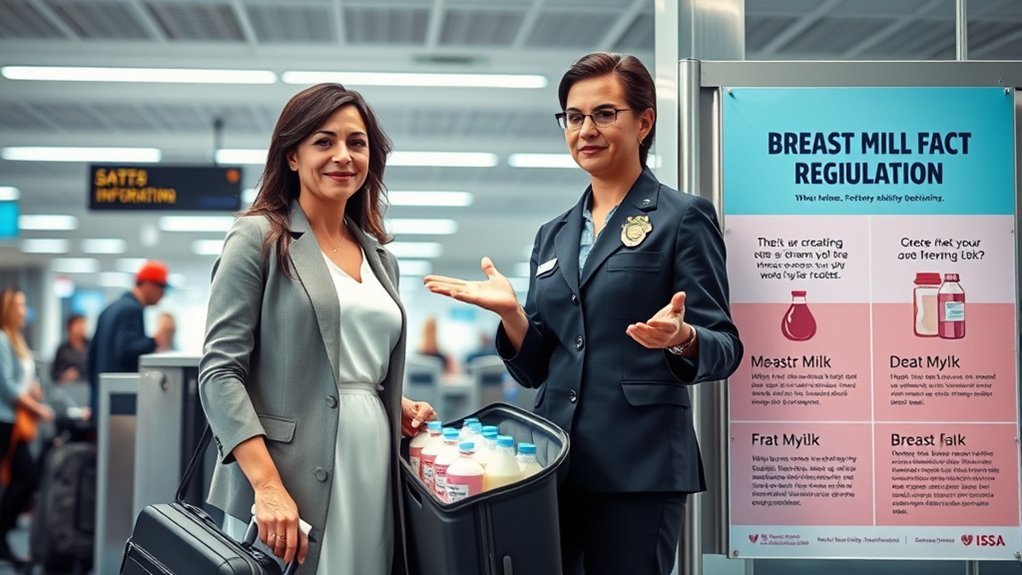
Traveling with breast milk can feel like maneuvering through a maze of misinformation. Many parents worry about what they can and can’t bring on board, especially around security regulations. Knowing the facts about TSA rules can make a real difference in your travel experience, helping you avoid unnecessary stress at the airport and making sure your baby has what they need throughout the journey.
Quick Answer
- Yes, you can bring breast milk on a plane in your carry-on in any quantity.
- Breast milk is exempt from the 3.4 oz (100 ml) liquid limit and does not need to fit in a quart-sized bag.
- Tell the TSA officer at the start of screening that you’re carrying breast milk, and remove it for separate screening.
- Ice packs, gel packs, and coolers are all allowed, even if they’re partially melted.
- Your child does not need to be traveling with you to bring breast milk through security.
Understanding TSA Regulations for Breast Milk
The TSA allows you to bring breast milk in your carry-on luggage in any quantity. It is classified as a medically necessary liquid, so it is exempt from the standard liquid limits that apply to other passengers.
Let the TSA officer know at the start of screening that you’re carrying breast milk. Then remove it from your bag so it can be screened separately.
You can store the milk in a cooler or insulated bag to maintain its temperature. Ice packs, gel packs, and freezer packs are all permitted, even when not fully frozen.
TSA X-ray machines are not harmful to breast milk or other food. If you prefer not to have your milk X-rayed or opened, let the officer know. You can request alternative screening, such as a swab test or visual inspection, but plan for some additional time at the checkpoint.
Can You Bring Breast Milk on a Plane?
You can bring breast milk on a plane, but there are specific TSA guidelines you need to follow.
Understanding these rules helps make the security process much smoother.
Packing your breast milk properly can also help you avoid any hold-ups at the checkpoint.
TSA Guidelines Explained
Traveling with breast milk is fairly straightforward once you know the TSA guidelines. You can bring breast milk in your carry-on luggage, and it is exempt from the standard liquid limit of 3.4 ounces.
You should declare it for inspection at the security checkpoint. Packing it in a cooler or insulated bag helps maintain its temperature, though this is not required by TSA.
If you’re traveling with a baby, you can also bring ice packs or frozen gel packs to keep the milk cold. TSA may need to screen your containers, so be ready for that step.
Always check the latest TSA regulations before your flight in case anything has changed.
Packing Tips for Travel
Use a cooler or insulated bag to keep your milk at the right temperature. You can bring more than 3.4 ounces, but you will need to declare it at the security checkpoint. Make sure each container is sealed well to avoid spills.
Pack ice packs to maintain freshness. These are allowed and do not count against your liquid limit. When you get to the airport, keep your breast milk easy to access in your carry-on so you can present it quickly.
Check your airline’s specific policies before flying, as some carriers may have additional requirements. It is also helpful to consult resources on maternal health conditions to better understand any potential impacts on your breastfeeding journey.
The 3-1-1 Rule: What It Means for Breast Milk
The TSA’s 3-1-1 rule limits most liquids to 3.4 ounces per container, but breast milk is an exception. Knowing this can help you move through the security screening process with far less friction.
Understanding the 3-1-1 Rule
The TSA’s 3-1-1 Rule says each passenger may bring liquids in containers of 3.4 ounces (100 milliliters) or less, all fitting in a single quart-sized bag.
Breast milk is exempt from these volume restrictions. You can carry more than 3.4 ounces, and your containers do not need to fit in the quart-sized bag.
Keep your breast milk separate for screening, and be prepared for possible additional screening steps. Always check your specific airline’s policies and give yourself extra time at the checkpoint.
Breast Milk Exceptions Explained
While the 3-1-1 Rule sets firm limits on liquids for most travelers, breast milk has specific exceptions for nursing parents. You are allowed to bring more than 3.4 ounces in your carry-on bag without being subject to the usual restrictions.
Let the TSA officer know at the start of screening that you have breast milk. You can carry it in a cooler or insulated bag to help maintain the right temperature.
You do not need to be traveling with your child to bring breast milk through security. TSA places no age restriction on this rule. Always check current TSA guidelines before your trip, as policies can be updated. Access to maternal child health nurses can also provide valuable support for nursing parents during travel.
The BABES Enhancement Act: What Changed in 2025
A significant update for traveling parents happened in late 2025. The BABES Enhancement Act was signed into law on November 25, 2025, building on the original 2016 BABES Act that first classified breast milk and formula as medically necessary liquids.
The new law addresses a long-standing problem: even though the rules were clear on paper, TSA officers did not always apply them consistently. Parents continued to report having milk confiscated, being forced to check cooling supplies, or dealing with unhygienic handling at checkpoints.
Under the updated law, TSA must maintain hygiene standards when handling breast milk, formula, and related items like ice packs. The agency is also required to issue updated guidance within 90 days of the law taking effect and to update it every five years. The Department of Homeland Security’s Office of Inspector General will audit TSA compliance and report back to Congress.
In short, the law creates clearer rules, better officer training, and real accountability, so parents can travel with more confidence.
Packing Tips for Traveling With Breast Milk
To keep your breast milk safe during travel, packing it correctly matters. Start with insulated bags or coolers and fill them with ice packs to maintain the right temperature. Label your milk with the date and time it was expressed.
| Packing Tip | Description | Additional Note |
|---|---|---|
| Use Sealed Containers | Opt for BPA-free bottles or bags | Make sure they’re leak-proof |
| Keep Milk Cold | Use ice packs or dry ice | Check temperature regularly |
| Label Everything | Include date and time of expression | Helps in organizing |
| Plan for Security | Know TSA rules for transport | Review before your trip |
Following these tips can ease your travel experience with breast milk. It is also worth being aware of the regulations regarding medications and treatments while breastfeeding to make sure everything stays safe during your trip.
Screening Procedures at the Airport
Understanding the screening process at the airport goes a long way toward making your journey smooth.
TSA allows you to bring breast milk in quantities exceeding the standard liquid limit. Let security officers know at the start of screening that you have breast milk.
Pack your breast milk in a cooler or insulated bag to help keep it at the right temperature during your travels.
At the security checkpoint, you will likely need to remove the breast milk from your bag for separate screening. Officers may swab your containers to test for traces of explosives. TSA X-ray machines are not harmful to breast milk, but if you prefer not to have it X-rayed or opened, say so at the start. Alternative screening will add a bit of time, so plan accordingly.
Keep your identification and any necessary documentation easy to reach, and give yourself extra time at the airport when traveling with milk.
Myths About Breast Milk and Air Travel
A few common myths make traveling with breast milk feel harder than it is.
One is that you cannot bring breast milk through security at all. In reality, TSA allows you to carry breast milk in any quantity without volume restrictions.
Another is that declaring breast milk at security is optional and skippable. TSA recommends informing the officer at the start of screening. It is not a formal legal declaration, but doing so speeds up the process and reduces the chance of confusion.
Many parents also think breast milk must be frozen to travel. It can be transported fresh, frozen, or refrigerated, depending on how long your trip is.
Finally, some worry about milk being confiscated. As long as you follow TSA guidelines, you should not face any issues. If a TSA officer is unfamiliar with the rules, you can politely cite the policy or ask to speak with a supervisor.
Storing Breast Milk During Your Journey
Storing breast milk correctly during travel keeps it safe and fresh for your baby. Here is a simple guide based on how long you will be traveling:
| Journey Length | Storage Method |
|---|---|
| Short (up to 2 hours) | Room temperature (up to 77°F) |
| Medium (2-4 hours) | Insulated cooler with ice packs |
| Long (4+ hours) | Refrigerated bag or freezer pack |
| Flight Travel | Carry-on with ice packs or frozen milk |
Label your milk with the date and time it was expressed. Check your ice packs regularly to make sure the temperature stays consistent. Proper storage keeps your milk fresh and safe throughout the trip.
Resources for Nursing Mothers Traveling With Breast Milk
Several resources can help nursing parents manage the logistics of traveling with breast milk. The TSA website provides detailed guidelines on transporting breast milk, including storage options and what to expect at screening. The CDC’s travel recommendations for nursing mothers is another trusted resource with practical storage and supply guidance.
Many airports offer lactation rooms, which provide a private space for pumping and storing milk. The Friendly Airports for Mothers (FAM) Act requires hub airports to provide these spaces in each terminal. Mobile apps like “Milk Stork” can also help you find local breast milk storage services or shipping options if you would rather not carry milk on the return flight.
Online forums and social media groups for traveling parents can be a good source of real-world tips. Your pediatrician can also offer personalized advice on safely handling and transporting breast milk for your specific situation.
Frequently Asked Questions
Can I Freeze Breast Milk Before Traveling?
Yes, you can freeze breast milk before traveling. Store it in airtight containers and use the oldest milk first to keep things organized.
How Do I Keep Breast Milk Cold During Transit?
Use insulated coolers with ice packs or frozen gel packs. These methods keep the milk at a safe temperature and are all permitted through TSA security.
Is There a Limit on the Amount of Breast Milk I Can Carry?
There is no specific limit on how much breast milk you can carry through security. Pack it separately for screening, and check with your airline for any additional guidance.
Can I Bring Formula Alongside Breast Milk?
Yes, you can bring formula alongside breast milk. Both are classified as medically necessary liquids and are exempt from the standard 3.4 oz limit. Just make sure they are properly stored and declared at security.
What if My Flight Is Delayed With Breast Milk?
If your flight is delayed, keep your breast milk refrigerated or packed in ice. Most airports have facilities for this. Check the temperature periodically to make sure the milk stays safe for your baby.
Conclusion
Traveling with breast milk does not have to feel overwhelming. Understanding TSA rules is the key to a smoother airport experience. You can bring any amount of breast milk as long as you let the officer know at the start of screening. With the right preparation and knowledge of your rights, including the protections added by the 2025 BABES Enhancement Act, you can travel confidently and make sure your little one has what they need, wherever you are headed.

