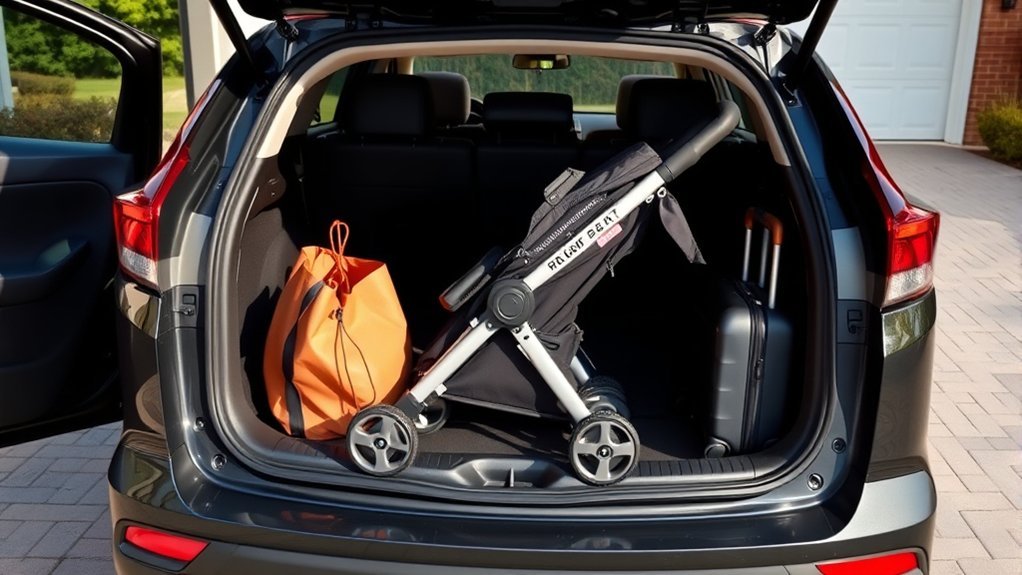
To know if a stroller will fit your car, you need to measure the trunk’s narrowest width, depth, height, and opening, then compare those numbers with the stroller’s folded length, width, and depth. Leave 1-2 inches of clearance so it slides in without twisting. Quick-fold, tri-fold, and removable-wheel designs usually fit tight boots better. Compact models reduce loading hassle, and the next steps show how to measure and choose well.
How to Measure Your Trunk for a Stroller Fit
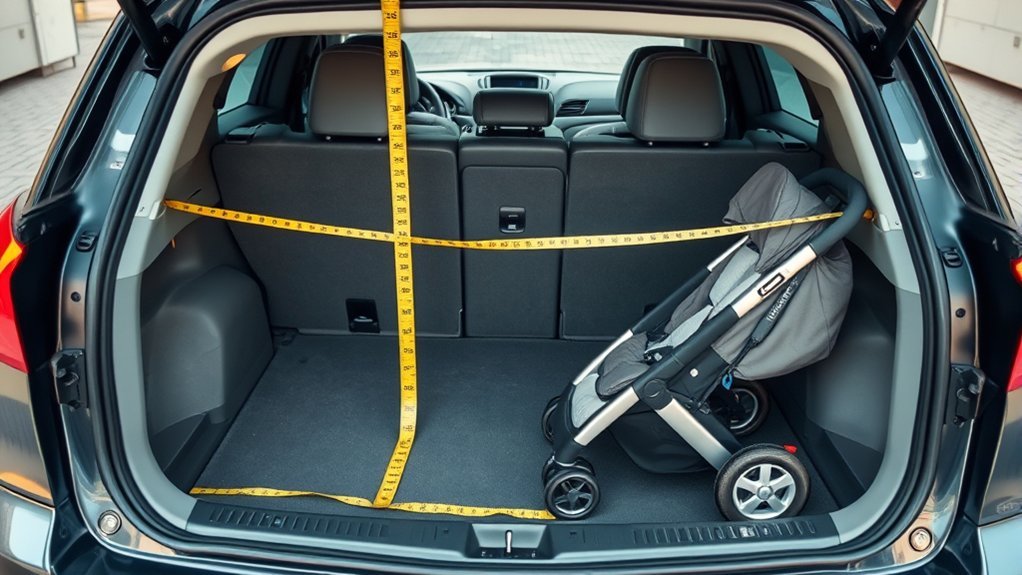
Before you buy a stroller, measure your trunk in three places: width at the narrowest point, depth from the back seat to the latch, and height up to the opening. Use a tape measure, note each number, and don’t guess. This gives you real trunk space, not a hopeful estimate.
If you’re choosing a compact stroller, compare its folded dimensions against those measurements and leave 1 to 2 inches of clearance in every direction so you can load and unload without scraping trim or fighting the hatch.
Depth matters because some models need to lie flat; height matters because a tall fold can block closure. Also check how storage baskets affect the folded shape, since added bulk can shift the fit.
Measure your trunk again if you change vehicles or add accessories. When you verify fit before purchase, you protect your time, your body, and your freedom to move without hassle.
Which Folded Stroller Measurements Matter?
You should measure the stroller’s folded length, width, and depth, since those dimensions determine whether it’ll fit your trunk at all.
Pay special attention to folded width and trunk opening height, because the stroller has to pass through the narrowest point before it can sit inside the cargo area.
Leave 1–2 inches of clearance around the folded frame so you can load it smoothly without scraping the stroller or your car.
Folded Dimensions To Measure
When checking a stroller against your car trunk, measure the folded length, width, and depth, since all three dimensions affect whether it will fit through the opening and sit properly inside.
Use these folded dimensions to judge stroller fit, not just the marketed folded size, because trunk space varies at the narrowest point.
Add 1-2 inches of clearance so you can load and unload without forcing the frame.
Compact strollers, like the Nano Compact Stroller at 51cm x 54cm x 30cm, usually suit tight trunks well.
Bulkier models, such as the Duet Twin Stroller at 89cm x 65cm x 32cm, demand careful comparison.
Measure your trunk carefully, and you’ll choose a setup that works with your vehicle, not against it.
Trunk Opening Clearance Counts
Trunk fit isn’t just about the stroller’s folded footprint; you also need to check the opening clearance that the folded frame has to pass through.
When measuring trunk space, check the opening width first, because the stroller’s folded dimensions must slide in without twisting. Then measure trunk depth from the back seat to the latch, and verify trunk height from floor to the top edge of the opening.
Add 1–2 inches of clearance on every critical side so you can load and unload cleanly without scuffing the frame or car interior.
Compact strollers, like the Mountain Buggy Nano, are built for this freedom, with small folded dimensions that suit tight cargo bays.
Precise measuring trunk space gives you control, not compromise, and keeps your setup mobile.
Fold Features That Help in Small Boots
Quick-fold mechanisms, especially one-handed designs, make a stroller far easier to stow in a small boot because they collapse into a compact profile with minimal handling. You’ll get better compact folding when you choose lightweight frames and a true one-hand fold, so you can lift, angle, and slot the stroller in without wrestling the bumper. Tri-fold designs also help because they create a thinner, flatter pack that leaves room for groceries or a diaper bag. Regular maintenance of stroller components ensures smooth and efficient equipment operation, enhancing the overall user experience.
| Feature | Benefit | Why it matters |
|---|---|---|
| One-hand fold | Faster collapse | Saves time at the boot |
| Tri-fold design | Slimmer package | Uses space efficiently |
| Lightweight frame | Easier lifting | Reduces strain at the opening |
Models with quick-release wheels or removable parts go further, shrinking the folded shape and improving access. A compact example like the Mountain Buggy Nano shows how engineered folds fit your lifestyle while preserving stability and comfort.
Compact vs Bulky Strollers in Real Cars
When you choose a compact fold, like the Nano Compact Stroller or Babyzen YOYO2, you’ll usually get easier trunk loading, better daily handling, and fewer fit issues in compact sedans and small SUVs.
Bulky strollers, such as the Urban Jungle Single, can offer more features but they often demand exact trunk measurements and more careful packing, especially in tighter vehicles.
Before you buy, you should check trunk opening width, folded dimensions, and whether you can load the stroller diagonally or remove wheels to make it fit.
Compact Fold Advantages
A compact stroller fold can make a real difference if you’re trying to load it into a small car, especially since models like the Nano Compact Stroller measure just 51 cm x 54 cm x 30 cm and are far easier to place in compact sedans and small SUVs.
You gain more usable trunk room, smoother packing, and faster exits when your travel stroller folds small and stays lightweight. A well-designed compact frame often uses one-hand folding, so you can lift, stack, and secure it without wrestling the cargo area.
Bulky Stroller Trade-Offs
Bulky strollers can quickly turn trunk planning into a measuring exercise, especially if you’re comparing a compact model like the Babyzen YOYO2, which folds to 20.5 × 17.3 × 7.1 in, with a double stroller such as the Mountain Buggy Duet at 89 cm × 65 cm × 32 cm.
When you choose bulky strollers, you often give up cargo flexibility, because the folded stroller can crowd compact trunks and leave little room for groceries or gear.
- Measure depth, width, and height before you buy.
- Expect extra pounds to slow lifting and loading.
- Favor a one hand fold if you need fast, independent handling.
You’re buying freedom, but size and weight can still chain you to careful packing.
Real Car Fit Checks
How do you know if a stroller will truly fit your car? Start with real car fit checks: measure trunk width, depth, and height, then compare them with the folded stroller dimensions.
Compact strollers, like the Nano Compact at 51cm x 54cm x 30cm, usually fit small sedans and compact SUVs with room to spare.
Bulkier models, such as the Mountain Buggy Duet Twin Stroller at 89cm x 65cm x 32cm, may push against trunk space and demand careful planning. Leave at least an inch of clearance so you can load without forcing the frame.
If your stroller has quick-release wheels, remove them to reduce depth. User reports also matter; a Bob Revolution fits a Subaru Crosstrek, but you should test your actual stroller before buying.
Stroller Fit Tactics for Tight Boots
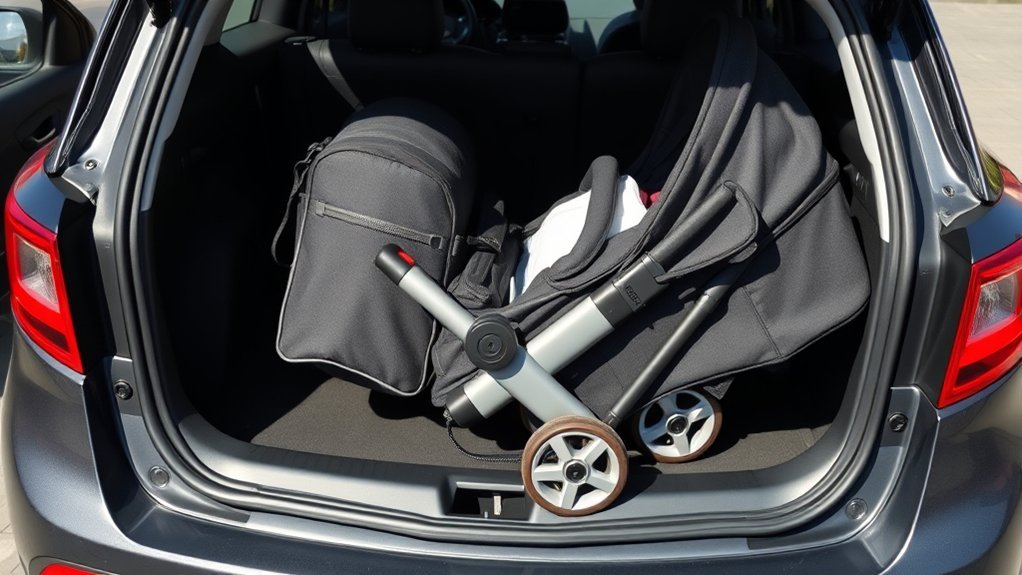
When you’re working with a tight boot, start by measuring the trunk’s width, height, and depth, then leave 1–2 inches of clearance so the folded stroller loads without forcing it.
That simple check helps you match stroller design to tight storage and avoids guesswork. If you measure your trunk before you buy, you can rule out bulky options fast.
Measuring your trunk first helps you choose a stroller that fits securely and avoids bulky surprises.
For compact trunks, choose models with true one-hand folding and quick-release wheels or detachable canopies; those features shrink the package and make loading easier.
Aim for strollers built for compact trunks, such as the Mountain Buggy Nano or Britax Holiday Compact, when you need a disciplined fit.
- Load the folded stroller diagonally to use unused corner space.
- Place heavier items at the bottom for stability during transport.
- Remove quick-release wheels to gain a few critical centimeters.
Which Fold Size Works Best for Your Car?
The best fold size for your car depends on your trunk opening and interior dimensions, so you’ll want a stroller whose folded measurements are clearly smaller than the available space, with 1–2 inches of clearance for easier loading.
Measure width, height, and depth, then compare them to the folded strollers you’re considering. In compact sedans and small SUVs, a quick-fold model often works best because it slips into narrow trunk space with less wrestling.
For example, a compact unit like the UPPAbaby MINU V3 fits tight openings well, while the Mountain Buggy Nano shows how a small footprint supports daily use.
If you need more room, tandem strollers usually offer a slimmer profile than side-by-side designs, which demand extra width.
Remove wheels or other components when possible to free up trunk space and improve access.
Choose the fold that preserves your freedom to load fast, drive light, and move without compromise.
Frequently Asked Questions
Do I Really Need a Full-Size Stroller?
No, you don’t really need a full-size stroller unless you want maximum baby comfort and storage solutions. Prioritize stroller weight, travel convenience, and budget options; a compact model can free you for easier, lighter movement.
Can You Fit a Stroller in a Crosstrek?
Yes, you can fit a stroller in a Crosstrek if you choose compact strollers and check stroller dimensions carefully. Your Crosstrek cargo space favors travel convenience, but car compatibility depends on folded size and clearance.
Which Stroller Folds up the Smallest?
The gb Pockit+ All City folds smallest at 13.0 × 8.0 × 21.3 inches, so you’ll want this among compact strollers, travel strollers, and lightweight options when prioritizing storage solutions and stroller dimensions.
What Size Stroller Fits in the Overhead Compartment?
You’ll fit compact travel strollers with stroller dimensions near 18 x 9 x 21 inches in overheads, but airport regulations vary. Check baby gear specs, prioritize lightweight options, and confirm your airline’s limits before flying.
Conclusion
When you measure your trunk and compare it to a stroller’s folded footprint, you’re really choosing how smoothly your day moves. A compact fold can be the key that opens your car’s boot, while a bulky frame can become the barrier that blocks it. So, test width, height, and depth before you buy, and favor folds that stand upright or collapse flat. That way, your stroller won’t just fit—it’ll ride with you, ready for every trip.
