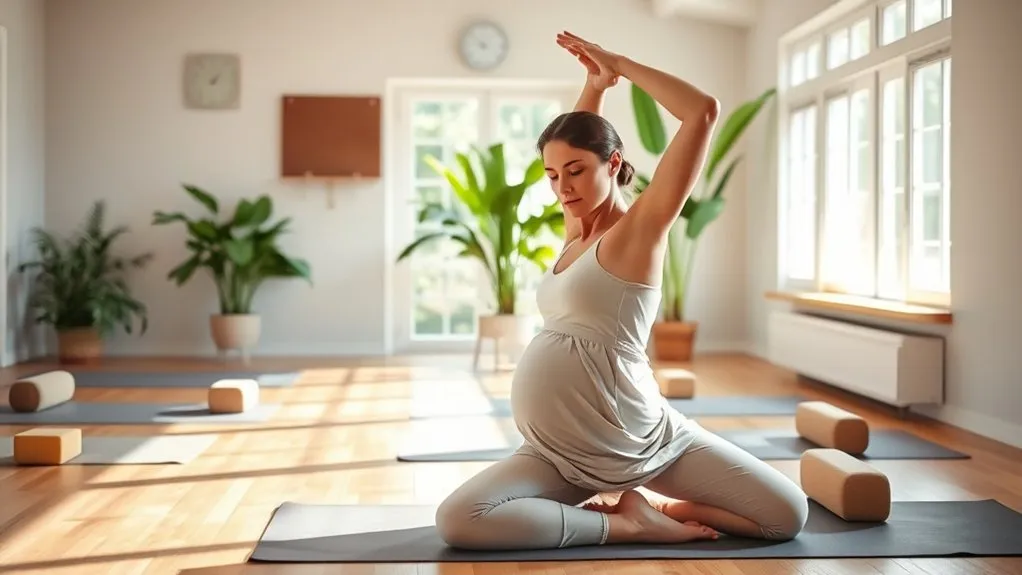
Prenatal yoga can be a gentle way to stay active, manage stress, and adapt movement to your changing body during pregnancy. The safest approach is to use pregnancy-friendly modifications rather than trying to maintain your pre-pregnancy range of motion or intensity. Your individual pregnancy, symptoms, balance, and medical history should guide what you do.
Quick Answer
For most people with uncomplicated pregnancies, prenatal yoga can be a safe way to stay active, reduce stress, and maintain mobility when poses are modified for pregnancy. Start gently, stay cool and hydrated, avoid hot yoga and prolonged flat-on-back positions, and stop for pain or warning symptoms. Ask your prenatal clinician about individual restrictions.
Key Takeaways
- Pregnancy changes balance, joint stability, circulation, and heat tolerance, so familiar poses often need modification as pregnancy progresses.
- Do not use pregnancy as the time to chase deeper stretches, difficult balances, or unfamiliar inversions.
- Hot yoga, poses that compress the abdomen, and prolonged lying flat on your back are poor choices during pregnancy.
- Vaginal bleeding, leaking fluid, dizziness, chest pain, painful contractions, or other warning symptoms mean you should stop exercising and contact your maternity care professional.
Understanding Prenatal Yoga
Prenatal yoga is yoga adapted for the physical and physiological changes of pregnancy. It usually combines gentle or moderate movement, mobility work, controlled breathing, balance practice, and relaxation while modifying positions that become uncomfortable or risky as your belly grows.
The goal is not to achieve the deepest stretch or most advanced pose. Pregnancy changes your center of gravity and can make joints more mobile, so a useful prenatal practice prioritizes stability, comfort, breathing, and controlled movement.
The CDC’s pregnancy physical-activity guidance says moderate physical activity is safe for generally healthy pregnant people and lists some forms of yoga among appropriate activities. If you have medical or pregnancy complications, your recommendations may be different.
Benefits of Practicing Prenatal Yoga
Prenatal yoga may support both physical comfort and mental well-being. Potential benefits include maintaining mobility and strength, practicing controlled breathing, reducing stress, and providing a structured way to remain active as your body changes.
Research has also found possible improvements in anxiety, depression, and stress symptoms. However, an overview of systematic reviews on prenatal yoga found important limitations in the quality of the underlying evidence, so these benefits should not be treated as guaranteed outcomes.
Pregnancy exercise more broadly has established benefits. Public-health guidance recommends at least 150 minutes of moderate-intensity aerobic activity per week for generally healthy pregnant people, although yoga does not have to supply all of that activity.
A class may also give you a chance to meet other expectant parents, learn comfortable movement options, and practice relaxation techniques that you can continue outside the studio.
When to Start Prenatal Yoga
If your pregnancy is uncomplicated, you can generally begin or continue appropriate physical activity during pregnancy. You do not have to wait for a particular trimester, but beginners should start gently and increase activity gradually.
Discuss your exercise plans during prenatal care, particularly if you have a medical condition, pregnancy complication, significant pain, bleeding, a history that affects exercise recommendations, or instructions to limit activity.
- Start at your current level: If you were not exercising before pregnancy, begin with easy sessions rather than jumping into a demanding class.
- Choose pregnancy-specific instruction: A prenatal class is more likely to offer appropriate alternatives for your changing balance and belly.
- Reassess as pregnancy progresses: A pose that feels comfortable early in pregnancy may need props, a wider stance, or a different position later.
Pregnancy is not a good time to prove that you can maintain your previous flexibility. Let comfort, control, and your clinician’s advice take priority.
Essential Do’s of Prenatal Yoga
The main prenatal yoga do’s are simple: choose an appropriate intensity, breathe normally, use support when needed, stay hydrated, and modify positions as your pregnancy changes. You should finish a session feeling comfortably worked rather than exhausted, overheated, dizzy, or painful.
Consult Your Healthcare Provider
Your obstetrician, midwife, or other maternity care professional can tell you whether your pregnancy creates any special exercise restrictions. This matters most if you have medical or obstetric complications rather than a straightforward, low-risk pregnancy.
The American College of Obstetricians and Gynecologists’ exercise guidance recommends discussing exercise during prenatal care and adjusting activity when medically necessary.
- Mention that you plan to practice yoga: Describe whether you are a beginner or an experienced practitioner.
- Discuss symptoms or complications: Ask whether any positions, intensity levels, or activities need to be limited.
- Recheck if your pregnancy changes: New symptoms or complications can change what is appropriate later.
Focus on Breath Awareness
Slow, comfortable breathing can help you relax and notice whether you are becoming tense or overexerted. You should be able to breathe continuously rather than straining or deliberately holding your breath through a difficult posture.
A simple option is relaxed diaphragmatic breathing: inhale comfortably, allow your rib cage and abdomen to expand naturally, then exhale without forcing the breath. There is no need to perform aggressive breath-control techniques during prenatal yoga.
Use your breathing as an intensity check. If you cannot speak normally during the active parts of class, reduce the effort or rest.
Modify Poses as Needed
Pose modifications become increasingly useful as your belly grows and your center of gravity shifts. Props can shorten the distance to the floor, improve stability, and make a pose easier to leave if you suddenly feel uncomfortable.
- Use props: Blocks, a wall, chair, bolster, strap, or cushions can reduce balance demands and support your body.
- Widen your stance when helpful: A slightly wider base can make standing poses more stable as pregnancy progresses.
- Keep twists open: Rotate through the upper torso without forcing your abdomen toward a thigh or compressing your belly.
- Reduce stretch depth: Pregnancy is not the time to push farther simply because a joint temporarily feels more flexible.
Key Don’ts of Prenatal Yoga
The main prenatal yoga don’ts involve overheating, abdominal compression, prolonged flat-on-back positions, uncontrolled stretching, and poses where a loss of balance could cause a fall. The exact modification depends on your trimester, symptoms, experience, and medical guidance.
- Don’t do hot yoga: Heated classes increase the risk of overheating. Use a comfortable, well-ventilated environment instead.
- Don’t force deep twists: Avoid twisting positions that press the abdomen against the legs or otherwise compress your belly.
- Don’t chase deep backbends or forward folds: Modify range of motion and make room for your abdomen.
- Don’t remain flat on your back for prolonged periods: This becomes increasingly important as pregnancy advances.
- Don’t overstretch: Increased joint mobility during pregnancy does not mean deeper stretching is beneficial.
- Don’t ignore balance changes: Use a wall, chair, or blocks when a standing pose feels less steady.
- Don’t start difficult inversions during pregnancy: For experienced practitioners, inversion decisions should consider fall risk, comfort, previous experience, and advice from a clinician and qualified instructor.
The NHS exercise guidance for pregnancy advises avoiding prolonged flat-on-back exercise later in pregnancy and stopping if you feel uncomfortable, overheated, or unwell.
A blanket rule that every inverted yoga position is medically forbidden is less clear-cut. Academic medical guidance from UT Southwestern Medical Center notes that evidence supporting universal avoidance of inversions is limited, but caution is still appropriate because balance and fall risk change during pregnancy.
Warning: Stop exercising and contact your maternity care professional if you develop vaginal bleeding, leaking fluid, dizziness or fainting, chest pain, a significant headache, regular painful contractions, calf pain or swelling, unusual shortness of breath, or muscle weakness affecting your balance.
Modifications for Various Trimesters
Prenatal yoga should become more adaptable as pregnancy progresses. Rather than using rigid rules for every week, adjust for fatigue, nausea, abdominal growth, balance, comfort, and any instructions from your care team.
First Trimester Adjustments
During the first trimester, you may not need obvious belly-related pose changes yet, but fatigue, nausea, dizziness, and heat tolerance can affect your practice. Start gently if yoga is new to you and reduce intensity on days when pregnancy symptoms are stronger.
- Avoid overheating: Skip hot yoga and practice in a comfortable environment.
- Do not force flexibility: Keep stretches controlled rather than trying to deepen them.
- Rest when needed: Fatigue can be significant even before your belly is visibly larger.
If your usual practice suddenly feels much harder, shorten the session rather than trying to push through it.
Second Trimester Considerations
During the second trimester, a growing abdomen and changing center of gravity often make modifications more noticeable. Standing poses may need a wider base or wall support, while twists and folds should leave space for your belly.
Start limiting poses that keep you flat on your back for extended periods. The CDC advises trying to avoid flat-on-back activities after the first trimester, while other medical guidance emphasizes avoiding prolonged supine positions as pregnancy advances.
Use blocks, bolsters, or a chair before you actually lose balance. Supported modifications are not a lesser version of a pose; they are a way to keep the movement controlled as your body changes.
Third Trimester Modifications
During the third trimester, comfort, balance, and ease of getting into and out of a position become especially important. Many people benefit from wider stances, more wall support, shorter holds, and fewer transitions between standing and floor positions.
- Use more support: Place blocks, a chair, wall, or bolster within easy reach before starting the pose.
- Choose open positions: Give your abdomen room during folds, twists, seated poses, and rest positions.
- Reduce fall risk: Replace difficult balances or unfamiliar inversions with stable alternatives.
- Rest on your side: Side-lying relaxation is an alternative to spending extended time flat on your back.
You do not need to keep the same routine until delivery. A shorter, gentler practice may be more appropriate as your pregnancy advances.
Importance of Listening to Your Body
Listening to your body means responding to symptoms instead of using pregnancy discomfort as something to overcome. Mild muscular effort can be normal; sharp pain, dizziness, faintness, significant breathlessness, or feeling unwell are signals to stop.
The talk test is a useful intensity check. At moderate intensity, you should still be able to speak in normal sentences. If you are struggling to talk because of exertion, lower the intensity.
Also distinguish ordinary fatigue from medical warning signs. ACOG advises stopping exercise for symptoms including vaginal bleeding, fluid leakage, dizziness, chest pain, headache, painful contractions, calf pain or swelling, or muscle weakness affecting balance.
Your energy and comfort may change from one day to the next. Modifying a practice is part of prenatal yoga, not a failure to complete it.
Choosing the Right Class or Instructor
A good prenatal yoga instructor should understand how pregnancy affects balance, joint stability, abdominal space, and positioning. They should also be comfortable offering alternatives instead of pressuring everyone to perform the same version of a pose.
Before joining, tell the instructor that you are pregnant and mention your trimester, yoga experience, relevant symptoms, and any restrictions your maternity care professional has given you.
Experience With Prenatal Yoga
An instructor with prenatal-specific training and regular experience teaching pregnant students is preferable to someone relying only on general yoga knowledge. The instructor should be able to explain why a modification is being offered and help you leave a pose safely if it becomes uncomfortable.
- Ask about prenatal training: Find out whether pregnancy-specific instruction is part of their background.
- Ask how they modify poses: A useful answer should include props, alternatives, balance support, and ways to make space for the abdomen.
- Notice the teaching style: You should be encouraged to rest or modify without pressure to match anyone else.
Class Size Considerations
Class size does not determine whether prenatal yoga is medically safe, but it can affect how much individual feedback you receive. Choose a format in which you can hear instructions clearly, ask questions, and get help with modifications when needed.
| Class Format | What It May Offer |
|---|---|
| Smaller in-person class | More opportunities for individual feedback |
| Mid-size in-person class | A balance of group interaction and instructor access |
| Larger in-person class | More group energy but potentially less individual attention |
| Virtual class | Convenience at home, with more responsibility for your own setup and positioning |
If you are new to yoga, have significant discomfort, or need several modifications, easier access to the instructor may be especially useful.
Certification and Qualifications
Look beyond the word “certified.” Yoga credentials vary, so the more useful questions are whether the instructor has pregnancy-specific training, regularly teaches prenatal students, understands common exercise precautions, and respects medical restrictions.
Mayo Clinic’s prenatal yoga guidance recommends choosing an instructor with prenatal-yoga training and considering the class environment, size, and teaching style.
- Prenatal-specific training: The instructor should understand pregnancy-related pose modifications.
- Practical experience: Regular work with pregnant students helps an instructor recognize when extra support may be useful.
- Clear boundaries: A yoga instructor should not diagnose symptoms or override advice from your maternity care professional.
Safe Poses for Expecting Mothers
No yoga pose is automatically right for every pregnant person, but several positions are commonly easier to adapt because they can be supported and do not require extreme range of motion. Comfort, stability, and your ability to enter and leave the position safely are more important than the pose name.
Cat-Cow can provide gentle spinal movement without requiring you to lie on your back. Keep the movement comfortable instead of forcing a large arch.
A supported Warrior II can help maintain leg strength while allowing you to use a wall or chair for balance. Shorten the stance if your pelvis, knees, or hips feel strained.
A wide-knee Child’s Pose may provide a comfortable rest if your abdomen has enough space and your hips and knees tolerate the position. Use a bolster or cushions to raise your torso if needed.
Side-lying relaxation is useful when lying flat on your back is no longer comfortable or appropriate. Pillows between the knees or under the abdomen can add support.
If a pose causes pain, abdominal pressure, dizziness, breathlessness, or instability, come out of it. A pose that was comfortable in one trimester may need a different setup later.
Creating a Comfortable Practice Environment
Your practice space should make it easy to stay cool, move safely, and reach support without walking across the room mid-pose. A simple setup is usually enough.
- Choose a stable surface: Use a mat that does not slide and clear away objects you could trip over.
- Keep support nearby: Position blocks, a chair, wall, bolster, or cushions before you begin.
- Keep the room comfortable: Avoid heated rooms and excessive humidity.
- Have water available: Drink enough to remain comfortable and hydrated.
- Allow room for wider positions: As your belly grows, you may need more space between your feet or knees.
Note: Prenatal yoga guidance is general. If your pregnancy is considered high risk, you have a medical or obstetric complication, or you have been advised to restrict exercise, ask your obstetrician, midwife, or other maternity care professional what level of activity is appropriate for you.
Frequently Asked Questions
Can I Practice Prenatal Yoga if I Have a High-Risk Pregnancy?
Possibly, but you need individualized medical advice first. A high-risk pregnancy can involve conditions that change which activities are appropriate, so your maternity care professional should decide whether yoga is suitable and whether you need specific restrictions.
How Can I Find a Prenatal Yoga Class Near Me?
Look for prenatal-specific classes at yoga studios, fitness centers, hospitals, birth centers, or community programs in your area. Before registering, ask about the instructor’s prenatal training, class format, modification options, and experience teaching people at different stages of pregnancy.
Are There Any Specific Breathing Techniques for Prenatal Yoga?
Slow, comfortable breathing is usually the simplest approach for prenatal yoga. Focus on breathing continuously without straining or holding your breath, and reduce the intensity of a pose if you cannot maintain relaxed, controlled breathing.
What Should I Wear for Prenatal Yoga Sessions?
Wear comfortable, breathable clothing that lets you move without restricting your abdomen or breathing. Choose clothing that helps you stay cool, and remove layers if you begin feeling too warm during the session.
Is It Safe to Practice Prenatal Yoga Throughout the Entire Pregnancy?
Many people with uncomplicated pregnancies can continue modified prenatal yoga throughout pregnancy. The practice should change as your balance, belly size, comfort, and symptoms change, and new medical or pregnancy complications may require additional restrictions.
Conclusion
Prenatal yoga works best when the goal is comfortable movement rather than maximum flexibility or difficult poses. Use props, modify as your body changes, stay cool and hydrated, and avoid forcing positions that create pain, abdominal pressure, dizziness, or instability.
If your pregnancy is uncomplicated, a well-adapted practice can be one part of staying active. Keep your maternity care professional informed, especially if you develop new symptoms or your pregnancy circumstances change.
Sources
- American College of Obstetricians and Gynecologists: Pregnancy exercise safety, modified yoga, overheating, hydration, supine positioning, and warning signs.
- Centers for Disease Control and Prevention: Physical-activity recommendations and pregnancy exercise guidance.
- NHS: Exercise during pregnancy, hydration, later-pregnancy positioning, and safety precautions.
- Mayo Clinic: Prenatal yoga modifications, class selection, heat precautions, and instructor training.
- PubMed: Prenatal Yoga-Based Interventions and Mental Health: Systematic-review evidence on stress, anxiety, depression, and limitations in evidence quality.
- UT Southwestern Medical Center: Pregnancy yoga pose guidance and evidence limitations regarding blanket inversion restrictions.