
The NT scan is more than a routine ultrasound. It’s a key screening tool for your baby’s health. The procedure itself won’t produce any symptoms or signs, but it plays a major role in checking for potential chromosomal conditions. Knowing what to expect before, during, and after the scan can help ease your concerns. Here’s what to know about the timing, procedure, and results of this important test.
Quick Answer
- The NT scan (nuchal translucency scan) measures fluid at the back of your baby’s neck to screen for chromosomal conditions like Down syndrome.
- It’s performed between 11 and 14 weeks of pregnancy.
- The scan is non-invasive and typically takes 20 to 30 minutes.
- Results show risk levels only, not a definitive diagnosis. Further testing may be recommended if the risk appears higher.
Understanding the NT Scan: Purpose and Procedure
When you’re expecting, the NT scan (short for nuchal translucency scan) is one of the first major screening tests you’ll encounter.
This non-invasive ultrasound is typically performed between 11 weeks 0 days and 13 weeks 6 days of pregnancy (often when the crown-rump length is about 45–84 mm). It measures the fluid at the back of your baby’s neck, which can indicate the risk of chromosomal conditions such as Down syndrome, trisomy 18, and trisomy 13.
During the procedure, you’ll lie on an exam table while a technician applies gel to your abdomen and uses a transducer to capture images. The scan usually takes about 20 minutes.
Your healthcare provider will discuss the results and any follow-up testing with you, keeping you supported and informed throughout the process.
Timing of the NT Scan: When to Schedule
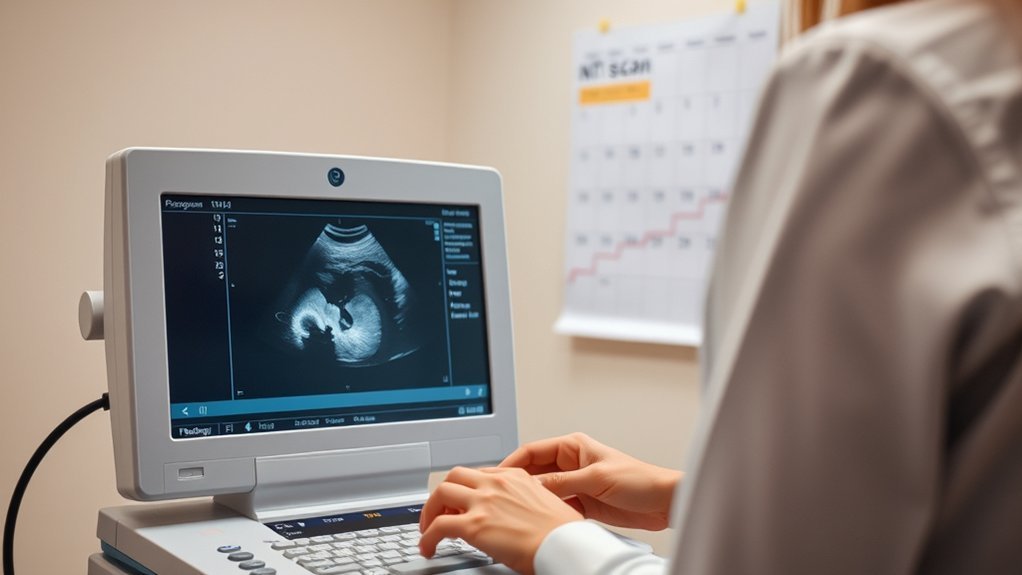
Timing matters with the NT scan. The ideal window is between 11 and 14 weeks of pregnancy.
Getting the scan within this range gives you time for earlier decisions and follow-up care if needed.
In the U.S., prenatal genetic screening options (serum screening with or without NT ultrasound, or cell-free DNA screening) and diagnostic testing (CVS or amniocentesis) are offered to all pregnant patients regardless of age or baseline risk. Coordinate with your healthcare provider early to make sure you get this screening at the right time.
Optimal Week for Scheduling
Scheduling your NT scan at the right time is key for accurate results.
The best window is typically between 11 and 14 weeks of gestation. During this period, your provider can measure the nuchal translucency, the fluid at the back of your baby’s neck. This measurement helps assess the risk of chromosomal abnormalities such as Down syndrome.
Scheduling within this timeframe gives you the most reliable results. If you’re unsure when to book, your healthcare provider can help you find the right appointment.
Importance of Early Detection
Early detection plays a big role in managing your pregnancy well. Scheduling your NT scan between 11 and 14 weeks allows for a timely look at potential chromosomal abnormalities.
Identifying risks early lets you explore further diagnostic options and make informed decisions about your pregnancy. This proactive approach helps you understand your baby’s health and gives you time to prepare, both emotionally and practically.
The sooner you know, the better equipped you’ll be to talk through your options with your healthcare provider. Prioritize your NT scan to protect both your well-being and your baby’s.
What to Expect During the NT Scan
The NT scan is a straightforward process designed with your comfort in mind.
When you arrive, a healthcare professional will walk you through the procedure. You’ll then lie down on an examination table, and the technician will apply gel to your abdomen. The gel helps the ultrasound probe make better contact with your skin.
The technician uses the ultrasound device to capture images of your baby’s neck and measure the nuchal translucency. The scan typically lasts about 20 to 30 minutes.
You can ask questions at any point, and the technician will keep you updated as they work. Feeling a mix of emotions during this appointment is completely normal.
Interpreting NT Scan Results
Getting your NT scan results can feel a bit overwhelming. Your healthcare provider will walk you through whether the measurements fall within normal ranges or show any concerning indicators.
A higher nuchal translucency measurement may suggest an increased risk for chromosomal abnormalities, but it does not confirm a diagnosis.
This test is a screening tool, not a definitive one. If your results show a higher risk, your doctor may recommend further testing such as amniocentesis or chorionic villus sampling (CVS). When an enlarged NT is found, guidelines support offering genetic counseling and planning a detailed ultrasound exam around 18–22 weeks to check for structural differences.
Feel free to ask your provider as many questions as you need. Being informed helps you make the best decisions for yourself and your baby.
Common Symptoms and Signs Leading to NT Scan
Many expectant parents wonder when to consider an NT scan. Typically, this screening is discussed between 11 and 14 weeks of pregnancy. In the U.S., prenatal genetic screening is offered to all pregnant patients, not only those with specific risk factors, so you can bring it up with your provider regardless of age or history.
Common factors that may prompt a conversation about the NT scan include advanced maternal age, a family history of genetic disorders, or previous pregnancies affected by chromosomal abnormalities.
Signs to discuss an NT scan with your provider include advanced maternal age, family history of genetic disorders, or past chromosomal abnormalities in pregnancies.
Feeling anxious about potential risks is also common, and that alone is a valid reason to bring it up with your provider. If you’ve had any abnormal first-trimester screenings, your doctor may also recommend the scan for additional clarity.
The NT scan measures nuchal translucency to help assess the risk of certain genetic conditions, giving you and your provider the information needed to make thoughtful decisions together.
Consult your healthcare provider for advice tailored to your specific situation.
Factors Affecting NT Scan Results
Several factors can affect the accuracy of your NT scan results. Understanding them helps you have a more informed conversation with your healthcare provider.
Maternal age, fetal position, and the skill of the ultrasound technician all play a significant role in how accurate the measurements turn out to be.
Maternal Age Impact
Maternal age has a real effect on how NT scan results are interpreted.
Women over 35 tend to have a higher risk of chromosomal abnormalities, which can influence the measurements taken during the scan. The nuchal translucency thickness is often read alongside maternal age, and older mothers may show different risk profiles as a result.
This doesn’t mean younger mothers are without concerns, but the data generally points to a heightened risk for older expectant mothers.
Discussing your individual risk factors with your healthcare provider will give you the most accurate picture of your situation.
Fetal Position Influence
Fetal position plays a significant role in the accuracy of NT scan results. When your baby is in a favorable position, the technician can measure the nuchal translucency more accurately.
If your baby is curled up or facing away, it can block clear views and lead to less reliable measurements. This can sometimes produce false positives or negatives and cause unnecessary concern.
Fetal positioning is temporary and can shift during the scan. If your baby isn’t in an ideal spot, the technician may ask you to reposition or wait a few minutes to see if the baby moves.
Try to stay calm. These variations are common and generally easy to manage.
Ultrasound Technician Skill
The skill of the ultrasound technician has a direct impact on the accuracy of NT scan results. Their experience helps ensure a proper measurement of the nuchal translucency, which is central to evaluating potential chromosomal abnormalities. Technique, experience, and communication all matter.
| Factor | Impact on Results | Importance Level |
|---|---|---|
| Measurement Technique | Precise measurements are essential | High |
| Equipment Quality | High-quality machines yield better images | Medium |
| Technician Experience | More experience leads to accuracy | High |
| Patient Interaction | Comfort can improve cooperation | Medium |
A skilled technician can meaningfully improve the reliability of your results, which is worth keeping in mind when choosing where to have your scan done.
Next Steps After the NT Scan
After your NT scan, the focus shifts to understanding what your results mean for your prenatal care. You’ll receive results that reflect your baby’s risk level for certain chromosomal conditions.
If your results suggest a higher risk, your healthcare provider may recommend further testing such as chorionic villus sampling (CVS) or amniocentesis. These tests can offer more definitive answers, but they do carry their own risks.
Discuss these options thoroughly with your provider, weighing both the benefits and potential implications. Whatever the outcome, keeping up with regular prenatal check-ups is essential for monitoring your health and your baby’s development.
Frequently Asked Questions
Can the NT Scan Detect All Genetic Disorders?
The NT scan can’t detect all genetic disorders. It primarily screens for specific chromosomal abnormalities like Down syndrome. For a more thorough assessment, talk to your healthcare provider about additional testing options.
Is It Safe for Both Mother and Baby?
Yes. When performed by trained professionals, the NT scan (diagnostic ultrasound) is generally considered safe for both you and your baby. It uses sound waves, not ionizing radiation. As a screening test, it doesn’t diagnose conditions, and detection rates vary depending on the screening approach used.
How Does the NT Scan Differ From Other Tests?
The NT scan measures nuchal translucency via ultrasound to help assess risk for chromosomal abnormalities. The first-trimester combined screening pairs this ultrasound with blood tests (PAPP-A and free β-hCG) to estimate risk. Cell-free DNA (cfDNA/NIPT) is a blood test available from about 10 weeks that is more sensitive for common trisomies. Diagnostic tests, such as CVS (typically 10–13 weeks) and amniocentesis (typically at or after 15 weeks), can provide definitive results.
Will I Need to Prepare Differently for the Scan?
You won’t need much preparation. Many clinics allow you to eat normally beforehand. Some ask you to arrive with a moderately full bladder to improve image quality. Follow the specific instructions from your clinic.
What if I Miss My Scheduled NT Scan Appointment?
Contact your healthcare provider as soon as possible. After about 13 weeks 6 days, the NT measurement may no longer be feasible. Your provider may offer alternatives such as cell-free DNA screening (available from 10 weeks onward) or the second-trimester quad screen (typically done between 15 and 22 weeks).
Conclusion
The NT scan doesn’t produce symptoms or signs on its own, but it plays a meaningful role in evaluating your baby’s health. Pregnancy symptoms won’t affect the scan itself. The results focus solely on the nuchal translucency measurement. If any concerns come up, talking them through with your healthcare provider will help you make informed decisions as your pregnancy progresses.