
Tongue tie in babies, also called ankyloglossia, happens when the thin tissue under the tongue is unusually short, tight, or attached in a way that limits tongue movement. It may cause breastfeeding trouble, poor latch, clicking during feeds, nipple pain, or slow weight gain. During pregnancy, genetics, normal fetal development, and possibly folate-related pathways may play a role, but the exact cause is not always clear. Doctors usually diagnose it with a mouth exam and a feeding review. Many babies do well with lactation support, while some need a simple frenotomy if feeding problems continue.
Quick Answer
Tongue tie in babies is usually caused by the lingual frenulum not separating or stretching enough before birth. It may run in families, and prenatal development may also play a role. The main signs are poor latch, clicking feeds, nipple pain, slow weight gain, and limited tongue movement.
Key Takeaways
- Tongue tie happens when the tissue under the tongue restricts normal movement.
- Common signs include shallow latch, clicking sounds, long or frequent feeds, nipple pain, and slow weight gain.
- Genes may play a role because tongue tie can run in families.
- Folate-related research is still developing, and folic acid remains important during pregnancy.
- Treatment may include lactation support, feeding adjustments, frenotomy, or, rarely, a more involved procedure.
What Is Tongue Tie in Babies?

Tongue tie, or ankyloglossia, is a condition some babies are born with when the lingual frenulum is too short, tight, or attached close to the tip of the tongue. The lingual frenulum is the small band of tissue that connects the underside of the tongue to the floor of the mouth.
When this tissue limits tongue movement, your baby may have trouble lifting the tongue, moving it side to side, or extending it forward. That can matter during feeding because babies use the tongue to cup the breast, create suction, and move milk effectively.
You may hear tongue tie described as mild, moderate, severe, anterior, or posterior. An anterior tongue tie is easier to see because the tissue is near the front of the tongue. A posterior tongue tie can be harder to spot because the restriction sits farther back or feels tight under the surface.
Because the tongue can’t lift, extend, or move freely, you might notice breastfeeding difficulties, such as poor latching, clicking, slipping off the breast, or lasting feeding strain. Other symptoms of tongue-tie can include difficulty reaching past the lower front teeth later on, oral tension, or speech and eating concerns as your child grows.
A pediatrician, pediatric dentist, ENT specialist, midwife, or lactation consultant may notice it soon after birth with a simple look and feel of the mouth and tongue. Many babies don’t need surgery, but if feeding problems continue despite support, a frenotomy may help improve tongue movement and make feeding easier.
What Causes Tongue Tie in Babies?
Tongue-tie happens when the lingual frenulum doesn’t develop, thin, stretch, or separate as expected before birth. The tissue remains tighter than usual, which can limit tongue movement.
You may notice that genetics and prenatal factors, like fetal development, maternal health, and normal tissue formation, can play a role in this variation.
Some research also looks at folic acid-related pathways, including MTHFR variations, as possible factors, but the evidence is not strong enough to say that folic acid causes tongue tie.
Lingual Frenulum Development
Although the exact cause isn’t always clear, tongue-tie in babies usually happens when the lingual frenulum—the small band of tissue under the tongue—doesn’t separate fully or remains too tight before birth. When that tissue stays short or restrictive, it can limit movement and make feeding harder.
During fetal growth, developmental variations can leave the frenulum shorter, thicker, or tighter than usual. You may also see patterns linked to genetic factors, since tongue-tie often appears in more than one family member.
In some pregnancies, environmental factors, medications, health conditions, or other prenatal influences may affect how tissues form. Still, most parents never get one clear cause, and many cases are simply part of normal variation in how a baby develops.
None of this means you did something wrong. It simply means your baby’s oral tissue formed in a way that may affect feeding. Many babies thrive once the issue is recognized and the family gets the right support.
Genetic and Prenatal Factors
During fetal growth, the lingual frenulum should allow enough tongue flexibility for feeding after birth. When genetic factors affect connective tissue formation, the frenulum may stay too tight or too short.
Tongue tie can run in families, and it may be seen more often in boys. That pattern suggests heredity may be part of the story, although researchers have not identified one single gene that explains every case.
Your maternal health and prenatal nutrition also support normal oral development, but they do not fully control whether a baby is born tongue tied. These influences don’t mean you caused the problem. They simply show that tongue-tie often starts early, shaped by biology and development before your baby is born.
Folic Acid Research Link
Recent research has looked at folic acid intake as one possible factor in tongue-tie development, though this does not mean folic acid itself causes the condition. Some studies have explored whether folate metabolism, genetic variants, and prenatal supplementation could influence oral tissue development.
Researchers think folate-related pathways may affect tissue growth during early development. Still, the findings do not prove harm, and differences in diagnosis may affect reported rates of tongue tie.
If you took folic acid before or during pregnancy, you didn’t do anything wrong. Folic acid is widely recommended because it helps support healthy prenatal development, especially early neural tube development. Many infants exposed to folic acid never develop ankyloglossia.
The evidence is still emerging, so the safest takeaway is balanced: folate is important in pregnancy, tongue tie may have several causes, and your baby’s provider can help you focus on feeding, growth, and comfort instead of blame.
Note: Do not stop prenatal vitamins or folic acid because of tongue-tie concerns unless your doctor tells you to. Pregnancy supplements should be guided by your clinician and your personal health history.
Could Genes or Folate Play a Role?
Genes and prenatal nutrition may both play a role in tongue-tie, and researchers think the condition often has a hereditary component. If you’ve heard of ankyloglossia, you’ve heard another name for tongue-tie, and genes may help explain why it can run in families.
Genes and prenatal development may both influence tongue-tie, but most families never get one simple cause.
Some research has looked at variations in the MTHFR gene, which can affect folate metabolism. Other research has explored whether regular folic acid use before or during early pregnancy is linked with a higher reported rate of tongue-tie. These studies are worth watching, but they do not prove that folic acid directly causes tongue tie.
Your body’s nutrition, your genes, your baby’s connective tissue development, and other environmental factors can interact in complex ways. A baby can have tongue tie even when pregnancy nutrition was excellent, and a baby can have no tongue tie even when the same supplements were used.
You deserve clear answers, so keep in mind that scientists still need more research before they can explain exactly how these factors fit together. For now, the most useful step is to watch your baby’s feeding, growth, comfort, and tongue movement.
How Tongue Tie Affects Feeding
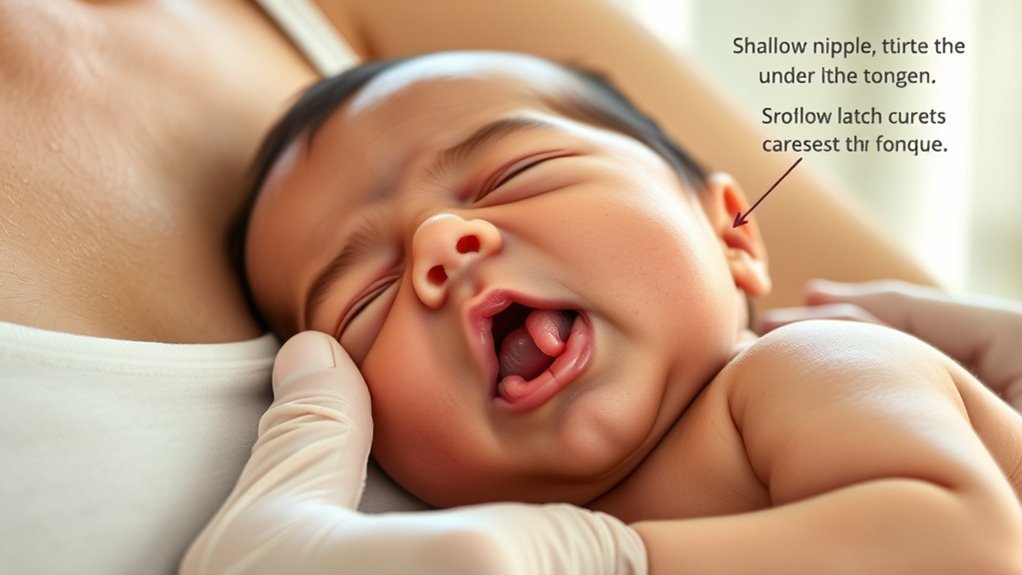
Tongue-tie can make it hard for your baby to latch well, which can turn breastfeeding into a frustrating start.
You might also notice that your baby isn’t transferring milk efficiently, even when they seem to feed often.
If feeding feels painful, noisy, slow, or stressful, early support can help you and your baby get back on track.
Breastfeeding Latch Problems
When ankyloglossia limits a baby’s tongue movement, breastfeeding can become difficult right from the start because the infant may not form a deep, steady, effective latch.
With tongue ties, you may notice breastfeeding latch problems like clicking, gulping, shallow attachment, or slipping off the breast. These can be signs of restricted tongue movement or weak suction.
A poor latch can leave you with nipple pain, cracked skin, compressed nipples, plugged ducts, or frustration, even when you’re trying to feed with care. Your baby may seem hungry again soon after feeding or may fall asleep before taking enough milk.
Early identification and management matter because support can protect your baby’s comfort and your own. Many families find relief when a frenotomy helps improve feeding, but the best next step depends on the baby’s symptoms, weight gain, tongue function, and feeding assessment.
You deserve options that make feeding easier, calmer, and more connected, so don’t ignore persistent latch issues or wait too long to ask for help.
Milk Transfer Challenges
If your baby has ankyloglossia, getting milk out efficiently can be the bigger problem—not just getting latched on. With tongue tie, your baby may suck, click, swallow air, and tire fast, so you can see feeding difficulties even when the breast looks well placed.
| What you notice | What it can mean |
|---|---|
| Noisy feeds | Poor suction or air swallowing |
| Short, frequent feeds | Low milk transfer |
| Slow weight gain | Not enough intake |
| Fussy feeds or pulling off | Frustration with flow or latch |
That mismatch can leave your milk supply feeling off-balance and your nipples sore or cracked. Early identification helps you act before frustration grows. Some babies improve with positioning and lactation support, while others may need a procedure if tongue movement remains clearly restricted.
Bottle Feeding and Tongue Tie
Tongue tie can also affect bottle feeding. Some bottle-fed babies leak milk from the corners of the mouth, click while sucking, take a long time to finish, gag on flow, or swallow extra air.
You may notice gas, reflux-like discomfort, hiccups, or fussiness after feeds. These signs do not prove tongue tie by themselves, but they are worth discussing if they happen along with limited tongue movement or poor weight gain.
A feeding specialist may suggest paced bottle feeding, a different nipple flow, improved positioning, or a full oral-motor evaluation before recommending a procedure.
Signs of Tongue Tie to Watch For

Signs of tongue tie in babies often show up during feeding, especially if your baby has trouble latching, seems frustrated at the breast, or isn’t gaining weight as expected.
Signs of tongue tie often show up at feeding, with latching trouble, clicking sounds, nipple pain, or slow weight gain.
You might notice clicking sounds during breastfeeding, which can point to an uneven latch from restricted tongue movement. Your baby’s tongue may also look notched, flat, or heart-shaped when it sticks out, another possible clue of tongue-tie.
In some babies, ankyloglossia makes it hard to move the tongue side to side, lift it to the upper gums, or extend it beyond the lower gum line. These limits can reduce effective feeding.
- Shallow latch or repeated slipping off the breast
- Clicking, smacking, or noisy sucking
- Long feeds that still leave baby unsatisfied
- Very frequent feeds with poor milk transfer
- Nipple pain, cracking, bleeding, or flattened nipples after feeds
- Poor weight gain or fewer wet diapers than expected
- Heart-shaped tongue tip when baby cries or sticks out the tongue
- Difficulty lifting the tongue toward the roof of the mouth
If you’ve tried different breastfeeding positions and the challenges keep happening, trust what you’re seeing and keep asking questions. You deserve support, and your baby deserves a feed that feels calm and nourishing.
These signs of tongue-tie don’t mean you’ve done anything wrong; they simply tell you it may be time to seek further help and more answers.
Warning: Call your baby’s doctor promptly if your baby has poor weight gain, fewer wet diapers, signs of dehydration, extreme sleepiness, or feeding that suddenly becomes much worse.
How Doctors Diagnose Tongue Tie
Doctors usually diagnose tongue tie, or ankyloglossia, with a physical exam that looks at how your baby’s tongue moves and how the frenulum is shaped.
If your infant has breastfeeding difficulties, your pediatrician may check for trouble latching, poor milk transfer, nipple pain, or slow weight gain. A lactation consultant can also watch a full feeding and help identify whether the problem is tongue movement, positioning, milk flow, oral tension, or something else.
During the exam, the provider may look at whether your baby can lift the tongue, extend it forward, move it side to side, cup the breast or bottle nipple, and maintain suction. They may also feel under the tongue to check how tight or thick the frenulum is.
These evaluations matter because some infants have subtle restrictions that are not obvious at first glance. A baby may have a visible frenulum and feed well, while another baby may have a less obvious restriction that causes real feeding problems.
Because diagnostic criteria can vary, different providers may assess the same baby a little differently. That’s why early, careful review helps you get clear answers and supports informed choices about your child’s feeding and comfort.
Questions to Ask the Provider
Before choosing a treatment, it helps to ask clear questions. This can keep the focus on function, not just appearance.
- Is my baby’s tongue movement actually restricted?
- Could the feeding problem come from latch, positioning, milk flow, reflux, prematurity, or another issue?
- Is my baby transferring enough milk and gaining weight well?
- Should we try lactation support before a procedure?
- What benefits and risks should I understand before frenotomy?
- Who will do the procedure, and what follow-up care is needed?
Tongue Tie Treatment Options for Babies
When tongue tie is causing feeding problems, treatment usually starts with supportive breastfeeding techniques and positioning to help your baby latch and transfer milk more easily. For many babies, this hands-on approach is enough.
In the treatment of ankyloglossia, lactation consultants can guide you through holds, breast support, oral stimulation, and pacing that ease strain for you both.
- A snug cradle hold
- Baby’s chin close to breast
- A deeper latch
- Gentle milk flow support
- Calm, patient feeding sessions
If a tongue-tie still limits movement and feeding problems continue, frenotomy is the most common procedure. A trained clinician releases the lingual frenulum, often with sterile scissors or another medical tool. The procedure is usually quick, but it should still be done only when there is a clear reason and a qualified provider recommends it.
Some babies feed better soon after release, while others need time, lactation help, or oral exercises to relearn a more effective suck. Improvement is not always instant, especially if the baby has had weeks of feeding tension or if another feeding problem is also present.
For severe or complex cases, frenuloplasty may offer a more extensive option. This is less common in young babies and may involve more planning. Still, most infants don’t need surgery; with support, they often adapt and build stronger feeding skills over time.
Frenotomy Benefits and Risks
Frenotomy may reduce nipple pain and improve latch when tongue tie is clearly affecting feeding. It is often brief, and many babies can feed soon afterward.
Possible risks include bleeding, pain, infection, reattachment, oral aversion, or no major improvement if tongue tie was not the main cause of the feeding problem. Serious problems are uncommon, but the decision should still be made with a trained clinician.
Ask your provider how they manage comfort, bleeding, aftercare, and follow-up feeding support. A release without skilled feeding help may not solve the full problem.
Pro Tip: If possible, schedule lactation follow-up soon after a tongue-tie release. Your baby may need help turning new tongue movement into a deeper, more comfortable latch.
When to Get Help for Tongue Tie
If your baby has trouble latching, leaves you with persistent nipple pain, or isn’t gaining weight well despite frequent feedings, it’s time to get help and have a tongue tie evaluated. You deserve support, and early care can ease breastfeeding strain and protect your baby’s growth.
| Sign | What it may mean |
|---|---|
| Poor latch or pain | Possible tongue tie or latch issue |
| Slow weight gain | Possible low milk transfer |
| Speech or eating trouble | Needs assessment |
| Bottle leaking or clicking | Possible poor seal or suction |
Reach out to a lactation consultant or pediatrician if breastfeeding stays painful or milk transfer seems weak. For older children, ask about tongue tie if you notice speech concerns, trouble with certain sounds, difficulty licking lips, messy eating, trouble clearing food from teeth, or difficulty with oral hygiene.
A timely assessment can clarify what’s going on and guide the next step. Trust your instincts: you don’t have to push through discomfort alone.
Can Tongue Tie Affect Speech or Oral Development?
Some children with tongue tie have no speech problems at all. Others may have trouble with sounds that need the tongue to lift or touch certain parts of the mouth, such as “t,” “d,” “l,” “r,” “s,” “z,” “th,” or “n.”
Speech concerns should be evaluated by a qualified speech-language pathologist. A visible tongue tie alone does not always mean a child needs surgery. The key question is whether the tongue restriction is causing a real functional problem.
Tongue movement can also affect licking, chewing, swallowing, clearing food from the mouth, and brushing teeth. If your child is older and you notice eating, dental, or speech concerns, ask your pediatrician, dentist, or speech therapist for an assessment.
What Parents Should Not Blame Themselves For
It is easy to wonder whether you caused your baby’s tongue tie during pregnancy. In most cases, there is no single action a parent took or failed to take that explains it.
Tongue tie usually forms before birth as part of oral development. Genetics, tissue growth, and prenatal biology may all contribute. You can focus on what helps now: feeding support, growth monitoring, pain relief, and a clear treatment plan if one is needed.
If you are struggling with feeding, you are not failing. Painful feeds, a hungry baby, and mixed advice can feel overwhelming. The right support can make a major difference.
Frequently Asked Questions
What causes a baby to be tongue tied at birth?
A baby is tongue tied at birth when the lingual frenulum under the tongue stays too short, tight, or restrictive during fetal development. Genetics may play a role because tongue tie can run in families. Prenatal development and connective tissue formation may also contribute.
What are the long-term effects of tongue tie in babies?
Some babies have no long-term effects, especially if feeding is normal. Others may have breastfeeding challenges, bottle-feeding problems, speech concerns, eating difficulty, oral hygiene problems, or dental concerns. The risk depends on how restricted the tongue is and whether it affects function.
What vitamin deficiency causes tongue tie?
No vitamin deficiency has been proven to directly cause tongue tie. Folate-related pathways are being studied, but the research is not conclusive. Folic acid remains an important prenatal nutrient, and you should not stop pregnancy supplements unless your clinician advises it.
What causes a tongue tie in pregnancy?
Tongue tie in pregnancy usually develops as the baby’s mouth and connective tissues form. Genetic factors, fetal development, and normal tissue variation may be involved. Maternal health and nutrition support development, but parents usually cannot prevent or predict tongue tie.
Can tongue tie go away on its own?
A tight frenulum may loosen somewhat as a child grows, and some babies adapt well without treatment. However, if tongue tie causes ongoing feeding pain, poor milk transfer, or slow weight gain, it should be evaluated instead of ignored.
Is frenotomy painful for babies?
Frenotomy is usually quick, but babies can feel discomfort. Some cry because of pain, being held still, or hunger. Ask the provider how they handle comfort, bleeding, feeding afterward, and follow-up care.
Conclusion
Tongue tie can make feeding harder for you and your baby, but it is also common, manageable, and often treatable. The main issue is not just how the frenulum looks, but whether it limits tongue function and affects feeding, comfort, growth, speech, eating, or oral care.
If your baby struggles to latch, feed well, or gain weight, talk with your doctor, lactation consultant, pediatric dentist, or ENT specialist. With the right assessment, you can understand whether supportive care is enough or whether a frenotomy may help.
You are not to blame for tongue tie. With early support, careful feeding guidance, and a treatment plan matched to your baby’s needs, you can help your baby feed more comfortably and grow with more ease.
Sources
- NHS: Tongue-tie — overview, symptoms, feeding effects, and treatment basics.
- NCBI Bookshelf: Ankyloglossia — medical background on tongue tie, diagnosis, and management.
- American Academy of Pediatrics: Breastfeeding — breastfeeding support and infant feeding guidance.
- CDC: Folic Acid — prenatal folic acid guidance and why folate is important during pregnancy.