Disclosure: As an Amazon Associate, we earn from qualifying purchases. If you buy through links on this page, we may earn a small commission at no extra cost to you.
By Editorial Team | Updated October 8, 2026
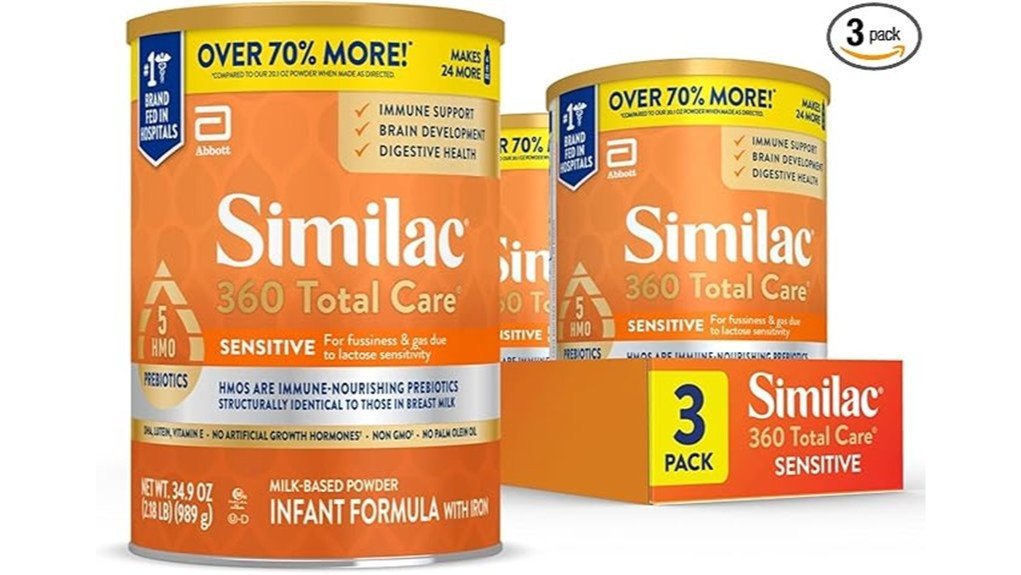
Similac 360 Total Care Sensitive Formula is a milk-based, iron-fortified infant formula designed for babies experiencing fussiness and gas associated with lactose sensitivity. It contains five human milk oligosaccharides (HMOs), nutrients for growth, and a carbohydrate blend that differs from standard Similac 360 Total Care.
Its main appeal is complete infant nutrition with a formula designed for sensitive tummies. However, it is not hypoallergenic, does not treat cow’s milk protein allergy, and will not solve every cause of crying or digestive discomfort. This review examines its ingredients, limitations, preparation requirements, and overall value.
Quick Verdict: Similac 360 Total Care Sensitive
Editorial feature assessment: 7.5/10
This subjective score reflects the formula’s published features and limitations. It is not a hands-on test result or a measure of medical effectiveness.
20 Cal/fl oz
Iron-fortified
Non-GMO ingredients
Milk-based powder
Best for: Infants whose pediatrician recommends a milk-based formula for suspected lactose-related feeding discomfort.
Skip if: Your baby has galactosemia or needs a hypoallergenic formula for diagnosed cow’s milk protein allergy.
Bottom line: A reasonable sensitive-formula option with complete nutrition and five HMOs. Its value depends on your baby’s actual feeding tolerance, not the number of ingredients listed.
Before You Buy
- It contains milk and soy: Sensitive does not mean hypoallergenic.
- Powder is not sterile: Babies at higher infection risk need extra feeding precautions.
- Galactosemia warning: Abbott states this formula must not be used for infants or children with galactosemia.
- Check the package: The linked Amazon ASIN was listed as three 34.9-ounce containers. Confirm the size, quantity, and expiration dates before ordering.
Key Takeaways
- Complete nutrition: The formula supplies protein, fat, carbohydrates, iron, vitamins, and minerals for infant growth.
- Digestive focus: Abbott markets it for fussiness and gas associated with lactose sensitivity, not every type of feeding discomfort.
- Five HMOs: These prebiotics are structurally identical to selected HMOs found in breast milk, but they are not extracted from human milk.
- Ingredient considerations: It contains milk protein isolate, corn syrup, sugar, and soy ingredients.
- Important limitations: It is not a treatment for cow’s milk protein allergy and is unsuitable for galactosemia.
- Safe feeding matters: Correct mixing, clean equipment, and prompt refrigeration are essential.
Jump to Review Sections
What Is Similac 360 Total Care Sensitive Formula?
Similac 360 Total Care Sensitive is a nutritionally complete, milk-based infant formula with iron. Abbott designed it as an alternative to standard milk-based formula for babies who may experience fussiness and gas related to lactose sensitivity.
It provides 20 calories per fluid ounce when prepared according to the manufacturer’s directions. That is the standard caloric concentration for many routine infant formulas.
The Sensitive formulation differs from regular Similac 360 Total Care mainly in its carbohydrate and protein ingredient profile. It also retains the five-HMO blend associated with the 360 Total Care product line.
Similac 360 Total Care Sensitive Specifications
| Specification | Verified Details |
|---|---|
| Brand | Similac, by Abbott Nutrition |
| Product | 360 Total Care Sensitive |
| Formula type | Milk-based infant formula with iron |
| Calories | 20 Cal/fl oz prepared |
| Protein | 2.1 g per 5 fl oz prepared |
| Fat | 5.4 g per 5 fl oz prepared |
| Carbohydrates | 10.9 g per 5 fl oz prepared |
| Prebiotics | Five HMOs |
| Other nutrients | DHA, lutein, vitamin E, iron, and other essential nutrients |
| Allergens | Contains milk and soy ingredients |
| Mixing ratio | One level scoop per 2 fl oz of water |
| Linked Amazon listing | ASIN B09F5FHFPC, listed as 34.9 oz, pack of 3 |
These values come from Abbott Nutrition’s published product information. Formulations and packaging can change, so the physical container remains the final reference for preparation and ingredients.
What’s in the Box?
The linked Amazon listing identifies a multipack containing three 34.9-ounce powder containers. Abbott’s preparation directions specify using the enclosed measuring scoop.
Bottles, nipples, water, and feeding accessories are not listed as included components. These must be supplied separately.
Abbott states that one 34.9-ounce container makes approximately 251 fluid ounces of prepared formula when mixed as directed. Actual feeding portions will depend on your infant’s needs.
Similac 360 Total Care Sensitive Ingredients and HMO Benefits
The formula combines milk protein, vegetable oils, carbohydrates, vitamins, minerals, and five HMOs. Its ingredients are designed to deliver complete nutrition while addressing the needs of babies who may have difficulty tolerating lactose.
Understanding the ingredient list is useful because the word “Sensitive” describes the formula’s intended use, not an absence of allergens.
What Are the Five HMO Prebiotics?
HMOs, or human milk oligosaccharides, are complex carbohydrates naturally found in breast milk. Certain HMOs help feed beneficial gut microorganisms and contribute to the developing intestinal environment.
Abbott lists five HMOs in this product:
- 2′-Fucosyllactose (2′-FL)
- Lacto-N-tetraose (LNT)
- 3-Fucosyllactose (3-FL)
- 6′-Sialyllactose (6′-SL)
- 3′-Sialyllactose (3′-SL)
These ingredients have structures matching selected HMOs in breast milk. They are not derived from human milk, and adding them does not make formula nutritionally identical to breastfeeding.
Abbott markets its HMO blend for digestive and immune support. However, the presence of five HMOs does not prove that an individual baby will experience less gas, fewer infections, or better developmental outcomes.
Protein, Carbohydrates, and Fats
The powder’s published ingredient list begins with corn syrup, milk protein isolate, high oleic safflower oil, sugar, soy oil, and coconut oil.
Corn syrup and sugar serve as carbohydrate sources in this formulation. Their presence does not make the product the same as ordinary sweetened cow’s milk, but parents who prefer lactose-based carbohydrates should understand the distinction.
Milk protein isolate remains a dairy-derived protein. This is particularly important for babies with a suspected cow’s milk protein allergy.
The formula also contains DHA and ARA sources, along with lutein and vitamin E. These nutrients are included to support normal growth and development, rather than to treat digestive disease.
What Do Non-GMO and No Artificial Growth Hormones Mean?
Abbott states that Similac 360 Total Care Sensitive uses ingredients that are not genetically engineered and milk ingredients from cows not treated with recombinant bovine somatotropin (rbST).
These are ingredient-sourcing characteristics. They should not be interpreted as proof that the formula is safer, more nutritious, or easier to digest than every competing product.
How Does Similac 360 Total Care Sensitive Help With Gas and Fussiness?
Similac 360 Total Care Sensitive is designed to help with fussiness and gas due to lactose sensitivity. Its alternative carbohydrate formulation may suit an infant who has difficulty tolerating a standard lactose-containing formula.
However, fussiness does not automatically mean lactose intolerance. Swallowed air, normal infant crying, overfeeding, reflux, and other feeding problems can produce similar symptoms.
The American Academy of Pediatrics’ formula guidance explains that significant lactose intolerance is uncommon in young infants. Some digestive symptoms are temporary and do not require a formula change.
| Feature | Potential Benefit | Limitation |
|---|---|---|
| Lactose-sensitive design | May improve feeding tolerance when lactose is the problem | Does not address every cause of gas |
| Five HMOs | Provide prebiotics that interact with gut microorganisms | Individual symptom relief is not guaranteed |
| Milk protein isolate | Supplies protein for growth | Not suitable for treating cow’s milk protein allergy |
| Iron-fortified nutrition | Helps meet nutritional needs during infancy | Not a treatment for colic or reflux |
How Long Does It Take to Notice a Difference?
There is no reliable, universal timeline for improvement after switching to this formula. Some caregivers report changes in feeding comfort, while others notice no meaningful improvement.
If your pediatrician recommends a formula change, follow the agreed feeding plan and monitor your baby’s symptoms, wet diapers, and weight gain.
Do not keep changing formulas solely because gas or crying continues. Persistent discomfort deserves medical evaluation rather than repeated experimentation.
Pros and Cons of Similac 360 Total Care Sensitive
Pros
- Nutritionally complete milk-based infant formula with iron
- Contains five HMO prebiotics
- Designed for lactose-related fussiness and gas
- Provides DHA, lutein, and vitamin E
- Available in powder and ready-to-feed formulations
Cons
- Not hypoallergenic; contains milk and soy ingredients
- Cannot treat all causes of fussiness and gas
- Powder requires careful preparation and storage
- Unsuitable for infants with galactosemia
Is Similac 360 Total Care Sensitive Safe and Trusted?
Similac 360 Total Care Sensitive is formulated as a complete infant formula, but its safety depends on choosing the appropriate product, following preparation instructions, and avoiding use when medically contraindicated.
Abbott specifically warns that the product must not be used for infants or children with galactosemia. It also warns that powdered infant formulas are not sterile.
Important safety warning: Babies younger than two months, babies born prematurely, and babies with weakened immune systems have a higher risk of serious infection from contaminated powdered formula. Discuss the safest feeding option with your clinician. Commercially sterile ready-to-feed formula is generally preferred for higher-risk infants.
How to Prepare Similac 360 Total Care Sensitive Powder
Abbott specifies one unpacked, level scoop of powder (8.8 g) for every 2 fluid ounces of water. Always use the enclosed scoop and follow the directions on your particular container.
- Wash your hands and clean the feeding area, bottle, nipple, and other equipment.
- Measure the water first. Pour the required amount of safe water into the clean bottle.
- Add the powder. Use one unpacked, level scoop for each 2 fluid ounces of water.
- Mix thoroughly. Close the bottle and shake until the powder dissolves.
- Check the temperature. Feed only when the formula is at a safe temperature.
- Use or refrigerate promptly. Follow the storage times below and discard leftovers after feeding.
For high-risk infants, the CDC recommends extra precautions when preparing powdered formula. These include boiling water and allowing it to cool for about five minutes before mixing, so it remains hot enough to reduce the risk of Cronobacter contamination. Cool the prepared formula to a safe feeding temperature before offering it.
Ask your baby’s clinician about special preparation requirements, particularly for premature or medically vulnerable infants.
How Long Can Prepared Formula Be Stored?
| Situation | Safe Handling Guidance |
|---|---|
| Freshly prepared, not refrigerated | Use within 2 hours of preparation |
| After feeding begins | Use within 1 hour, then discard leftovers |
| Prepared but not used | Refrigerate promptly and use within 24 hours |
| Opened powder container | Keep tightly closed in a cool, dry place; use within 1 month |
| Expired formula | Do not use after the package’s use-by date |
Never microwave infant formula. A microwave can create hot spots that burn a baby’s mouth even when the bottle feels cool.
Quality Standards and Recall Checks
Infant formulas sold in the United States must meet applicable federal nutritional and safety requirements. However, regulatory requirements do not eliminate every manufacturing or contamination risk.
Check the container seal, expiration date, and lot information. For current infant formula safety notices, consult the FDA’s infant formula information and recall resources.
Do not use a container with a damaged seal, suspicious odor, visible contamination, or a lot number included in an applicable recall.
Who Should Use Similac 360 Total Care Sensitive?
Similac 360 Total Care Sensitive may be considered for infants who need complete formula nutrition and have feeding discomfort that a clinician believes could be related to lactose sensitivity.
Its milk-based composition makes it different from formulas intended for cow’s milk protein allergy, severe digestive disorders, or special metabolic needs.
When It May Be a Good Fit
- Suspected lactose-related discomfort: When a pediatrician believes a sensitive formula is appropriate.
- Combination feeding: When formula is used alongside breastfeeding and the baby tolerates the product.
- Routine infant nutrition: When a complete iron-fortified formula is needed and no contraindication is present.
When Another Formula May Be Better
- Cow’s milk protein allergy: A hypoallergenic formula may be required.
- Galactosemia: This product must not be used.
- Prematurity or immune problems: A clinician may recommend ready-to-feed formula or another specialized feeding plan.
- Unexplained persistent symptoms: Evaluation is more useful than switching formulas repeatedly without identifying the cause.
Seek prompt medical advice for blood in the stool, repeated vomiting, dehydration, poor feeding, or inadequate weight gain. Serious symptoms should not be attributed to ordinary formula adjustment.
What Parents Report About Similac 360 Total Care Sensitive
Caregiver experiences can offer practical context, but they do not establish medical effectiveness. Publicly available feedback includes promotional reviews, and families may respond differently to the same formula.
Examples from Target’s product feedback and Walmart’s customer experiences include:
- Feeding tolerance: Some caregivers describe less gas and fussiness after switching from another formula.
- Mixing: Some report that the powder dissolves smoothly and is convenient to prepare.
- Combination feeding: Several caregivers describe using the product to supplement breastfeeding.
- Packaging: Some appreciate the large container and integrated scoop storage.
- Cost: Some consider the formula expensive for regular use.
These observations are individual experiences rather than controlled comparisons. The strongest measure of suitability is whether your baby feeds comfortably, gains weight appropriately, and remains healthy under your pediatrician’s guidance.
Similac 360 Total Care Sensitive vs. Other Infant Formulas
The best alternative depends on why your baby is uncomfortable. A formula with less lactose, partially broken-down protein, or extensively broken-down protein addresses different needs.
| Formula | Main Difference | Who May Benefit |
|---|---|---|
| Similac 360 Total Care Sensitive | Sensitive carbohydrate formulation and five HMOs | Babies with suspected lactose-related discomfort |
| Similac 360 Total Care | Standard milk-based formula containing lactose and five HMOs | Babies who tolerate routine milk-based formula |
| Similac Pro-Total Comfort | Partially hydrolyzed whey protein and 2′-FL HMO | Babies whose clinician recommends partially broken-down protein |
| Similac Alimentum | Extensively hydrolyzed protein; hypoallergenic formulation | Babies with diagnosed cow’s milk protein allergy or related conditions |
| Similac 360 Total Care Sensitive Ready-to-Feed | Liquid formulation; no powder mixing required | Families needing convenience or sterile ready-to-feed formula |
Sensitive vs. Regular Similac 360 Total Care
Regular Similac 360 Total Care uses lactose in its carbohydrate profile and also contains five HMOs. It is an option for infants who tolerate standard milk-based formula.
Switching to Sensitive is not automatically an improvement. It is most relevant when the baby’s feeding symptoms and clinician’s assessment support that choice.
Sensitive vs. Similac Pro-Total Comfort
Similac Pro-Total Comfort uses partially hydrolyzed whey protein, meaning some protein has been broken into smaller pieces. Similac 360 Total Care Sensitive instead uses milk protein isolate and focuses on a sensitive carbohydrate formulation.
These are not interchangeable solutions for every digestive concern. Neither should be treated as a substitute for a prescribed hypoallergenic formula.
Sensitive vs. Similac Alimentum
Similac Alimentum is a hypoallergenic formula with extensively broken-down protein. It is intended for infants with food allergies and colic symptoms related to protein sensitivity.
If cow’s milk protein allergy is suspected, discuss the diagnosis and formula choice with your pediatrician rather than assuming a sensitive-labeled standard milk formula is sufficient.
Sensitive Powder vs. Ready-to-Feed
Both formats belong to the same Similac 360 Total Care Sensitive family, but their ingredient lists differ somewhat. Ready-to-feed formula is supplied as liquid and does not require adding water.
For infants at higher risk of infection, commercially sterile ready-to-feed formula has an important safety advantage over powder. Always follow the instructions specific to the format you buy.
Is Similac 360 Total Care Sensitive Worth the Price?
Similac 360 Total Care Sensitive may be worth considering when your baby needs a milk-based sensitive formula, tolerates it well, and your household values its five-HMO formulation.
However, the HMO count alone should not determine your purchase. A formula that meets nutritional requirements and agrees with your baby is more useful than one with additional features that do not address your child’s needs.
When comparing packages, examine the container quantity, the amount of prepared formula each makes, and the recurring cost per prepared fluid ounce. Do not compare packages using the container size alone.
Buying verdict: This is a reasonable option for an appropriate infant, but it is not automatically better than standard formula or a medically recommended alternative.
How We Evaluated Similac 360 Total Care Sensitive
This review is based on published product information, independent pediatric feeding guidance, regulatory safety information, and publicly available caregiver experiences. It does not claim hands-on product testing or clinical testing.
- Ingredients: Checked against Abbott Nutrition’s published formula specifications.
- Nutrition: Reviewed listed nutrient values and the formula’s stated intended use.
- Safety: Compared preparation and storage instructions with CDC guidance.
- Medical suitability: Used pediatric guidance to distinguish lactose sensitivity from milk protein allergy.
- Caregiver experience: Considered reported benefits and limitations without treating testimonials as scientific proof.
The editorial feature assessment reflects these factors, with limitations for allergy suitability, individual tolerance, and powdered-formula preparation. It is not a substitute for a pediatric recommendation.
Frequently Asked Questions
How Does Similac 360 Total Care Sensitive Compare to Regular Formula?
Similac 360 Total Care Sensitive uses a different carbohydrate profile designed for lactose-related feeding discomfort. Regular Similac 360 Total Care uses lactose and is intended for babies who tolerate standard milk-based formula. Both provide complete infant nutrition and five HMOs. A sensitive formula is not automatically better for every baby.
Can Similac 360 Total Care Sensitive Be Used for Mixed Feeding?
Yes. Similac 360 Total Care Sensitive can be used alongside breastfeeding when it is appropriate for your baby. Combination feeding allows caregivers to provide expressed breast milk, direct breastfeeding, and formula according to family needs. A pediatrician or lactation professional can help plan supplementation while supporting milk supply and healthy growth.
What Is the Shelf Life After Opening Similac 360 Total Care Sensitive?
Abbott directs caregivers to use an opened powder container within one month. Keep it tightly closed in a cool, dry location, not in the refrigerator. Prepared formula follows different rules: refrigerate unused bottles promptly and use them within 24 hours. Never use powder past the package’s expiration date.
How Should Similac 360 Total Care Sensitive Be Prepared Safely?
Wash your hands and prepare the formula using clean equipment and safe water. Abbott specifies one unpacked, level scoop for each 2 fluid ounces of water. Measure water before adding powder. Babies at higher infection risk require extra precautions. Discard formula left after feeding and never warm bottles in a microwave.
Does Similac 360 Total Care Sensitive Affect Stool Color or Frequency?
Yes. Changes in stool color, consistency, or frequency can occur when an infant changes formulas. Yellow, tan, and green stools can be normal. Contact your pediatrician if your baby develops blood in the stool, persistent watery diarrhea, hard painful stools, poor feeding, or signs of dehydration. Feeding tolerance matters more than color alone.
Is Similac 360 Total Care Sensitive Hypoallergenic?
No. Similac 360 Total Care Sensitive contains milk and soy ingredients and is not a hypoallergenic formula. Its sensitive formulation is intended for fussiness and gas associated with lactose sensitivity. Infants with diagnosed cow’s milk protein allergy may need an extensively hydrolyzed or amino acid-based formula selected with their pediatrician.
Can Newborns Use Similac 360 Total Care Sensitive?
It is an infant formula, but newborns need an age-appropriate feeding plan and careful preparation. Powdered formula is not sterile, and babies younger than two months have a higher risk of serious infection from contamination. Ask your baby’s clinician whether the powder or a commercially sterile ready-to-feed option is more suitable.
How Quickly Does Similac 360 Total Care Sensitive Work for Gas?
There is no guaranteed timeframe for gas relief after starting Similac 360 Total Care Sensitive. Any improvement depends on the actual cause of the discomfort. Some feeding problems are unrelated to lactose. If symptoms continue or worsen, contact your pediatrician instead of repeatedly switching formulas without a clear reason.
Is Similac 360 Total Care Sensitive Ready-to-Feed the Same as Powder?
Both belong to the Similac 360 Total Care Sensitive product family, but the liquid and powder versions have some ingredient differences. Ready-to-feed formula does not require mixing with water and is manufactured as a sterile liquid. Always check the exact product label because preparation, handling, and storage instructions differ between formats.
Bottom Line: Should You Buy Similac 360 Total Care Sensitive?
Similac 360 Total Care Sensitive offers complete milk-based infant nutrition, five HMO prebiotics, and a formula designed for lactose-related fussiness and gas. It may be a suitable option for families whose babies need this type of feeding support.
Its limitations are equally important. It is not hypoallergenic, cannot address every digestive condition, and requires careful preparation in powder form.
Final verdict: Consider Similac 360 Total Care Sensitive when its intended use matches your baby’s needs and your pediatrician agrees with the feeding plan. Actual tolerance, safe preparation, and healthy growth matter more than marketing claims.
Similac 360 Total Care Sensitive
Milk-based sensitive infant formula with five HMOs and complete nutrition. Check the exact package details before ordering.
Confirm the pack size, expiration dates, and formula suitability before purchase.