Disclosure: As an Amazon Associate, we earn from qualifying purchases. If you buy through links on this page, we may earn a small commission at no extra cost to you.
By Editorial Team | Updated October 9, 2026
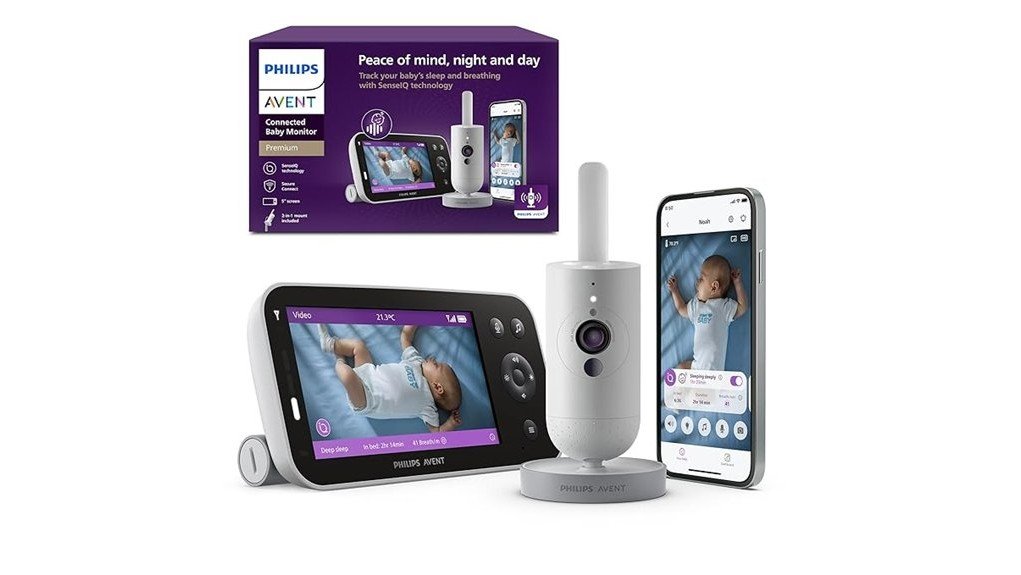
The Philips Avent Premium Connected Baby Monitor combines a 1080p camera, 5-inch HD parent screen, and SenseIQ sleep and breathing tracking in one system. Model SCD973/37 also offers two-way communication, night vision, cry interpretation, and smartphone monitoring through the Philips Avent Baby Monitor+ app.
Its biggest advantage is the combination of a dedicated screen that works without Wi-Fi and wearable-free sleep tracking. However, its advanced features require careful camera placement, Cry Translation has an optional paid subscription after the trial, and the breathing information is not medical monitoring.
QUICK VERDICT
Philips Avent Premium Connected Baby Monitor
Editorial Rating: 8.5/10 (Features-based assessment; not hands-on tested)
Best for: Parents who want a dedicated video monitor, remote app access, and wearable-free sleep insights.
Skip if: You need medical breathing alerts, a basic low-cost monitor, or a system with no optional subscriptions.
Bottom line: A feature-rich monitoring system with useful flexibility, provided you understand what its sleep and breathing information can and cannot tell you.
Check the model, seller, delivery options, and return policy before purchasing.
Before You Buy: Four Things to Know
- Breathing tracking is not a medical alarm. SenseIQ does not diagnose or reliably identify every breathing problem and cannot prevent SIDS.
- Some features need the app. SenseIQ must first be activated through Baby Monitor+, even if you plan to monitor without Wi-Fi afterward.
- Cry Translation has a trial limit. The included three-month period is followed by an optional paid subscription for continued use.
- Mounting affects tracking. The included camera mount and a clear view of your baby’s movements help SenseIQ work as intended.
Review Contents
- Specifications and What’s Included
- Key Takeaways
- Who Should Buy This Monitor?
- Pros and Cons
- SenseIQ Sleep Tracking
- Video and Connectivity
- Communication Features
- Privacy and Security
- Best Uses
- Setup Guide
- Safety Tips
- Owner Feedback
- Alternatives
- Is It Worth the Price?
- Frequently Asked Questions
- Final Verdict
Philips Avent Premium Connected Baby Monitor Specifications
The Philips Avent SCD973/37 is designed for both direct parent-unit monitoring and connected smartphone use. Its specifications explain why it offers more functionality than a basic audio or video monitor.
| Feature | Specification |
|---|---|
| Model | SCD973/37 |
| Camera | Full HD 1080p |
| Parent screen | 5-inch color LCD, 1280 × 720 |
| Direct connection range | Up to 400 m (about 1,312 ft) outdoors; up to 50 m (about 164 ft) indoors |
| Connectivity | Direct peer-to-peer link and Wi-Fi |
| Parent unit battery | Up to 12 hours in Eco mode after a full charge |
| Camera power | Mains power required |
| Tracking | Wearable-free sleep and breathing-rate analysis |
| Camera features | Night vision, digital zoom and pan, sound and motion alerts |
| Comfort features | Nightlight, room thermometer, lullabies, soothing sounds, white noise, two-way talk |
| Mounting | Included 2-in-1 crib and wall mount |
What’s in the Box?
The Amazon listing describes the following included equipment:
- One baby camera unit.
- One dedicated parent screen.
- Two power supplies.
- One 2-in-1 wall and crib mounting system.
- Access to the Philips Avent Baby Monitor+ app, available as a separate download in supported markets.
The camera must remain connected to power. The portable parent screen has a rechargeable battery, making it easier to move between rooms.
Key Takeaways
- The 1080p camera and 5-inch HD screen provide a flexible way to check your baby’s room without relying exclusively on your phone.
- SenseIQ analyzes video to estimate breathing rate and sleep status without requiring a wearable accessory.
- The parent unit works without Wi-Fi, while remote smartphone access needs an internet connection.
- Cry Translation attempts to identify five types of crying but requires Wi-Fi and may involve a subscription after the trial.
- Security features include encrypted connections and privacy controls, but software updates and account security remain important.
- The monitor is a consumer monitoring aid, not a medical device or substitute for direct supervision.
Who Should Choose the Philips Avent Baby Monitor?
The Philips Avent Premium Connected Baby Monitor is best suited to families who want both traditional video monitoring and app-based sleep insights. It brings those functions together without requiring a separate wearable sensor.
The dedicated screen is particularly useful when you want to keep your phone available for other tasks. The Baby Monitor+ app adds another monitoring option when you are away from home and a responsible caregiver is with your baby.
Best for These Parents
- Parents who want a dedicated monitor screen rather than relying on a smartphone all night.
- Families interested in learning about sleep patterns and estimated breathing rates.
- Caregivers who want remote access through an app while someone remains with the baby.
- Households that prefer a direct monitor connection when home Wi-Fi is unavailable.
Who Should Consider Another Monitor?
- Families who only need basic audio monitoring.
- Parents who want a portable, battery-powered camera unit.
- Buyers who require a medical-grade device for a diagnosed health concern.
- Families who prefer not to deal with advanced settings, mounting requirements, or optional subscriptions.
Philips Avent Premium Connected Baby Monitor Pros and Cons
Pros
- Clear 1080p camera with night vision.
- Dedicated parent screen works without Wi-Fi.
- Wearable-free SenseIQ sleep insights.
- Remote viewing through the Baby Monitor+ app.
- Two-way talk, nightlight, and soothing sounds.
- Included crib and wall mounting system.
Cons
- Not a medical breathing or apnea alarm.
- Cry Translation may require a paid subscription after the trial.
- SenseIQ accuracy depends on camera positioning and visibility.
- Camera requires a continuous power connection.
- Wireless range is lower indoors than the advertised outdoor maximum.
- Dedicated parent unit is not a touchscreen.
SenseIQ: How Does Philips Avent Sleep and Breathing Tracking Work?
SenseIQ is the main feature that separates this monitor from many standard video models. Instead of using a sock or chest sensor, it analyzes the movement visible through the camera.
Philips says the system examines small chest movements and combines them with body-motion information to estimate breathing rate and sleep status. These readings are intended to help parents recognize patterns rather than diagnose medical problems.
Sleep Status and Breathing-Rate Insights
SenseIQ can display real-time sleep information on the parent screen and in the Baby Monitor+ app after activation. The system also produces an automated sleep diary, with historical sleep information presented as charts.
These features may help you review when your baby sleeps, wakes, or becomes active. However, video-based analysis depends on a clear view and suitable conditions.
Does SenseIQ Require a Wearable?
No. The Philips Avent SCD973/37 does not require a wearable sensor for its SenseIQ tracking functions.
This avoids the extra routine of putting on and adjusting a dedicated monitoring accessory. However, the camera still needs a suitable view of your baby’s movements to produce useful readings.
Camera Positioning Matters
Philips recommends using the included mounting system. For a wall installation with the 2-in-1 mount, Philips specifies a recommended mounting height of approximately 1.1 meters (43 inches) from the floor.
The company also recommends placing the camera centrally along the long side of the crib or bed when practical. Follow the exact model instructions, especially when securing the mounting system and keeping all cables inaccessible to your baby.
What SenseIQ Cannot Do
SenseIQ is not designed to detect every breathing interruption or medical emergency. Philips explicitly states that the monitor is not a medical device and cannot be used to diagnose or treat breathing disorders or other health conditions.
Its readings should never replace direct supervision, recommended safe-sleep practices, or medical advice.
Important Safety Warning: This monitor cannot prevent sudden infant death syndrome (SIDS). If your baby has a medical condition that requires breathing or cardiorespiratory monitoring, speak with your child’s healthcare professional about an appropriate medical device.
Cry Detection and Translation
The monitor also includes cry detection and an interpretation feature powered by Zoundream. It attempts to classify cries into five categories:
- Hunger.
- Sleepiness.
- Discomfort.
- Need to burp.
- Irritation.
These labels are estimates, not reliable diagnoses of why a baby is crying. Philips says Cry Translation is designed for infants up to 12 months, with the feature best optimized for babies from birth through six months.
Cry Translation requires Wi-Fi and includes an initial three-month usage period. Continued use afterward may require a paid subscription through the app.
Video Quality, Night Vision, Range, and Wi-Fi
The Philips Avent Premium Connected Baby Monitor has a 1080p camera and a 5-inch color parent display with 1280 × 720 resolution. These specifications provide a strong foundation for checking a crib or nursery during the day and at night.
Actual image quality still depends on the camera angle, lighting, distance, and connection conditions.
Night Vision and Digital Zoom
Automatic night vision allows the camera to show your baby’s room when normal room lighting is low or turned off. Digital zoom and pan let you examine part of the image more closely.
Remember that digital zoom enlarges the existing image rather than adding detail beyond the camera’s resolution.
How Far Does the Monitor Reach?
Philips specifies a direct connection range of up to 400 meters outdoors and 50 meters indoors.
The outdoor figure is roughly 1,300 feet, but it should not be treated as a guaranteed range inside a house. Walls, floors, building materials, and wireless interference can reduce the distance.
Will It Work Without Wi-Fi?
Yes. The dedicated parent unit can communicate directly with the baby camera without an internet connection.
The distinction is important:
- Direct parent-unit monitoring: Does not require Wi-Fi.
- Remote smartphone monitoring: Requires an internet connection.
- SenseIQ: Requires initial activation through the app, then can operate without Wi-Fi.
- Cry Translation: Requires Wi-Fi.
This hybrid connection system is helpful if you want local monitoring even when your home internet is unavailable.
Communication Features: Talkback, Lullabies, and Nightlight
The Philips Avent monitor includes more than a camera and microphone. It also provides tools for talking to your baby and controlling parts of the nursery environment.
True Talkback
The True Talkback function allows two-way communication, including speaking and listening at the same time. This can be useful when your baby or older child needs to hear your voice while you are elsewhere in the home.
It is a convenience feature rather than a replacement for checking on a child who may need immediate care.
Lullabies and White Noise
Philips lists five lullabies, five soothing sounds, and five white-noise options for the SCD973/37. Timers allow you to control how long supported sounds play.
The app also supports personal voice recordings. These can be useful for a consistent bedtime routine, although every baby responds differently to sounds.
Room Temperature and Nightlight
A built-in thermometer displays room temperature, with adjustable temperature alerts. The nightlight provides additional lighting that you can control through the monitoring system.
These features are useful for checking the room environment without adding another device. The temperature reading is still a room measurement, not your baby’s body temperature.
How Secure Connect Protects Your Data
Philips uses its Secure Connect System to manage communication between the camera, parent screen, and smartphone app. It supports a direct peer-to-peer connection as well as local Wi-Fi and internet-based access.
According to Philips, the system uses multiple encrypted connections to protect transmitted information. The company also states that transmitted audio and video are not stored on its servers, while saved recordings and snapshots are stored on the user’s mobile device.
| Privacy Feature | What It Means |
|---|---|
| Encrypted connections | Helps protect data during transmission between devices and services. |
| Direct peer-to-peer link | Allows parent-unit monitoring without requiring an internet connection. |
| Privacy mode | Supports a connection limited to the parent unit and baby unit. |
| Software updates | Help address supported security and functionality improvements. |
| Account and device controls | Allow users to manage connected access and remove connections when needed. |
Philips does not establish that the product is immune to unauthorized access. Use a strong, unique password for the app account, protect your home Wi-Fi, and keep both the app and monitor firmware updated.
Best Uses for the Philips Avent Premium Connected Monitor
Monitoring a Sleeping Baby at Home
The dedicated parent screen is convenient for checking your baby while preparing meals, working in another room, or moving around the house. It keeps monitoring separate from your phone and can continue operating without Wi-Fi.
Understanding Sleep Routines
Parents who like reviewing sleep information may find the automated sleep diary useful. It can help reveal patterns of sleep and waking over time, although the estimates should be understood as general insights rather than medical findings.
Checking in While Away
The Baby Monitor+ app allows remote viewing when the required internet connection is available. This can be helpful when another trusted adult is caring for your baby and you want to check in.
Remote monitoring must not replace having a responsible caregiver physically present with your child.
How to Set Up the Philips Avent Premium Connected Baby Monitor
Initial setup involves safely positioning the baby camera, connecting power, checking the dedicated parent screen, and optionally installing the smartphone app. The most important step is securing the camera and its electrical cord properly.
- Unpack and inspect the equipment. Check that the camera, parent unit, adapters, and mounting parts are present and undamaged.
- Choose a suitable mounting position. Use the included 2-in-1 mount and follow the model’s instructions for your crib or wall type.
- Secure the camera and cord. Keep cables completely out of your baby’s reach, using the supplied mounting and cord-management instructions.
- Connect the baby camera to power. Use the approved power adapter and ensure the camera is operating normally.
- Charge and turn on the parent unit. Check that the parent unit connects to the camera and displays live video.
- Install Philips Avent Baby Monitor+ if desired. Download the official app, create or sign in to the required account, and follow its on-screen pairing process.
- Activate SenseIQ in the app. Follow the setup guidance and confirm that the camera has a suitable view for motion analysis.
- Test the monitor. Check video, sound, alerts, night vision, and the direct connection from the places where you plan to use it.
If the picture looks poor, check the camera position, lighting, and signal strength. If SenseIQ cannot detect suitable movements, review its mounting requirements and the baby’s visibility in the camera frame.
Essential Safety Tips for Using Your Baby Monitor
Baby monitors support supervision, but safe installation and proper infant sleep practices matter more than any monitoring feature. Pay particular attention to cables, camera attachments, and the limitations of automated alerts.
- Prevent cord hazards: Follow Philips mounting instructions and keep every cord inaccessible. The CPSC generally advises keeping loose baby monitor cords and parts at least three feet from the crib.
- Use approved power accessories: Do not substitute damaged adapters or attempt unsafe battery repairs.
- Check the mount regularly: Make sure mounting hardware is secure and cannot be reached or loosened by your child.
- Maintain safe sleep practices: Use an appropriate firm, flat sleep surface and keep the sleep area free of loose bedding and soft objects.
- Keep software updated: Install supported monitor firmware and app updates to maintain security and functionality.
- Respond to your baby’s needs directly: Do not assume a normal SenseIQ reading guarantees that everything is medically normal.
Philips offers a 2-in-1 crib and wall mount designed for this model. Follow its specific installation guidance rather than improvising a camera position or leaving cables exposed.
What Owners Report About the Philips Avent Monitor
Manufacturer-hosted owner feedback highlights several practical strengths, especially video clarity, direct connection, and easy access to monitoring features. However, many of the available reviews were provided through product testing promotions, so they should not be treated as independent laboratory results.
What Owners Appreciate
- Clear video and useful night vision.
- The convenience of a separate parent display.
- The ability to monitor without home Wi-Fi.
- Wearable-free sleep information.
- Two-way audio and soothing sound features.
Owner Watch-Outs
- Wall installation may require drilling.
- Some owners dislike paying extra for Cry Translation.
- Camera placement limits portability when accurate sleep tracking is a priority.
- Some users would prefer a touchscreen or more detailed controls.
These observations describe reported experiences, not guaranteed performance. Your home layout, setup method, and use of app features can make a noticeable difference.
Philips Avent Premium Connected vs. Other Baby Monitors
The Philips Avent Premium Connected Baby Monitor occupies an interesting position between a standard dedicated-screen monitor and a smart sleep-tracking camera. Other models may be more suitable depending on which features you prioritize.
| Monitor | Video / Display | Key Difference | Best For |
|---|---|---|---|
| Philips Avent Premium Connected SCD973/37 | 1080p camera, 5-inch HD screen | Wearable-free SenseIQ and direct/app connections | Hybrid smart monitoring |
| Nanit Pro | 1080p camera, smartphone app | Breathing motion tracking uses patterned Breathing Wear | App-focused sleep monitoring |
| Infant Optics DXR-8 PRO | 720p video, 5-inch screen | Non-Wi-Fi closed-loop monitoring | Simple dedicated-screen use |
| VTech RM7766HD | 1080p camera, 7-inch 720p screen | Remote access and motorized pan/tilt | Larger display and camera movement |
Philips Avent vs. Nanit Pro
Nanit Pro is built around app-based monitoring and video analysis. It uses a 1080p camera and patterned Breathing Wear to monitor breathing movement without an electronic sensor worn on the baby.
The Philips Avent differs by providing a dedicated parent screen and SenseIQ tracking that does not require special clothing or a breathing band. Nanit may be more appealing if you prefer a smartphone-centered monitoring setup.
Philips Avent vs. Infant Optics DXR-8 PRO
The Infant Optics DXR-8 PRO focuses on dedicated-screen monitoring without Wi-Fi. Its 5-inch screen, 720p video, and noise-reduction features suit buyers who want straightforward local monitoring.
Philips offers more app and sleep-analysis features, while Infant Optics is the simpler option if you do not need remote smartphone viewing or sleep tracking.
Philips Avent vs. VTech RM7766HD
The VTech RM7766HD offers a larger 7-inch parent display, a 1080p camera, and motorized pan-and-tilt functionality. Its smart connection supports remote access through a mobile app.
Philips is the stronger fit for buyers specifically interested in wearable-free SenseIQ sleep information. VTech is worth comparing if the larger screen and movable camera are higher priorities.
Is the Philips Avent Premium Connected Baby Monitor Worth the Price?
The Philips Avent Premium Connected Baby Monitor is worth considering if you will regularly use its combination of direct video monitoring, remote app access, and wearable-free sleep insights.
Its value is less compelling if you mainly need to hear when your baby wakes up. In that case, a simpler monitor can meet your basic needs without the added setup or advanced monitoring functions.
There are also potential ongoing costs. SenseIQ sleep tracking does not require a paid subscription, but Cry Translation may require one after its included trial period. Review the subscription terms before treating that feature as part of the long-term value.
How We Evaluated This Baby Monitor
This review is based on published product specifications, Philips support information, Amazon listing details, and publicly available owner feedback. It is an editorial assessment, not a report of independent hands-on testing.
We considered camera and screen specifications, connectivity, monitoring features, setup needs, safety limitations, ongoing costs, and competing products.
The editorial score reflects those documented capabilities and trade-offs. We did not independently measure video performance, wireless range, battery endurance, sleep-tracking accuracy, or the accuracy of Cry Translation.
Frequently Asked Questions
What Is the Battery Life of the Philips Avent Baby Monitor?
The Philips Avent SCD973/37 parent unit is rated for up to 12 hours on a full charge in Eco mode. Actual runtime can be shorter depending on screen use and settings. The baby camera requires mains power, so it cannot operate independently from an electrical outlet.
Can I Use the Monitor Without Wi-Fi?
Yes. The dedicated parent screen connects directly to the baby camera without needing Wi-Fi. Remote viewing from your smartphone needs an internet connection. SenseIQ can continue without Wi-Fi after activation, but Cry Translation requires Wi-Fi. This makes the parent screen useful during internet outages.
How Do I Set Up the Monitor Initially?
Start by installing the camera using the supplied mounting system and safely securing its power cord. Connect the camera to power, charge the parent unit, and confirm the video connection. Then install Philips Avent Baby Monitor+ if you want smartphone monitoring or SenseIQ activation.
Is the Monitor Compatible With Smart Home Devices?
The confirmed connected features operate through the Philips Avent Baby Monitor+ app and the included parent screen. General compatibility with smart speakers or home automation platforms has not been established for this model. Do not assume Alexa, Google Home, or other integrations are supported without explicit manufacturer confirmation.
What Is the Warranty Period for This Baby Monitor?
Warranty coverage should be confirmed for the specific Philips Avent SCD973/37 purchase and seller. Philips provides warranty and service support, but the exact coverage should be checked against the applicable regional policy and proof of purchase. The original one-year claim could not be confirmed for every purchase.
Does SenseIQ Require a Paid Subscription?
No. Philips states that SenseIQ sleep tracking, breathing-rate information, and motion analysis do not require a paid subscription. You must activate SenseIQ through the Baby Monitor+ app first. That is separate from the optional Cry Translation service, which has its own trial and subscription terms.
Is Cry Translation Free Forever?
No. Philips includes a three-month usage period for Cry Translation after activation. Continued use may require a monthly subscription through the Baby Monitor+ app, with the service provided by Zoundream. Cry interpretation is an estimate and should not replace checking your baby’s actual needs or condition.
Can SenseIQ Detect Sleep Apnea or Prevent SIDS?
No. Philips states that this monitor is not a medical device and is not intended to detect breathing disorders or every breathing interruption. It cannot prevent SIDS or replace medical monitoring. Always follow recommended infant safe-sleep guidance, and consult a healthcare professional if you have concerns about your baby’s breathing.
Final Verdict: Should You Buy the Philips Avent Premium Connected Baby Monitor?
The Philips Avent Premium Connected Baby Monitor stands out for combining high-definition video, a dedicated parent screen, app access, and wearable-free sleep tracking. Its direct connection works without Wi-Fi, and its soothing features add everyday convenience.
Its limits deserve equal attention. SenseIQ is not a medical breathing alarm, mounting affects tracking quality, and Cry Translation can involve an ongoing cost.
Our verdict: It is a strong option for parents who value detailed sleep insights and flexible video monitoring. If you only want basic audio and video, a simpler monitor may offer better value.
Philips Avent Premium Connected Baby Monitor
1080p camera, 5-inch HD display, SenseIQ tracking, and remote monitoring in one system.
Editorial Rating: 8.5/10
Confirm model SCD973/37 and review all seller terms before purchasing.