Disclosure: As an Amazon Associate, we earn from qualifying purchases. If you buy through links on this page, we may earn a small commission at no extra cost to you.
By Editorial Team | Updated October 8, 2026
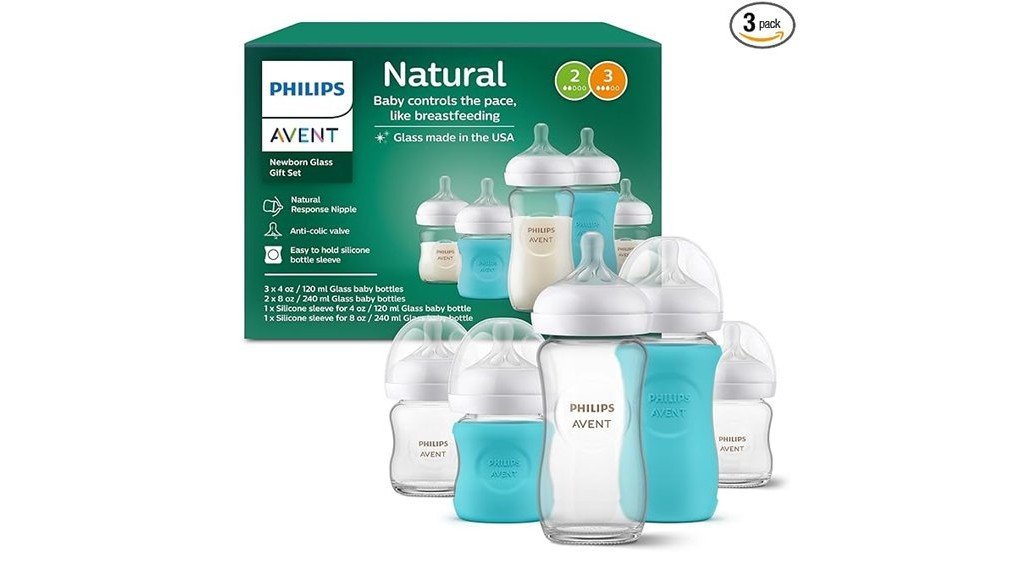
The Philips Avent Glass Bottle gift set combines five borosilicate glass baby bottles with Natural Response nipples that release milk when your baby actively drinks. The SCD858/01 set includes three 4 oz bottles, two 8 oz bottles, and two protective silicone sleeves.
Its main strengths are simple cleaning, flexible bottle sizes, and a feeding design that supports a baby’s natural drinking rhythm. However, glass requires careful handling, and the Natural Response nipple may take some babies time to adjust to. Here is what you should know before buying.
Quick Verdict: Philips Avent Natural Response Glass Gift Set
Editorial Rating: 8/10
Specification-based editorial assessment. We have not performed hands-on laboratory testing.
4 oz + 8 oz
Flow 2 + Flow 3
Borosilicate glass
BPA-free
2 silicone sleeves
Best for: Parents who prefer glass bottles and want multiple capacities for breast milk or formula feeding.
Skip if: You need lightweight, shatter-resistant bottles or a nipple that releases milk without active sucking.
Bottom line: This is a well-equipped glass bottle starter set. Its strongest feature is the combination of several bottle sizes and responsive nipple flow, but finding the correct nipple speed matters more than the baby’s age.
Before You Buy
- Only two sleeves are included. You receive one sleeve for each bottle size, not a sleeve for all five bottles.
- Glass can break. Borosilicate glass resists heat changes, but it is not shatterproof.
- Nipple flow is individual. Some newborns may need a different flow than the supplied Flow 2 nipple.
- Check the exact model. Philips Avent sells different glass bottle sets with different included accessories.
Review Contents
Key Takeaways
- The Philips Avent SCD858/01 set includes five borosilicate glass bottles and two removable silicone sleeves.
- Natural Response nipples release milk through active sucking rather than a continuous free-flow opening.
- Three smaller bottles use Flow 2 nipples, while two larger bottles use Flow 3 nipples.
- The integrated anti-colic valve is designed to help reduce air intake during feeding.
- The wide-neck design and dishwasher-safe construction simplify everyday cleaning.
- Glass resists staining and odors but requires more care during handling and storage.
Why Choose the Philips Avent Glass Natural Bottle?
The Philips Avent Glass Natural Bottle is a good option if you want the benefits of a glass feeding surface without a complicated bottle design. Its wide neck, soft silicone nipple, and straightforward assembly support everyday use.
The main attraction is the Natural Response feeding system. Philips designed the nipple to allow babies to control when milk flows, making it useful for families combining breastfeeding and bottle feeding.
The gift set also provides practical flexibility. You get smaller bottles for shorter feeds and larger bottles for bigger servings without immediately purchasing another set.
Unlike some anti-colic bottles with separate internal vent tubes, this bottle uses an integrated nipple valve. That reduces the number of small components you need to handle during cleaning.
However, no nipple design guarantees that every baby will accept the bottle. Individual latch preferences, sucking strength, and flow needs still matter.
Philips Avent Glass Bottle Design and Safety
The bottle uses premium borosilicate glass, a material chosen for its resistance to heat and sudden temperature changes. Philips states that the glass bottles are suitable for refrigeration, warming, and sterilization.
Unlike many plastic bottles, glass does not easily retain odors or discolor from normal milk use. Its smooth surface also makes it easier to see residue that needs washing.
Is Borosilicate Glass Safe for Baby Bottles?
Borosilicate glass is designed to withstand routine temperature changes better than ordinary glass. It is also naturally free of BPA, a chemical associated with certain plastics.
However, heat resistance does not mean the bottle is unbreakable. Dropping it onto a hard floor or striking it against a countertop can still cause damage.
Inspect the bottle before each use. Do not use it if you notice chips, cracks, or other signs of damage.
What Do the Silicone Sleeves Actually Do?
The included silicone sleeves improve grip and provide an extra protective layer around the glass. One fits the 4 oz bottles, and the other fits the 8 oz bottles.
Each sleeve has an opening that helps you read the bottle’s measurement markings. This is useful when checking how much milk remains during a feed.
Still, a sleeve does not make a glass bottle shatterproof. It may reduce slipping, but careful handling remains necessary.
Safety note: Always hold your baby during bottle feeding. Never prop up a bottle or leave it in your baby’s mouth unattended. Discard any glass bottle with visible cracks or chips.
How the Natural Response Nipple Works
The Philips Avent Natural Response nipple uses a special opening that releases milk when a baby actively sucks. When the baby stops to swallow or breathe, the flow pauses.
This differs from nipples that allow milk to drip more freely when the bottle is tilted. The goal is to support a drinking pattern closer to breastfeeding.
How Does the Nipple Control Milk Flow?
The soft silicone nipple combines a breast-shaped design with an opening that responds to sucking pressure.
Philips describes the system as helping babies control their individual drinking rhythm. This is a product design claim, not a guarantee that every baby will feed more comfortably.
Some babies adjust quickly, while others need a different nipple flow or time to learn the sucking pattern.
Does the Anti-Colic Valve Really Help?
The integrated anti-colic valve is designed to direct air away from the baby’s stomach during feeding.
Reducing swallowed air may help with feeding discomfort, but the bottle cannot guarantee relief from colic, gas, or reflux.
If your baby repeatedly struggles during feeds, has poor weight gain, or shows persistent discomfort, speak with a pediatric healthcare professional.
How Do You Know Which Flow Is Correct?
Start with the nipple supplied with the bottle and watch how your baby drinks.
- Flow may be too slow: Your baby becomes frustrated, falls asleep before finishing, or works hard without getting enough milk.
- Flow may be too fast: Your baby gulps, coughs, or lets milk spill from the mouth.
- Flow may be appropriate: Your baby drinks comfortably, takes natural pauses, and receives enough milk.
Philips recommends choosing flow according to feeding behavior rather than relying only on age. Replacement Natural Response nipples are available in different flow levels.
Philips Avent Bottle Sizes, Flows, and Set Contents
The SCD858/01 gift set contains five bottles in two capacities. The smaller bottles come with slower Flow 2 nipples, while the larger bottles include Flow 3 nipples.
| Specification | Details |
|---|---|
| Brand | Philips Avent |
| Model | SCD858/01 |
| Amazon ASIN | B098Z6HYGV |
| Bottle count | 5 |
| Small bottles | 3 × 4 oz / 120 mL |
| Large bottles | 2 × 8 oz / 240 mL |
| Included nipples | 3 Flow 2 and 2 Flow 3 |
| Bottle material | Borosilicate glass |
| Nipple material | Soft silicone |
| Silicone sleeves | 2, one per bottle size |
| BPA-free | Yes |
| Dishwasher-safe | Yes, according to Philips |
What Is Included in the Box?
- Three 4 oz glass bottles with Flow 2 nipples.
- Two 8 oz glass bottles with Flow 3 nipples.
- One protective sleeve for a 4 oz bottle.
- One protective sleeve for an 8 oz bottle.
That gives you five ready-to-assemble bottle combinations. The sleeves can be transferred between bottles of the corresponding size.
The smaller capacity is useful when you want to prepare a modest serving. The larger capacity provides more room as feeding volumes increase.
Do not assume the larger bottle automatically needs a faster nipple. Choose the nipple based on how your baby feeds, regardless of bottle size.
How to Use, Clean, and Sterilize the Bottles
Philips Avent glass bottles have a wide opening and relatively few parts, making them straightforward to prepare and clean.
Good cleaning habits are especially important for newborns and babies with increased infection risk.
How to Prepare the Bottle for Feeding
- Wash your hands. Use clean hands and a clean preparation surface.
- Inspect the components. Check the bottle for damage and the nipple for tears or weakness.
- Assemble the nipple. Pull it fully into the screw ring so its base sits correctly.
- Prepare the milk. Use breast milk or correctly prepared infant formula.
- Attach the bottle top. Screw it on securely without forcing the threads.
- Check the temperature. If the milk has been warmed, confirm it is not too hot.
- Feed responsively. Hold your baby, allow pauses, and stop when your baby shows signs of fullness.
How to Clean the Bottles After Feeding
- Disassemble the bottle, nipple, ring, and cap.
- Rinse the parts under running water.
- Wash with warm soapy water and a clean bottle brush, or use a dishwasher when permitted by the manufacturer.
- Clean the nipple opening and valve area thoroughly.
- Rinse away soap if washing by hand.
- Allow the parts to air-dry completely in a clean area.
- Store the dry components in a clean, protected location.
The CDC recommends using a separate clean basin for handwashing infant feeding items rather than placing them directly in the kitchen sink.
Can You Sterilize Philips Avent Glass Bottles?
Yes. Philips states that the glass bottles are suitable for sterilization. Use the method allowed by the current product instructions.
The CDC recommends sanitizing feeding items at least daily when a baby is younger than two months, was born prematurely, or has a weakened immune system.
For older, healthy babies, careful cleaning after each use may be sufficient without daily sanitizing.
If you use a dishwasher with hot water and a heated drying cycle or sanitizing setting, the CDC says a separate sanitizing step is generally unnecessary.
Can You Warm Milk in These Glass Bottles?
The bottles can be warmed using a compatible bottle warmer or warm water, according to the product’s heat-resistance guidance.
Do not microwave breast milk or prepared formula. Microwaving can create unevenly heated areas that may burn your baby’s mouth.
Always check the milk temperature before feeding, and keep water from entering the bottle during warming.
Who Should Buy the Philips Avent Glass Bottle Set?
This gift set makes the most sense for families who want reusable glass bottles and enough capacity options to support changing feeding routines.
Good Choice If You:
- Prefer glass over plastic bottle bodies.
- Want several bottles for a newborn feeding routine.
- Combine breastfeeding with bottle feeding.
- Prefer fewer removable valve components.
- Want both 4 oz and 8 oz capacities.
Consider Another Bottle If You:
- Need a bottle that will not shatter when dropped.
- Prefer a lighter bottle for travel.
- Need a specialized internal anti-colic vent system.
- Want protective sleeves for every bottle.
- Already know your baby dislikes responsive-flow nipples.
Philips Avent Glass Bottle Pros and Cons
The SCD858/01 offers useful flexibility and a straightforward design. Its main compromises are typical of glass bottles, along with the adjustment some babies need for responsive-flow nipples.
Pros
- Borosilicate glass resists stains and odors.
- Natural Response nipples support baby-controlled milk flow.
- Five bottles cover two feeding capacities.
- Wide neck and few parts simplify cleaning.
- Two silicone sleeves improve grip.
- Dishwasher-safe bottle design.
Cons
- Glass can crack or break if dropped.
- Some babies may struggle with the initial nipple flow.
- Only two sleeves are supplied for five bottles.
- Glass may feel heavier than plastic alternatives.
- Not every warmer or pump is compatible without checking.
For many parents, the decision depends on whether easier glass cleaning and responsive milk flow outweigh the risk of breakage and the need to monitor nipple performance.
Best Uses for the Philips Avent Glass Bottle Set
The combination of bottle sizes and nipple flows makes this set flexible for several feeding situations. The best setup depends on how your baby drinks rather than the number printed on the nipple.
Combination Breastfeeding and Bottle Feeding
The Natural Response nipple is intended to make switching between breastfeeding and bottle feeding feel more familiar.
Because the baby must actively draw milk, the design may suit families who want to support a pause-and-drink rhythm.
However, successful combination feeding depends on individual latch and feeding behavior. The bottle cannot guarantee a smooth transition.
Newborn Feeding Routines
The three 4 oz bottles are convenient when smaller servings are appropriate.
The included Flow 2 nipples may work well for some newborns, while others need a slower or faster flow. Watch feeding behavior instead of assuming the included nipple will suit every baby.
Growing Feeding Needs
The two 8 oz bottles provide extra capacity for larger feeds.
They come with Flow 3 nipples, but bottle capacity and nipple speed are separate choices. You can use a compatible nipple that better matches your baby’s drinking behavior.
Home Feeding and Routine Cleaning
Glass bottles are especially practical in households where odor resistance and repeated cleaning are priorities.
Their smooth surfaces, wide openings, and removable parts make it easier to inspect the bottle after washing.
What Owners Report About Philips Avent Glass Bottles
Published owner feedback offers useful observations about daily handling, but it is not a substitute for controlled product testing. Experiences vary between babies and households.
Some reviews on Philips and retailer pages also come from promotional testing programs, so those experiences should be read with that context in mind.
What Parents Commonly Like
- Easy cleaning: Several reviewers describe the glass surfaces as straightforward to wash and less likely to retain milk odors.
- Helpful sleeve grip: Parents report that the silicone sleeves make the bottles easier to hold during feeds.
- Convenient capacities: Owners appreciate having smaller and larger bottles in one set.
- Breast-to-bottle transitions: Some reviewers say their babies accepted the Natural Response nipple without major difficulty.
What Parents Say to Watch For
- Slow milk flow: One reviewer described a baby struggling to get milk through the supplied nipple during a prolonged feed.
- Measurement visibility: Some parents find the sleeve partially blocks their view of the milk level despite its cutout.
- Individual nipple preference: A flow level that works for one baby may not work for another.
- Glass handling: Parents need to be more careful about hard drops than with typical plastic bottles.
These reports support the main trade-off: the bottle is easy to maintain, but feeding performance depends heavily on nipple choice and your baby’s sucking pattern.
Philips Avent Glass Bottle vs. Alternatives
The Philips Avent set is not the only option for parents who prefer glass or glass-contact feeding surfaces. Other bottles emphasize stronger vent systems, a different nipple shape, or a hybrid construction.
| Bottle | Material / Capacity | Main Difference | Best Consideration |
|---|---|---|---|
| Philips Avent Natural Response | Glass; 4 oz and 8 oz | Milk releases through active sucking | Combination feeding |
| Dr. Brown’s Options+ Wide-Neck Glass | Glass; 5 oz model | Separate internal vent system | Parents prioritizing vent-system design |
| Evenflo Balance+ Wide-Neck Glass | Glass; 6 oz | Naturally sloped, slow-flow nipple | A different latch and nipple shape |
| Chicco Duo Hybrid | Glass inner layer, plastic outer body; 5 oz or 9 oz | Hybrid construction | Parents wanting a lighter, shatter-resistant design |
Dr. Brown’s Options+ Wide-Neck Glass
Dr. Brown’s uses an internal anti-colic vent system rather than relying only on a nipple valve. Its 5 oz wide-neck glass model includes a Level 1 slow-flow nipple.
This design may appeal to parents who prioritize a dedicated vent system. However, the internal vent creates extra components to clean.
Evenflo Balance+ Wide-Neck Glass
The Evenflo Balance+ glass bottle uses a naturally sloped silicone nipple and is available in a 6 oz capacity.
It is worth considering if your baby does not prefer the Philips Avent nipple shape. Nipple acceptance is individual, so neither design is automatically better.
Chicco Duo Hybrid Bottle
Chicco Duo uses a glass inner surface bonded to a plastic outer shell. The design aims to combine glass-contact feeding with a lighter, shatter-resistant bottle body.
It may suit families who want some benefits associated with glass but are concerned about dropping a fully glass bottle.
These alternatives use different nipple systems and construction methods. Comparing the exact model matters more than choosing based on brand reputation alone.
Is the Philips Avent Glass Bottle Worth the Price?
The Philips Avent Natural Response Glass Gift Set is worth considering if you plan to use glass bottles regularly and need several feeding capacities.
You get five bottles, five nipples, and two sleeves in one package. That makes it more practical as a starter collection than purchasing one bottle at a time, provided the set meets your baby’s feeding needs.
Its long-term value depends on three factors:
- Nipple acceptance: You may need to buy another flow level if the included nipples do not suit your baby.
- Durability: Glass resists odors and staining, but a damaged bottle must be replaced.
- Daily convenience: The simple design saves effort compared with bottles that have several separate vent components.
For parents who value a glass feeding surface, the design and range of included capacities are meaningful benefits.
If your main priority is low weight or resistance to impact, a different bottle material may provide better practical value.
How We Evaluated This Philips Avent Glass Bottle
This review is based on the published product specifications, manufacturer feeding guidance, product documentation, and available retailer feedback. It is not presented as a hands-on test.
We checked the exact SCD858/01 configuration against the official Philips Avent product information and the corresponding Amazon listing.
We also used Philips nipple-flow instructions to assess feeding guidance.
Cleaning and safety advice was checked against CDC cleaning recommendations and CDC bottle-feeding guidance.
The editorial rating reflects the set’s documented features, practical trade-offs, and available feedback. It does not represent a laboratory performance score or a claim that every baby will respond the same way.
Frequently Asked Questions
Can Philips Avent Glass Bottles Be Used With Breast Pumps?
Yes, these bottles can work with compatible Philips Avent breast pump components. Compatibility with other pump brands depends on bottle threading and the adapter system. Do not assume every wide-neck pump will connect securely. Confirm the exact pump model and adapter before pumping directly into a glass bottle.
Do the Silicone Sleeves Come in Different Colors?
The reviewed SCD858/01 set includes two silicone sleeves, one for each bottle size. Philips does not confirm multiple color choices in the product specifications used for this review. Sleeve colors and separately sold accessories may differ between retail listings. Check the exact package contents before purchasing.
Are Replacement Philips Avent Natural Response Nipples Sold Separately?
Yes. Philips Avent sells Natural Response replacement nipples in different flow levels. Choose a flow based on how your baby drinks, not only their age. Philips recommends replacing feeding nipples every three months for hygiene and immediately if you notice damage, weakness, or unusual wear.
Will Philips Avent Glass Bottles Fit Standard Bottle Warmers?
They may fit many bottle warmers, but compatibility is not universal. The warmer must accommodate the bottle’s dimensions and should be approved for use with glass. Check the warmer manufacturer’s instructions before use. Never assume a warming program designed for a plastic bottle will work identically with glass.
Is the Philips Avent Glass Gift Set Suitable for Newborns?
Yes. The SCD858/01 is marketed as a newborn glass bottle gift set and includes smaller 4 oz bottles with Flow 2 nipples. However, nipple choice depends on each baby’s sucking ability. Some newborns may need a different flow. Ask a healthcare professional for help with persistent feeding difficulties.
Can Philips Avent Glass Bottles Go in the Dishwasher?
Yes. Philips identifies the glass bottles as dishwasher-safe. Disassemble the bottle before cleaning and follow the current care instructions for each component. Small nipples and rings should be secured so they cannot fall into the dishwasher filter. Allow all parts to dry completely before storing them.
Do Philips Avent Natural Response Nipples Help Prevent Colic?
The nipples contain an anti-colic valve designed to help keep air away from the baby’s stomach. That may support feeding comfort, but it does not guarantee prevention or treatment of colic. If your baby has ongoing feeding distress, frequent vomiting, or poor growth, contact a pediatric healthcare professional.
Are Philips Avent Glass Bottles Breakproof?
No. The bottles are made from heat-resistant borosilicate glass, but they can still break if dropped or struck. The included silicone sleeves improve grip and offer some protection without making the bottles shatterproof. Always inspect glass bottles for chips, cracks, and other damage before feeding your baby.
How Do I Know If the Nipple Flow Is Too Slow?
A nipple may be too slow if your baby becomes frustrated, tires before finishing, or struggles to draw enough milk. Philips recommends watching feeding behavior and trying another flow when needed. If your baby repeatedly struggles to feed or is not gaining weight as expected, seek professional feeding advice.
Conclusion: Is the Philips Avent Glass Bottle a Good Buy?
The Philips Avent Natural Response Glass Gift Set is a practical choice for parents who want glass bottles with easy cleaning, multiple capacities, and responsive milk flow.
Its borosilicate glass construction, wide openings, and soft silicone nipples are useful everyday features. The two included sleeves also improve handling, although they do not eliminate the risk of breakage.
The biggest consideration is nipple compatibility. If your baby accepts the Natural Response design and you prefer glass, the five-bottle set offers a well-rounded feeding setup.
If low weight, impact resistance, or a specialized internal vent system is more important, compare the alternatives before buying.
Philips Avent Natural Response Glass Gift Set
Five bottles, two sizes, responsive-flow nipples, and protective silicone sleeves.