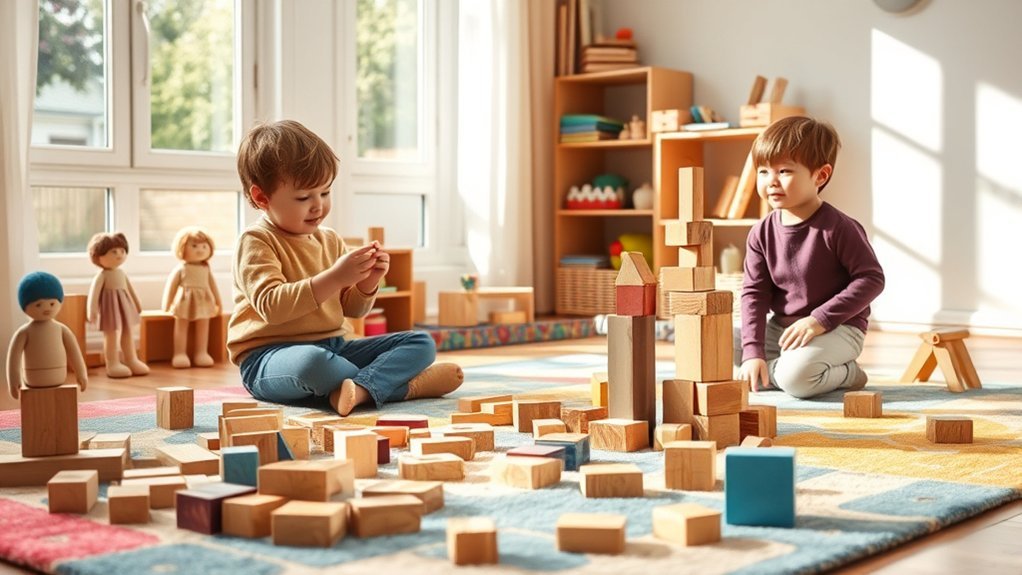
You might think that structured toys are the only way to guide children in their play, but open-ended toys offer a unique path to creativity. By encouraging imaginative exploration, you can help children develop critical thinking skills and problem-solving abilities. However, steering through the dos and don’ts of open-ended play can be tricky. Understanding how to strike the right balance will greatly enhance their play experience and foster their growth.
Understanding Open-Ended Toys
When you explore the world of open-ended toys, you’ll discover they offer endless possibilities for creativity and imagination.
These toys, unlike traditional ones, don’t come with specific instructions or predetermined outcomes. Instead, they encourage you to engage your child’s problem-solving skills, allowing them to build, create, and invent freely.
Materials like blocks, art supplies, and loose parts foster exploration and experimentation.
Blocks, art supplies, and loose parts ignite creativity, encouraging children to explore and experiment freely.
It’s important to recognize that open-ended toys promote cognitive development by allowing children to think critically and make decisions. They also support social interaction when kids collaborate on projects.
Do: Encourage Imagination and Creativity
Encouraging imagination and creativity in your child is essential for their development.
By fostering role-playing scenarios, you can help them explore different perspectives and situations, enhancing their social skills.
Supporting experimental play activities allows them to test ideas and push boundaries, sparking innovation and problem-solving abilities.
Foster Role-Playing Scenarios
Role-playing scenarios serve as a powerful tool for fostering imagination and creativity in children. By encouraging your child to step into different roles—whether a doctor, teacher, or superhero—you ignite their ability to explore various perspectives.
This type of play not only enhances storytelling skills but also promotes problem-solving as they navigate different situations. You can provide props or costumes to support their roles, but let them take the lead in crafting the narrative. This freedom allows for self-expression and critical thinking.
Additionally, role-playing with peers fosters social skills, as they learn to collaborate and communicate. Embracing these scenarios can greatly enrich your child’s developmental journey, nurturing a lifelong love for imaginative exploration.
Support Experimental Play Activities
To truly release your child’s imagination and creativity, supporting experimental play activities is essential. These activities allow your child to explore new ideas and concepts in a safe environment.
Encourage them to use open-ended toys, like building blocks or art supplies, which invite endless possibilities. When your child experiments, they’re not just playing; they’re learning critical problem-solving skills and how to think outside the box.
As you observe, resist the urge to direct their play. Instead, ask open-ended questions that spark curiosity and further exploration.
Celebrate their unique creations, reinforcing their confidence in experimentation. By providing a supportive atmosphere, you’re nurturing their ability to innovate, adapt, and express themselves—skills that will serve them well throughout life.
Don’t: Limit Play With Rigid Rules
When you impose strict rules on play, you stifle imaginative exploration and limit your child’s ability to think outside the box.
Open-ended toys thrive on creativity, allowing kids to experiment and solve problems in unique ways.
Encourage Imaginative Exploration
Encouraging imaginative exploration in play is essential for fostering creativity and problem-solving skills in children, so it’s crucial not to impose rigid rules that can stifle their creativity.
When you provide open-ended toys, you’re allowing your child to navigate their own stories, develop characters, and invent scenarios. This freedom promotes self-expression and critical thinking.
Instead of dictating how a toy should be used, invite your child to experiment. Ask open-ended questions that spark their imagination, like “What happens next?” or “How can we make this even better?”
Foster Creative Problem-Solving
While it’s tempting to set strict guidelines around play, doing so can hinder your child’s ability to develop creative problem-solving skills. When you allow open-ended play, your child learns to think critically and explore multiple solutions to a problem. Instead of imposing rigid rules, encourage experimentation and flexibility.
| Rigid Rules | Open-Ended Play | Benefits |
|---|---|---|
| Limits creativity | Encourages imagination | Enhances problem-solving |
| Discourages exploration | Promotes risk-taking | Builds resilience |
| Fosters dependency | Cultivates independence | Develops critical thinking |
Do: Provide a Variety of Materials
Providing a variety of materials is essential for fostering creativity and problem-solving skills in children. When you offer different textures, colors, and shapes, you encourage exploration and imaginative play.
Items like building blocks, fabric scraps, and natural elements like stones or leaves can spark unique ideas and solutions. By mixing these materials, children learn to experiment, combine, and innovate, enhancing their critical thinking abilities.
It’s important to observe what captures their interest and adapt your offerings accordingly. This approach not only keeps playtime engaging but also helps children develop a sense of agency in their creations.
Don’t: Overwhelm With Too Many Options
Although offering a variety of materials is important, overwhelming children with too many options can stifle their creativity instead of nurturing it. When you present too many choices, kids may feel paralyzed or anxious, unable to focus on any one idea. This can lead to frustration rather than imaginative play.
Instead, aim for a balanced selection that encourages exploration without causing confusion. By limiting options, you allow children to dive deeper into their ideas, fostering critical thinking and problem-solving skills. Remember, it’s not about quantity but quality.
Curate your materials thoughtfully, ensuring they inspire creativity and engagement. Simplifying choices can lead to richer play experiences, helping children develop their imagination and confidence in a supported environment.
Do: Join in the Play Experience
Joining in the play experience not only enhances children’s creativity but also strengthens your bond with them. When you participate actively, you show that their interests matter, fostering a nurturing environment.
Here are three ways to engage effectively:
- Encourage Imagination: Ask open-ended questions that prompt them to think creatively, like, “What can we build with these blocks?”
- Model Problem-Solving: Demonstrate how to tackle challenges together. If a structure collapses, explore rebuilding it instead of showing frustration.
- Celebrate Their Ideas: Acknowledge and praise their unique creations. This validation boosts their confidence and inspires further exploration.
Frequently Asked Questions
What Age Groups Benefit Most From Open-Ended Toys?
Children aged 2 to 8 benefit most from open-ended toys. During these formative years, their creativity and problem-solving skills flourish, allowing them to explore concepts, develop social skills, and engage in imaginative play.
How Can Open-Ended Toys Support Social Skills Development?
Open-ended toys spark creativity and collaboration, allowing kids to negotiate, share, and build friendships. They’re not just playthings; they’re social skill powerhouses, turning little ones into future diplomats—minus the briefcases and endless meetings.
Are There Specific Brands Known for Quality Open-Ended Toys?
Yes, brands like Grimm’s, Haba, and Tegu are renowned for quality open-ended toys. They focus on durability and creativity, ensuring your child engages in imaginative play while developing important skills. You won’t be disappointed!
How Do Open-Ended Toys Promote Problem-Solving Skills?
Open-ended toys invite your child into a world of creativity, encouraging exploration and experimentation. As they manipulate shapes and materials, they naturally develop problem-solving skills, learning to navigate challenges and think critically in playful scenarios.
Can Open-Ended Toys Be Used in Structured Educational Settings?
Yes, you can use open-ended toys in structured educational settings. They encourage creativity and critical thinking, allowing students to explore concepts while adhering to learning goals. This balance enhances engagement and deepens understanding in various subjects.
Conclusion
Incorporating open-ended toys into playtime can transform a child’s creative journey. By encouraging imagination, providing diverse materials, and actively engaging in their world, you set the stage for limitless exploration. But beware of rigid rules and overwhelming choices—they can snuff out that spark of creativity. What might happen if you let go of constraints and embraced the unexpected? The possibilities are as vast as your child’s imagination, just waiting to unfold in ways you can’t yet envision.
