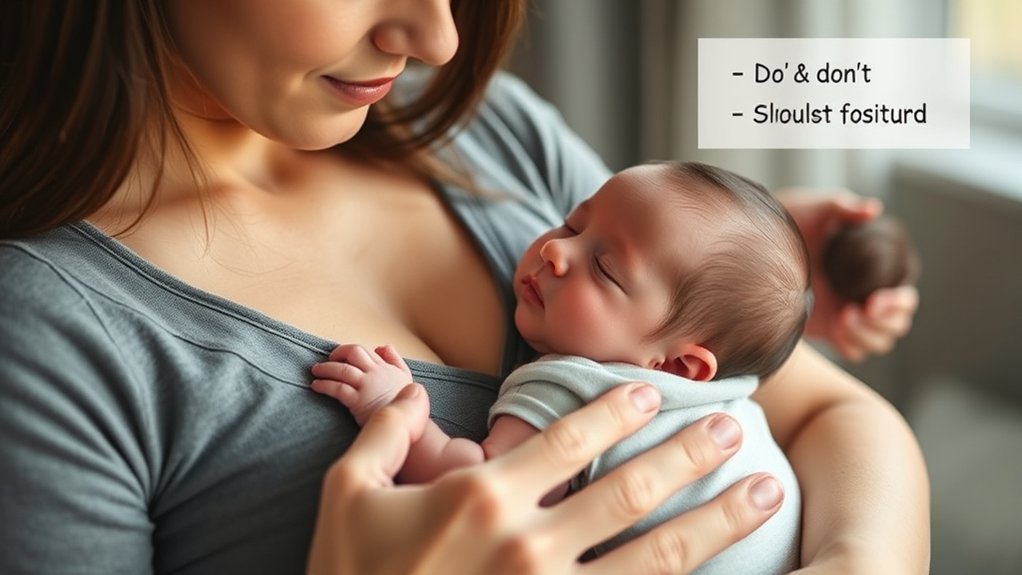
When carrying your newborn, the safest positions keep your baby close, upright enough to breathe easily, and fully supported from head to hips. Newborns have weak neck muscles, soft developing joints, and limited body control, so small positioning mistakes can affect comfort and safety. The goal is simple: support the head and neck, keep the airway clear, hold the baby high on your chest, and avoid any position where the chin drops, the spine twists, or the legs dangle straight down.
Quick Answer
The best newborn carry position keeps your baby high and close against your chest, with the head and neck supported, the face visible, the chin off the chest, and the hips supported in a natural “M” position. Avoid loose slings, dangling legs, covered faces, and any carry that blocks breathing.
Key Takeaways
- Always support a newborn’s head, neck, spine, and hips because they cannot hold themselves steady yet.
- Keep your baby close enough to kiss, with their face visible and their airway open.
- Use carriers and slings only when they fit your newborn’s age, weight, and stage of development.
- Avoid positions where the baby’s chin presses to the chest, legs hang straight down, or the body slumps deeply into fabric.
- Check your baby often for breathing, color, temperature, fussiness, and signs of discomfort.
At a Glance
| Best Newborn Position | High on your chest, close enough to kiss, with supported head, neck, spine, and hips |
| Difficulty | Easy, but requires frequent safety checks |
| Tools Needed | Your arms, or a newborn-safe carrier or sling that matches your baby’s weight range |
| Main Safety Rule | Baby’s face must stay visible, uncovered, and free from fabric, your body, or their own chest |
Warning: This article is for general education only. If your baby was premature, has low birth weight, breathing issues, reflux, hip concerns, low muscle tone, or any medical condition, ask your pediatrician before using a sling, wrap, or structured carrier.
Understanding Newborn Anatomy and Development
Understanding your newborn’s anatomy helps you carry them safely. A newborn’s head is large compared with the rest of the body, while the neck and upper-back muscles are still weak. This means your baby cannot reliably hold the head upright or correct a poor position on their own.
Your baby’s skull, spine, hips, and muscles are still developing. During the first weeks, they depend on you for full support, especially around the head, neck, back, bottom, and thighs. A safe carry should work with your baby’s natural curled posture instead of forcing them straight.
As your baby grows, their coordination and strength slowly improve. You may notice early milestones such as turning toward your voice, lifting the head briefly during tummy time, or pushing with the legs. These changes affect how much support your baby needs during carrying, but newborns still need close supervision in every position.
By recognizing your baby’s stage, you can adjust your carrying method to protect their airway, support their joints, and help them feel calm and secure.
The Importance of Safe Carrying Positions
Safe carrying positions matter because they protect your baby’s breathing, spine, hips, and comfort. A newborn should never be left to slump deeply in your arms, a sling, or a carrier. Their chin can drop toward the chest, and that can make breathing harder.
Good positioning also protects you. When your baby is held close to your center of gravity, your back, shoulders, and wrists do less work. This makes longer carries more comfortable and lowers the chance of strain.
Safe Body Alignment
Maintaining safe body alignment while carrying your newborn is essential for both your comfort and your baby’s well-being. Proper positioning gives ergonomic support, reduces strain on your body, and helps your baby rest in a secure, natural posture.
| Safe Positioning | Unsafe Positioning |
|---|---|
| Baby high and close to your chest | Baby hanging low or far from your body |
| Head supported with neck aligned | Head unsupported, tilted back, or chin pressed down |
| Spine supported in a gentle natural curve | Twisted spine, deep slumping, or folded body |
| Weight distributed evenly across your body | One-sided carrying that strains one shoulder or hip |
| Baby’s face visible and uncovered | Face buried in fabric, your chest, or a blanket |
Supportive Carrying Techniques
Supportive carrying techniques help keep both you and your newborn comfortable. Choose positions that keep your baby snug against you without squeezing them. Their chest should rest against your body, their head should turn to the side, and their nose and mouth should stay clear.
When using a carrier, look for ergonomic support that spreads your baby’s weight across your shoulders, back, and hips. A good fit helps you stand naturally instead of leaning forward or arching your back.
Avoid any position that lets your baby dangle, slump, twist, or slide. If your newborn looks folded, buried, or too low to kiss, stop and reposition them.
Pro Tip: Use the “close enough to kiss” check. If you cannot easily lower your head and kiss the top of your baby’s head, your baby may be too low.
Safe Newborn Carry Checklist
Before each carry, take a few seconds to check your baby’s position. This is especially important with soft wraps and ring slings because fabric can loosen or shift as you move.
- Face visible: You should be able to see your baby’s nose and mouth at all times.
- Chin up: Keep at least a small space between the chin and chest so breathing is not restricted.
- Head supported: The head should not flop backward, forward, or sideways.
- Back supported: Your baby should not slump into a deep C-shape that compresses the chest.
- Hips supported: Thighs should be supported, with knees slightly higher than the bottom when possible.
- Snug but not tight: Your baby should feel secure without pressure on the chest, belly, or neck.
- Temperature checked: Feel the back of your baby’s neck to check for overheating or chill.
Recommendations for Supporting the Head and Neck
To keep your newborn’s head and neck properly supported during carrying, use techniques that promote stability and comfort. A newborn’s head can drop suddenly, especially when you bend, sit, stand, or adjust your hold.
Follow these head and neck support tips:
- Cradle your newborn’s head with one hand while supporting their body with the other.
- Keep your baby’s head turned slightly to one side, with the nose and mouth uncovered.
- Avoid pressing your baby’s face flat against your chest or into carrier fabric.
- Use a carrier that gives firm upper-back and neck support for newborn use.
- Maintain natural alignment, avoiding excessive tilting, twisting, or folding.
- Support the head when leaning forward, bending down, or moving quickly.
Note: Newborn head support does not mean forcing the head straight. Your baby should be supported, but still able to breathe freely with the face visible.
Optimal Positions for Skin-to-Skin Contact
Skin-to-skin contact can help your baby feel warm, calm, and connected. It may also support bonding and early feeding. The safest skin-to-skin positions keep your baby’s chest against your chest while protecting the airway.
The cradle hold works well when you are sitting back slightly and your baby rests across your chest or upper body. Support the head, neck, back, and bottom with your arms. Make sure your baby’s face is turned to one side and not covered by clothing or blankets.
The upright hold places your newborn vertically against your chest. This position can feel secure and soothing, especially after feeding, but the head and neck still need steady support. Keep your baby high enough that their head rests near your collarbone, not low on your stomach.
For any skin-to-skin position, use a light blanket over both of you if needed, but never cover your baby’s face. If you feel sleepy, place your baby in a safe sleep space instead of continuing to hold them.
Best Newborn Carry Positions
The safest newborn carry position depends on whether you are using your arms, a wrap, a sling, or a structured carrier. In every method, the same safety rules apply: high, close, supported, visible, and breathing freely.
Cradle Carry
The cradle carry is a classic arm hold. Your baby lies across your forearm with the head resting near the bend of your elbow. Your other arm supports the back, bottom, and legs.
This position is useful for short carries, calming, and bonding. It also gives you a clear view of your baby’s face. Be careful not to let the chin press down toward the chest.
Upright Chest Carry
The upright chest carry keeps your baby vertical against your chest. One hand supports the upper back and head, while the other supports the bottom and thighs.
This position is often comfortable for newborns because they can hear your heartbeat and feel your warmth. Keep the baby high and close, with the face turned to the side and the airway open.
Football Hold
The football hold places your baby along your forearm with their head near your hand and their body tucked beside your side. This may be helpful for feeding, burping, or calming a baby who prefers a different angle.
Use this position only when you can fully support the head and body. Your baby should not hang from your arm or twist at the neck.
Newborn Carrier Carry
A newborn carrier carry can be safe when the carrier is designed for newborns and adjusted correctly. The carrier should support your baby from the base of the neck to the bottom, while keeping the baby close to your chest.
Check the manufacturer’s age, weight, and insert requirements. Some carriers need an infant insert; others do not. Never assume a carrier is newborn-safe unless the instructions say so.
Dos for Using Baby Carriers and Slings
When using baby carriers and slings, safety and comfort should come before convenience. A good carrier supports your baby’s body while keeping your hands freer, but it still requires active monitoring.
Keep these dos in mind:
- Do choose a newborn-safe carrier: Check the minimum weight, age guidance, and whether an infant insert is required.
- Do guarantee a secure fit: Adjust the carrier or sling so your baby is snug against you without being compressed.
- Do choose breathable fabrics: Lightweight, breathable materials help reduce overheating, especially in warm weather.
- Do practice safe positioning: Keep your newborn’s head and neck supported, and make sure the airway stays clear.
- Do check your baby often: Look at their face, color, breathing, and comfort during the entire carry.
- Do support the thighs: Choose a position that supports the legs from knee to knee when possible.
- Do read the instructions: Every wrap, sling, and carrier has its own setup rules.
Don’ts for Using Baby Carriers and Slings
Many carrier problems happen when the baby is too low, too loose, too covered, or poorly supported. These mistakes can increase the risk of breathing restriction, falls, hip strain, and discomfort.
- Don’t cover your baby’s face: Fabric, blankets, coats, and your body should never block the nose or mouth.
- Don’t let the chin drop to the chest: This can narrow the airway, especially in young babies.
- Don’t use a loose sling: Loose fabric can let the baby slump or slide into an unsafe position.
- Don’t forward-face a newborn: Most newborns do not have enough head, neck, or trunk control for outward-facing positions.
- Don’t let the legs dangle straight down: Unsupported dangling can place stress on the hips.
- Don’t cook, drink hot liquids, or handle sharp objects while babywearing: Burns and spills can happen quickly.
- Don’t sleep while holding or wearing your baby: If you feel drowsy, move your baby to a safe sleep surface.
Warning: Be extra cautious with very young, premature, or medically fragile babies in slings. Their airways can become restricted if the body curls deeply or the face presses into fabric.
Common Mistakes When Carrying Your Newborn
Many new parents make carrying mistakes without realizing it. Most are easy to fix once you know what to look for. The main goal is to avoid poor support, poor airflow, and uneven pressure on your baby’s body.
| Common Error | Why It Can Be a Problem | Safer Fix |
|---|---|---|
| Carrying too low | Can strain your back and make baby harder to monitor | Raise baby high on your chest, close enough to kiss |
| Not supporting the head | Can allow head drop or poor neck alignment | Support the head and upper back until baby has strong control |
| Cradling too tightly | May restrict movement or make breathing less comfortable | Keep baby snug, not compressed |
| One-sided slinging | Can create uneven weight distribution for you and baby | Adjust the sling evenly and switch sides when appropriate |
| Face buried in fabric | Can block airflow and make monitoring harder | Keep face visible, nose clear, and chin lifted |
Be mindful of these errors to create a safer and more nurturing carrying experience. Proper support can improve your baby’s comfort while helping you feel more confident.
Avoiding Hip Dysplasia and Other Risks
Healthy hip positioning is an important part of newborn carrying. Babies are naturally curled, and their hips often rest best in a spread-squat position. This is sometimes called an “M” position because the knees sit slightly higher than the bottom.
A safe newborn carry supports the thighs and bottom instead of letting the legs hang straight down from the hips.
Keep these hip-safety points in mind:
- Make sure your baby’s hips are positioned in a natural, spread-squat posture.
- Avoid carrying with the legs dangling straight down for long periods.
- Support your baby’s thighs instead of placing pressure only under the crotch.
- Do not force the legs wide, straight, or flat.
- Watch for signs of discomfort, such as crying, stiffening, excessive fussiness, or trouble moving the legs.
If your baby has a known hip concern or family history of hip dysplasia, ask your pediatrician or specialist which carrier positions are safest.
Airway Safety While Carrying a Newborn
Airway safety is the most important newborn carrying rule. A newborn’s airway is small, and their head can fall forward more easily than an older baby’s. That is why the face should always stay visible and the chin should stay off the chest.
Use these airway checks during every carry:
- Your baby’s nose and mouth are uncovered.
- Your baby’s chin is not pressed into the chest.
- Your baby’s face is not pressed into your body, fabric, or bedding.
- Your baby is not curled so tightly that the chest looks compressed.
- You can hear or feel normal breathing.
- Your baby’s color looks normal for them.
If your baby seems limp, unusually quiet, blue, gray, pale, struggling to breathe, or difficult to wake, remove them from the carrier and seek urgent medical help.
The Role of Comfort for Both Parent and Baby
Comfort matters for both you and your baby. A position that feels secure and balanced helps your baby relax while protecting your body from strain. If either of you seems uncomfortable, pause and adjust.
Importance of Proper Support
Proper support protects your baby’s developing body and helps you carry with less effort. Supportive materials and ergonomic designs can make a big difference, especially during longer carries.
Focus on these key areas:
- Spinal alignment: Support your baby’s natural curve without letting them collapse or twist.
- Weight distribution: Keep your baby close so their weight does not pull your shoulders forward.
- Breathability: Choose fabrics that help regulate temperature and do not cover the face.
- Hip support: Support the thighs and bottom to avoid dangling.
- Parent comfort: Adjust straps so weight is spread across your body, not placed on one shoulder.
Adjusting for Baby’s Comfort
Your baby will show cues when a position is not working. Fussing, arching, stiffening, squirming, or turning red may mean the hold is too tight, too hot, too loose, or poorly aligned.
| Adjustment Type | Signs of Discomfort | Recommended Changes |
|---|---|---|
| Positioning | Crying, arching, or stiffening | Shift to a more secure, upright hold |
| Tightness | Restricted movement or pressure marks | Loosen straps or fabric slightly while keeping baby snug |
| Temperature | Sweating, flushed skin, or cool neck | Adjust clothing layers and carrier fabric |
| Airway | Face covered, chin down, or muffled breathing | Remove or reposition baby immediately |
Parent’s Posture and Alignment
Good posture protects your back, shoulders, neck, and wrists while carrying. Proper ergonomic positioning helps you hold your newborn securely without leaning, twisting, or overusing one side of your body.
To improve your posture:
- Use a supportive carrier: Choose one that distributes weight evenly across your body.
- Engage your core: Light core engagement helps stabilize your spine and supports your lower back.
- Keep baby close: A baby held far from your body feels heavier and creates more strain.
- Switch sides: If carrying in your arms, alternate sides to reduce repeated strain.
- Use your legs: Bend at the knees instead of bending at the waist while holding your baby.
Adapting Carry Positions as Baby Grows
As your baby grows, you will need to adapt your carrying positions to match their strength, size, and developmental stage. Newborns need the most head and neck support. Older babies with stronger neck and trunk control may tolerate more upright and interactive positions.
In the early weeks, use supportive holds such as cradle carries, upright chest carries, and newborn-safe carrier positions. As your baby starts lifting their head and showing better control, you can slowly adjust to positions that allow more looking around while still protecting alignment.
Do not rush into outward-facing carries. Babies need strong head and trunk control before they can safely handle positions that expose them to more movement and stimulation. Even then, outward-facing carries should be used carefully and only if the carrier instructions allow it.
By adapting your carry positions gradually, you support your baby’s comfort, safety, and independence while keeping the bond strong.
Tips for Transitioning Between Carrying Methods
Changing carrying methods can be smooth when you move slowly and watch your baby’s cues. Some newborns enjoy wraps, while others prefer arms or a structured carrier. There is no single perfect method for every baby.
- Observe your baby’s reactions: Watch for calm breathing, relaxed hands, normal color, and settled movement.
- Practice gradual changes: Try a new hold for a short time before using it for a longer carry.
- Ensure proper support: Check the head, neck, spine, bottom, and thighs after every adjustment.
- Use a mirror: A mirror can help you check whether your baby is centered, high, and visible.
- Try when baby is calm: Learning a new carrier is easier when your baby is fed, dry, and not overtired.
- Stop if it feels unsafe: If the carrier slips, feels loose, or blocks your view of baby’s face, take baby out and reset.
When to Stop and Reposition Your Baby
Stop and reposition your baby any time the carry no longer looks or feels safe. Do not wait for crying, because some babies become quiet when uncomfortable or overly sleepy.
Reposition your baby if you notice:
- The face is covered or pressed into fabric.
- The chin is tucked tightly to the chest.
- The head flops backward or sideways.
- The body slumps deeply or twists.
- The legs dangle straight down without thigh support.
- Your baby seems too hot, sweaty, cold, pale, or unusually quiet.
- You feel sharp pain, numbness, or strong strain while carrying.
If repositioning does not fix the issue, remove your baby from the carrier and use a supported arm hold instead.
Frequently Asked Questions
How do I choose the right baby carrier for my newborn?
Choose a carrier that clearly states it is safe for newborns and matches your baby’s weight. Look for firm head and neck support, adjustable straps, breathable fabric, and a seat that supports the thighs and hips. Always read the manufacturer’s instructions before using it.
Can I carry my newborn while breastfeeding?
Yes, some parents breastfeed while carrying, but it requires extra care. Make sure your baby’s airway stays open, the nose is not pressed into the breast or fabric, and the baby is returned to a high, upright, visible position after feeding. Newborns should never remain low or covered in a carrier after nursing.
What should I do if my baby cries while being carried?
Check your baby’s position first. Make sure the head, neck, airway, back, hips, and legs are supported. Then check for hunger, gas, a wet diaper, temperature discomfort, or overstimulation. Try gentle rocking, soft sounds, or a different safe hold. If crying seems unusual or intense, contact your pediatrician.
Are there cultural practices for carrying newborns that I should know?
Yes. Many cultures use wraps, shawls, slings, or cloth carriers to keep babies close. These practices can support bonding and convenience, but the same safety rules still apply: keep the baby’s face visible, airway clear, head supported, body snug, and hips well positioned.
How can I ensure my carrier is hygienic for my newborn?
Wash the carrier according to the care label, especially after spit-up, diaper leaks, or outdoor use. Clean buckles, straps, and high-touch areas. Let the carrier dry fully before storage, and check for worn fabric, loose stitching, stretched elastic, or damaged buckles before each use.
When can my baby face outward in a carrier?
Most newborns should not face outward because they lack strong head, neck, and trunk control. Wait until your baby has steady control and the carrier’s instructions say outward-facing is allowed. Even then, keep sessions short and watch for overstimulation or poor posture.
How tight should a newborn carrier be?
A newborn carrier should be snug enough to hold your baby securely against your chest, but not so tight that it compresses the chest, belly, or airway. Your baby should not slump, slide, or pull away from your body. If you see pressure marks or restricted movement, adjust the fit.
Conclusion
Safe newborn carrying starts with simple habits: keep your baby high, close, supported, visible, and able to breathe freely. Support the head and neck, protect the hips in a natural position, and avoid loose, low, covered, or dangling carries. As your baby grows stronger, you can adjust your carrying methods while still checking comfort and alignment. When in doubt, stop, reposition, and choose the safest hold for both you and your baby.
Sources
- HealthyChildren.org from the American Academy of Pediatrics — baby carrier safety and airway awareness
- U.S. Consumer Product Safety Commission — infant product safety awareness
- International Hip Dysplasia Institute — hip-healthy baby carrier positioning
- NHS — holding and supporting a newborn safely

