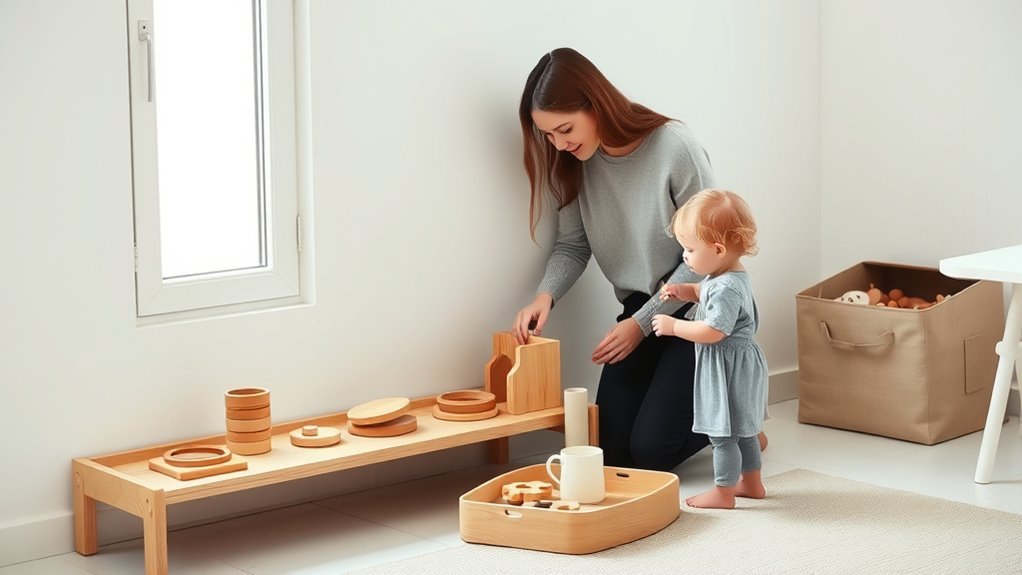
Montessori at home is less about buying special toys and more about arranging daily life so your child can participate with growing independence. A simple setup with reachable tools, clear places for belongings, meaningful choices, and time to concentrate can bring Montessori principles into ordinary rooms without turning your home into a classroom.
Quick Answer
Start with one area your child uses every day. Put a few age-appropriate items within reach, show slowly how to use and return them, invite your child into real tasks such as pouring or folding, then step back. Observe what holds attention and adjust the environment instead of constantly directing play.
Key Takeaways
- A Montessori home depends more on accessibility, order, observation, and meaningful work than on a particular decorating style.
- Practical life means letting children participate in real self-care and household tasks at an appropriate level.
- Following your child means responding to interests and readiness within clear limits, not allowing unrestricted choice.
- Toy rotation works best when you watch engagement and change what is available as interests and abilities change.
- Hands-on materials must still match your child’s developmental level and be safe from choking and other hazards.
Montessori Home Basics for Parents
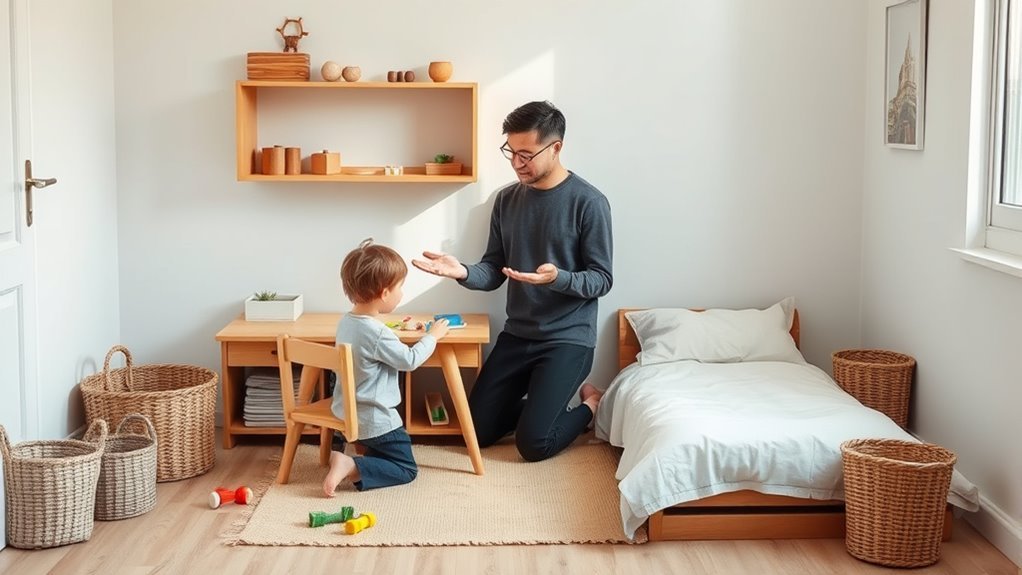
The foundation of Montessori at home is a prepared environment: a space arranged so your child can make meaningful choices, use appropriate materials, and do more without unnecessary adult help. The Association Montessori Internationale describes Montessori environments as accessible, organized spaces shaped around children’s developmental needs and interests.
Your role is not to entertain your child or correct every attempt. Instead, observe first, prepare what is needed, demonstrate new tasks clearly, and give your child enough time to practice.
- Observe: Notice what your child repeatedly chooses, avoids, masters, or finds frustrating.
- Prepare: Place suitable materials and everyday tools where your child can see, reach, use, and return them.
- Model: Demonstrate a new action slowly and simply rather than giving a long explanation.
- Step back: Allow repetition, small mistakes, and problem-solving when the situation is safe.
The American Montessori Society’s Montessori-at-home guidance similarly emphasizes observation, demonstration, adapting the environment, real-life skills, and inner motivation. You do not need to reproduce a classroom. You are applying the same ideas to normal family life.
Create a Child-Sized Montessori Space
A Montessori home becomes easier for your child to use when everyday spaces match their reach and abilities. Start with the places where your child most often needs help, then change only what would let them complete a useful action more independently.
Use child-sized furniture where it is genuinely useful. Low, open storage can hold a small number of books, toys, or activity trays, while reachable hooks, clothing, and everyday supplies can reduce unnecessary dependence on adults.
Give important activities a clear home. A reading area might have a small selection of books, while practical-life supplies can sit near the place where they are used. Keeping each item in a predictable location also makes putting things away part of the activity.
Natural materials such as wood, cotton, or metal can be pleasant and durable, but Montessori is not an all-wood decorating style. Accessibility, order, purpose, and suitability for your child matter more than whether everything matches a particular aesthetic.
Safety still comes first. Keep only materials your child can use safely and make sure furniture, tools, and activities suit their current abilities. Independence works best when adults prepare sensible boundaries before inviting the child to act freely within them.
Simplify Toys and Learning Materials
Reducing visible clutter can make it easier for a child to choose an activity and stay with it. You do not need a bare room; the goal is to present a manageable number of worthwhile choices instead of filling every shelf.
There is also limited research supporting this idea. In a study of 36 toddlers ages 18–30 months, children played longer with individual toys and used them in more varied ways when four toys were available rather than 16. The findings are available through PubMed’s record of the toddler toy study. That study does not establish a perfect number of toys for every home, but it supports the practical value of reducing competing choices.
Declutter Play Spaces
Start by removing broken, incomplete, developmentally unsuitable, and clearly unused items from the active play area. Store uncertain items temporarily rather than feeling that everything must be donated immediately.
Then arrange the remaining materials so your child can see what is available without digging through a crowded bin. Baskets or trays can keep related pieces together and make the beginning and end of an activity obvious.
You can also create simple areas for books, art, construction, or practical work. The point is not to label every corner, but to make it easy for your child to choose something, use it, and restore the space afterward.
Rotate Toy Selection
Toy rotation should respond to your child rather than follow a rigid calendar. Keep a small, useful selection available and store the rest out of sight. Then observe what your child repeatedly chooses, ignores, has mastered, or seems ready to explore next.
Keep favorite materials available when they are still supporting deep engagement. Replace an item when interest has clearly faded, the challenge is no longer meaningful, or another material better matches a developing skill.
This approach creates novelty without requiring you to buy more. It also helps you notice whether a toy is actually useful or simply taking up shelf space.
Rotate Toys Without Overwhelm
A successful rotation changes only enough to refresh the space without making everything unfamiliar at once. Leave a few well-used materials in place and introduce one or two alternatives that match what you have recently observed.
For example, if your child repeatedly transfers objects between containers, you might offer another safe transferring activity. If puzzles are being ignored but drawing is absorbing long stretches of attention, keep art materials accessible and give the puzzles a break.
Watch what happens after each change. A useful rotation should make choosing and concentrating easier, not create pressure to use every item you put out.
Pro Tip: Before adding something new, ask whether your child needs a new material or simply more time with the one already being repeated. Repetition is often part of the learning, not a sign that an activity has become boring.
Follow Your Child’s Interests
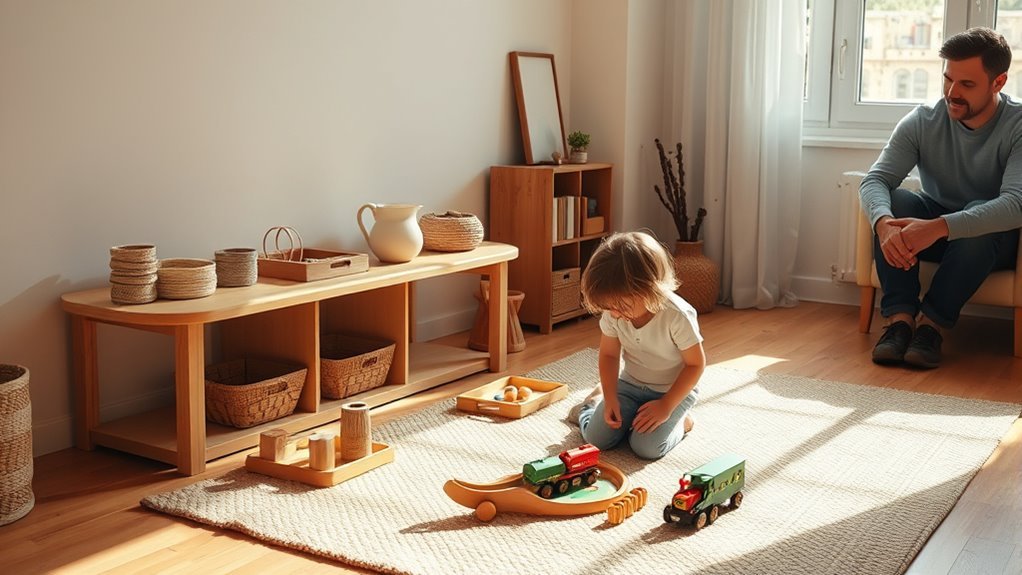
Following your child means observing interests and readiness, then offering appropriate opportunities to go further. It does not mean letting your child make every household decision or avoiding necessary limits.
The Montessori Foundation explains this distinction in its guidance on what “follow the child” means: adults observe carefully, prepare meaningful choices, establish boundaries, and decide when to present something new or step back.
If your child is fascinated by water, that interest might lead to pouring, washing vegetables, watering plants, or cleaning a table. An interest in vehicles might lead to books, matching activities, drawing, counting, or conversations about how machines move.
You do not have to turn every fascination into a lesson. Sometimes the best response is simply to make suitable materials available and allow exploration.
Also watch for readiness rather than comparing your child with another child of the same age. Interests develop at different times. Your observations can help you decide whether an activity is too easy, too difficult, or ready for another level of challenge.
Let Playtime Stay Uninterrupted
When your child becomes deeply engaged in safe, purposeful activity, avoid interrupting simply to offer another idea, ask unnecessary questions, or correct a harmless imperfection. Protected concentration gives children time to repeat, solve problems, and complete a work cycle at their own pace.
Uninterrupted activity gives children time to choose, repeat, solve problems, finish, and restore their work without being rushed.
The American Montessori Society identifies uninterrupted work periods as a core Montessori component. In a classroom, a work cycle includes choosing an activity, doing and possibly repeating it, cleaning up, returning the materials, and choosing what comes next.
Montessori schools may protect long formal work periods, but you do not need to impose a classroom-length schedule at home. Protect realistic stretches of concentration within your family’s day. A young child who is absorbed for a shorter period does not need to be pushed to continue merely to reach a target.
Stay available when help is genuinely needed. Otherwise, allow manageable frustration and repeated attempts. Solving a problem independently can be more valuable than receiving the fastest solution from an adult.
Use Respectful Language, Questions, and Storytelling
Language at home can support Montessori principles when it is respectful, clear, and connected to real experience. Ask questions that invite thought, but avoid turning every conversation into a quiz or interrupting concentrated work just to make it more educational.
Offer genuine choices when both options are acceptable: “Would you like the blue shirt or the green shirt?” is clearer than offering a choice where the adult cannot actually accept one of the answers.
Open questions can encourage language and reasoning. You can ask your child what they noticed, how they solved a problem, what they think might happen next in a story, or what they want to tell you about their artwork.
Storytelling, songs, books, and conversation also give children rich opportunities to hear and use language. Use normal vocabulary, name real objects accurately, and give your child time to respond rather than filling every pause.
When acknowledging effort, be specific rather than relying only on “good job.” The Montessori Foundation’s guidance on descriptive alternatives to general praise recommends noticing what the child actually did. Saying “You kept trying until that button went through” gives useful information without making adult approval the whole point of the activity.
Support Focus With Hands-On Activities
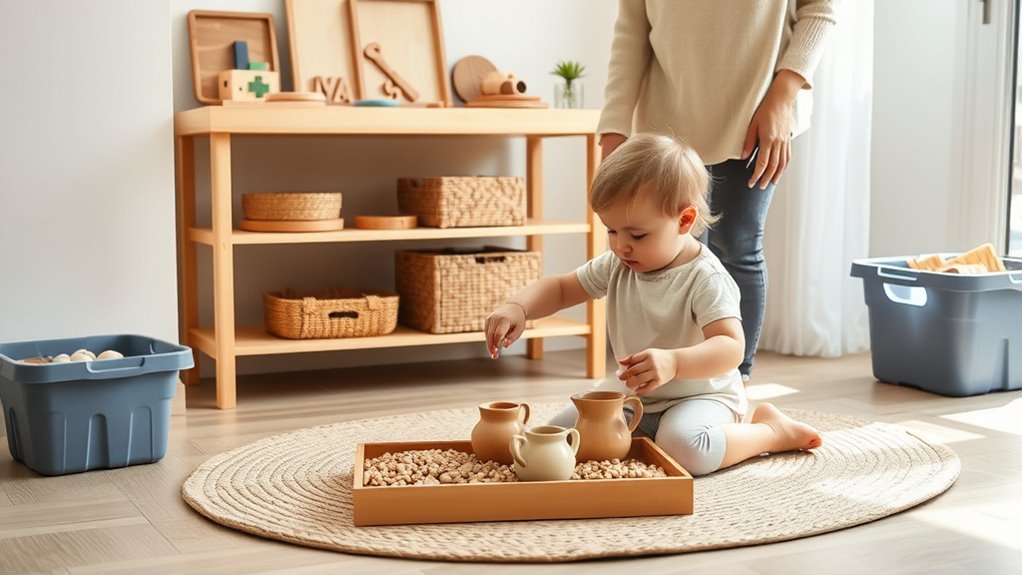
Hands-on activities work best when they have a clear purpose, suit your child’s abilities, and allow repetition. Everyday tasks such as pouring, wiping, sorting, dressing, gardening, and preparing food can provide meaningful practice without requiring elaborate materials.
Hands-On Concentration
Practical Life is the Montessori term for purposeful activities connected to self-care, care of the environment, movement, and social life. AMI’s guidance on Exercises of Practical Life emphasizes meaningful purpose, independence, logical sequence, concentration, and a complete work cycle.
At home, practical-life opportunities might include pouring a drink, wiping a spill, folding a cloth, carrying laundry, watering a plant, preparing part of a meal, or putting personal belongings away.
Choose a task your child can participate in safely. Show the sequence slowly, provide only the help that is needed, and leave time for repetition. Real competence usually grows through many ordinary attempts.
Sensory Skill Builders
Sensory activities help children notice qualities such as texture, sound, shape, weight, color, or size. You can use safe household objects, fabric, water, clay, nesting containers, natural objects, or other materials that match your child’s developmental stage.
Activities can stay simple. Your child might match two textures, compare the sounds of securely closed containers, arrange objects from large to small, or sort items by one visible property.
Warning: Avoid loose small objects for children under 3 and for any child who still mouths objects. The U.S. Consumer Product Safety Commission’s small-parts guidance identifies choking, aspiration, and ingestion hazards as the reason small-part children’s products are restricted for this age group. Choose larger alternatives and supervise activities according to your child’s abilities.
That means sensory bins filled with beans, rice, beads, coins, or similar loose pieces are not suitable for every child. A sensory activity is useful only when its setup is safe for the individual child using it.
Focus-Friendly Activities
A focus-friendly activity is simple enough to understand but challenging enough to hold attention. Present all the pieces together in a tray, basket, or defined work area when that helps your child see what belongs to the task.
Offer one clear challenge at a time. Pouring water between two small containers, sorting a small set of safe objects, washing a table, matching socks, or placing books back on a shelf can all provide a visible beginning, middle, and end.
Then reduce unnecessary distractions. You do not need silence, but a child who is already concentrating usually benefits more from time than from another adult suggestion.
Avoid Common Montessori Home Mistakes
Most Montessori-at-home mistakes come from focusing on the appearance of Montessori rather than its purpose. A beautiful shelf is useful only if your child can understand it, access it, use what is there, and take increasing responsibility for the space.
| Common mistake | Better Montessori approach |
|---|---|
| Offering too many choices | Present a manageable selection and adjust it after observing what your child uses. |
| Helping immediately | Pause first. Give your child time to attempt a safe challenge before stepping in. |
| Buying everything labeled Montessori | Use real household tasks and carefully chosen materials that serve a clear purpose. |
| Treating child-led learning as no limits | Offer meaningful freedom inside boundaries that protect people, property, and concentration. |
| Using constant rewards or generic praise | Use specific observations and encouragement that help the child notice effort and progress. |
| Copying an activity without checking safety | Match tools, loose parts, food preparation, and sensory materials to your child’s actual abilities. |
Another common mistake is changing several things at once. Start with one frustrating part of the day, such as getting dressed, putting toys away, or helping in the kitchen. Make that one area easier for your child to use, then observe what changes before adding more.
Build Daily Montessori Routines
Daily routines can support Montessori at home when they create a predictable rhythm without controlling every minute. Your child benefits from knowing what normally happens next while still having meaningful choices within each part of the day.
In the morning, make dressing, washing, eating, and putting belongings away as participatory as your child can safely manage. During the day, invite contribution through practical-life tasks rather than separating learning from ordinary family work.
Include time for movement and outdoor exploration when possible. Also protect periods when your child can choose and complete an activity without unnecessary interruption.
In the evening, a steady sequence such as tidying, washing, reading, and preparing for sleep can make expectations clear. The exact routine matters less than keeping it understandable and reasonably consistent.
Instead of rewarding every completed task, notice what happened: “You put your shoes on the shelf,” or “You carried the plate carefully.” That kind of feedback keeps attention on the action and growing competence.
As your child develops, update the environment and responsibilities. A Montessori home is not a finished room; it is a space that changes as your child becomes capable of doing more.
Frequently Asked Questions
How Do I Introduce Montessori at Home if My Child Resists Change?
Introduce Montessori gradually instead of changing the whole home at once. Begin with one useful adjustment, such as a reachable clothing drawer or a small shelf, and keep familiar routines around it. Offer limited choices, demonstrate new tasks calmly, and observe your child’s response before making the next change.
What Age Should I Start Montessori Practices at Home?
You can apply age-appropriate Montessori principles from infancy onward. For babies, that mainly means respectful interaction, safe freedom of movement, observation, and an uncluttered environment. As children grow, you can gradually add accessible belongings, practical-life tasks, meaningful choices, and materials suited to their current abilities.
How Do I Handle Siblings With Different Developmental Needs?
Give each child access to work that matches their abilities while keeping some family responsibilities shared. Older and younger siblings may participate in the same task at different levels, such as setting the table or caring for plants. Keep unsafe materials for older children inaccessible to younger siblings who are not ready for them.
How Do I Balance Montessori With My Child’s School or Daycare Routines?
You do not need school and home to look identical for Montessori principles to be useful. At home, focus on independence, respectful communication, practical responsibilities, accessible belongings, and time for concentration. Keep essential family routines predictable while allowing appropriate choices, and adjust expectations to what your child manages in each setting.
Conclusion
Montessori at home works best when you prepare the environment, invite your child into real life, and then give them room to practice. Start with one reachable shelf, one practical task, or one routine that currently requires too much adult help. Observe what happens, adjust thoughtfully, and let independence grow through everyday repetition.
Sources
- American Montessori Society: Montessori at Home: Supports observation, child-accessible organization, toy rotation, real-life skills, and intrinsic motivation.
- Association Montessori Internationale: Montessori Environments: Supports the prepared environment, accessible furniture, observation, free choice, and hands-on learning.
- American Montessori Society: Core Components of Montessori: Supports practical life, prepared environments, child-directed work, and uninterrupted work periods.
- Montessori Foundation: Follow the Child: Supports observation, readiness, meaningful choices, adult guidance, and freedom within limits.
- PubMed: The Influence of the Number of Toys in the Environment on Toddlers’ Play: Supports the discussion of fewer available toys and sustained toddler play.
- U.S. Consumer Product Safety Commission: Small Parts Guidance: Supports the choking and ingestion warning for small parts intended for children under 3.
- Montessori Foundation: Words of Praise: Supports descriptive feedback in place of relying only on general praise.