Disclosure: As an Amazon Associate, we earn from qualifying purchases. If you buy through links on this page, we may earn a small commission at no extra cost to you.
By Editorial Team | Updated October 9, 2026
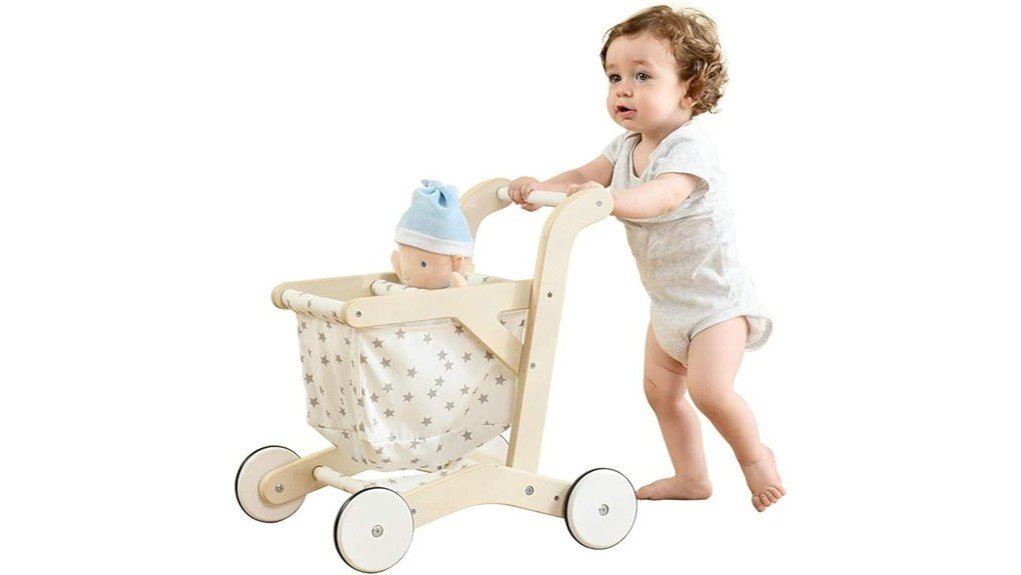
The Labebe Baby Push Walker Doll Stroller combines a wooden push walker, doll stroller, and toy cart in one toddler-friendly design. Measuring 18.7 x 15.2 x 19.7 inches and weighing approximately 5.46 pounds (2.48 kg), it features four rubber-ringed wheels, rounded wooden edges, and a fabric basket for dolls and toys.
Designed for children ages 12 to 36 months, it offers a way to combine supervised walking practice with pretend play. Its main attractions are the wooden construction and multipurpose storage area. However, assembly quality, fabric cleaning, and wheel control deserve attention before you buy.
Quick Verdict: Labebe Baby Push Walker Doll Stroller
Editorial rating: 8/10 (research-based assessment, not a hands-on test)
Best for: Toddlers who enjoy pushing toys, carrying dolls, and pretending to shop.
Skip if: You need confirmed adjustable wheel resistance, a compact folding walker, or a ride-on toy.
Bottom line: A practical wooden push toy with imaginative-play value. Check the assembly hardware and wheel movement carefully, especially for children who are just starting to stand.
Before You Buy
- Not a ride-on: The fabric seat is for dolls and toys, never for a child.
- Check rolling speed: Rubber-covered wheels do not guarantee controlled movement on every floor.
- Plan for assembly: Some owner feedback mentions difficult screws and unclear instructions.
- Think about cleaning: Removing the fabric insert may require partial disassembly.
In This Review: Jump to a Section
Key Takeaways
- The Labebe Baby Push Walker Doll Stroller combines a wooden push walker with a fabric doll seat and toy-storage area.
- Its listed dimensions are 18.7 inches long, 15.2 inches wide, and 19.7 inches high.
- The recommended age range is 12 to 36 months, but readiness and supervision matter more than age alone.
- Rubber-ringed wheels and rounded wooden edges are useful design features, though they do not eliminate tipping or fall hazards.
- Its open-ended pretend-play design can remain engaging after a toddler learns to walk independently.
- Assembly, loose hardware, and fabric-cleaning convenience are important buying considerations.
Labebe Baby Push Walker Doll Stroller Specifications
The Labebe walker is a manually operated wooden push toy with a fabric carrying area. The following specifications correspond to the product identified as model HY1810009-BLW-GWC and Amazon ASIN B087P9SXZQ.
| Brand | Labebe |
|---|---|
| Product | Baby Push Walker Doll Stroller |
| Model | HY1810009-BLW-GWC |
| Dimensions | 18.7 x 15.2 x 19.7 inches (L x W x H) |
| Item weight | Approximately 5.46 lb (2.48 kg) |
| Recommended age | 12–36 months |
| Main materials | Wood and fabric |
| Wheels | Four rubber-ringed wheels |
| Color and design | Natural beige-and-white styling with a star-patterned fabric basket |
| Primary uses | Push toy, doll stroller, pretend shopping cart, toy storage |
What’s in the Box?
The available assembly information describes wooden frame components, a handle, four wheels, a fabric basket, connecting hardware, and assembly instructions. The exact packaging inventory was not independently confirmed, so compare the delivered parts with the checklist included in your unit.
You may need a screwdriver for assembly. Keep screws, packaging, and other loose parts away from children until the walker is fully assembled and inspected.
What Makes the Labebe Baby Push Walker Doll Stroller a Good Choice?
The main attraction is its two-in-one approach to walking practice and pretend play. Toddlers can push the wooden frame while keeping a favorite doll, stuffed animal, or small toy in the fabric basket.
The walker has a broad base and a handle positioned approximately 19.7 inches above the floor at its overall maximum height. Its rubber-ringed wheels are intended to reduce rolling noise and help protect indoor floors.
Unlike a toy designed only for early walking, this stroller can also serve as a pretend shopping cart once a child walks without support. That may extend its usefulness during the toddler years.
Still, a broad base does not make a moving walker tip-proof. Children can lose balance if the wheels roll faster than expected or if they pull down on the handle.
Benefits of the Baby Push Walker Doll Stroller
The Labebe stroller offers three practical play benefits: movement, carrying toys, and pretend caregiving. These activities let toddlers practice different skills with the same toy.
Encourages Active Play
A toddler who can already stand with support may enjoy pushing the stroller across an open floor. Gripping the handle, taking steps, and changing direction provide opportunities to practice coordination.
However, a push walker does not guarantee earlier walking or faster development. Children learn to walk at different rates, and they still need safe opportunities for independent movement.
Supports Imaginative Play
The fabric doll seat is a distinctive feature. A toddler can place a doll in the seat, pretend to go shopping, or move stuffed animals from one room to another.
These simple activities encourage make-believe scenarios. Parents can join by naming toys, asking where the cart is going, or pretending to buy groceries.
Combines Walking Play With Toy Storage
The basket provides space for small toys, books, or plush animals. This makes the stroller useful even when a child prefers sitting on the floor and arranging toys instead of pushing the cart.
Choose light items that fit securely. Do not overload the basket or use heavy objects to alter the stroller’s movement without guidance from the manufacturer.
Design Features for Safety and Usability
The Labebe stroller uses a wooden frame, rounded edges, and rubber-covered wheels. These features are intended to make everyday toddler play more practical, but they should be viewed as design advantages rather than guarantees against injury.
Wooden Frame and Wide Base
The frame is built around a broad four-wheel footprint. Compared with a narrow push toy, that design may offer a more substantial contact area with the floor.
However, stability depends on the child’s actions, the weight inside the basket, floor conditions, and how smoothly the wheels move. A child pulling backward on the handle can still tip a wheeled toy.
Rubber-Ringed Wheels
Rubber rings are designed to soften wheel contact with the floor and reduce noise. The product information also describes them as useful for protecting indoor flooring.
No independently confirmed wheel-locking or adjustable-speed mechanism was found for this exact model. For a new walker, test how easily the wheels roll before allowing a toddler to use it.
Rounded Edges and Material Claims
The stroller has rounded wooden edges intended to reduce sharp contact points. Seller descriptions also state that its materials meet EN 71 and ASTM F963 toy safety requirements.
These compliance statements are manufacturer or seller claims. Independent test certificates for this particular unit were not confirmed during this review.
Important safety distinction: This is a push-behind toy, not a seated infant walker. The American Academy of Pediatrics advises against seated wheeled baby walkers because of injury risks. Its early-walking guidance discusses sturdy push toys as an option while stressing stability and safe surroundings. Use this stroller only with direct adult supervision and away from stairs, slopes, and water.
Ideal Age Range for the Labebe Stroller
The listed recommended age is 12 to 36 months. This covers the period when many toddlers are learning to walk and beginning more involved pretend play.
Age alone does not determine readiness. A child who cannot maintain standing balance with support may not be ready to control a wheeled push toy.
For Toddlers Learning to Walk
Start with a clear, flat floor and a caregiver close enough to steady the child if needed. The wheels should move at a pace the toddler can control.
If the stroller rolls away as soon as a child leans on the handle, stop using it as walking support. A fixed piece of stable furniture may be more suitable until the child’s balance improves.
For Confident Walkers
Once a toddler walks independently, the stroller becomes more useful for pretend shopping, transporting dolls, and organizing toys.
This is where the doll seat and basket provide value beyond a basic push walker.
Assembling Your Stroller for Better Play
The Labebe Baby Push Walker Doll Stroller requires assembly before use. The available product information describes setup using wooden frame parts, wheels, connecting hardware, and a fabric basket.
Although the process is fairly simple in principle, some owners report that screws or illustrated instructions can make assembly less convenient than expected.
Step-by-Step Assembly
- Unpack and inspect: Lay the parts on a clean surface and compare them with the supplied instructions.
- Arrange the wooden frame: Identify the side panels, base, and handle, then check their orientation.
- Fit the wheels: Attach the wheels according to the provided instructions, making sure they rotate properly without wobbling.
- Secure the frame: Fasten the wooden parts using the correct screws. Avoid overtightening and damaging the wood.
- Fit the fabric basket: Position the basket and doll-seat divider as illustrated for your unit.
- Check the completed walker: Inspect joints, screws, wheels, and the handle before allowing a child to push it.
Final Safety Checks
Test the stroller without a child first. Push it forward, turn it gently, and check whether it stays level.
All wheels should remain attached, and the handle should feel firmly secured. If any part is loose, damaged, or misaligned, stop and resolve the problem before use.
Who Should Buy the Labebe Baby Push Walker?
The Labebe stroller suits families who want a wooden push toy that also works as a doll stroller or pretend shopping cart. Its simple design may appeal to parents who prefer toys without batteries or electronic activities.
Good Match For
- Toddlers ages 12–36 months who meet the needed physical readiness.
- Children who enjoy dolls, stuffed animals, and pretend shopping.
- Families seeking a wooden, non-electronic push toy.
- Homes with suitable flat indoor play space.
Consider Another Option If
- You need a confirmed resistance-control system for early walking.
- You prefer a toy with built-in music, lights, or activity panels.
- You need a stroller that folds for frequent travel.
- You want a cart designed for outdoor terrain.
Labebe Baby Push Walker Pros and Cons
The stroller’s strongest points are its wooden design, rubber-ringed wheels, and flexible play options. Its biggest potential drawbacks involve assembly and maintenance.
Pros
- Wooden frame with rounded edges.
- Rubber-ringed wheels suit smooth indoor floors.
- Fabric doll seat and toy-storage space support pretend play.
- Wide footprint offers a practical push-behind design.
Cons
- Some owners report difficult assembly or troublesome screws.
- Fabric removal can take extra work.
- No confirmed wheel brake or adjustable rolling resistance.
Best Ways to Use the Labebe Stroller
The stroller is most useful when you match its role to the toddler’s balance and interests. It can support several types of play without needing extra accessories.
Supervised Push-Along Play
On a flat, open floor, a toddler who is ready for a moving push toy can hold the handle and push the stroller. Keep the path free of cords, rugs that catch the wheels, and furniture corners.
Doll and Stuffed-Animal Stroller
Place a suitable doll or small stuffed animal in the basket and let the child pretend to take it for a walk. This gives the toy a purpose after independent walking begins.
Pretend Grocery Shopping
Add a few lightweight pretend groceries or soft toys. The toddler can load the basket, move to a pretend checkout, and unload the items.
Sorting and Carrying Toys
Children can practice putting toys into the basket and taking them out again while seated on the floor. This activity does not require using the cart for walking support.
What Owners Report About the Labebe Stroller
Available owner comments provide useful clues about day-to-day use, although individual experiences are not controlled product tests. The feedback is generally favorable toward the stroller’s appearance and play value, with some practical concerns.
What Owners Like
- Sturdy feel: Several reviewers describe the assembled cart as solid during ordinary play.
- Enjoyable toy storage: Parents report that children enjoy placing toys in the basket and pushing the cart around.
- Smooth wheels: Some owners find that the wheels roll well across their indoor flooring.
- Extended play value: Comments describe children continuing to enjoy the cart beyond their first walking attempts.
Common Complaints and Watch-Outs
- Assembly effort: Some reviewers mention difficult screws or instructions that rely heavily on small illustrations.
- Fabric cleaning: A reported inconvenience is having to remove screws to take the insert out for thorough washing.
- Wheel movement: Some buyers describe limited maneuverability or difficulty turning.
- Hardware checks: Screws and wheel connections deserve inspection during assembly and routine use.
These comments describe individual owner experiences. They do not establish how often a defect occurs, and they should not replace checking your own unit before use.
Labebe Baby Push Walker vs. Alternatives
Three other push toys are worth comparing with Labebe: the Radio Flyer Classic Push Walker Wagon, Hape Wonder Walker, and Melissa & Doug Chomp & Clack Alligator Push Toy. Each emphasizes a different type of play.
| Product | Listed Age | Main Feature | Best Fit |
|---|---|---|---|
| Labebe Baby Push Walker Doll Stroller | 12–36 months | Wooden cart with fabric doll seat | Doll play and carrying toys |
| Radio Flyer Classic Push Walker Wagon | 1–4 years | Resist-push mechanism and wooden wagon | Families prioritizing rolling resistance |
| Hape Wonder Walker | 12 months+ | Wooden activity walker with gears and beads | Hands-on activity play |
| Melissa & Doug Chomp & Clack Alligator Push Toy | 1–2 years | Moving alligators and spinning beads | Interactive push-along play |
Labebe vs. Radio Flyer Classic Push Walker Wagon
The Radio Flyer model has a manufacturer-described resist-push feature intended to slow rolling. It also has removable wooden sides and storage space for toys.
Labebe may be more attractive if the doll seat is your priority. Radio Flyer is worth considering if you specifically want a walker with a documented rolling-resistance feature. The two designs serve overlapping but different needs.
Labebe vs. Hape Wonder Walker
The Hape Wonder Walker offers built-in activities, including moveable knobs, beads, and gears. Hape lists it for children ages 12 months and older.
Choose Labebe for doll-stroller play and a roomy fabric carrying area. Consider Hape if your toddler would prefer an activity center that moves.
Labebe vs. Melissa & Doug Chomp & Clack
The Melissa & Doug Chomp & Clack focuses on movement and interaction. Its wooden alligators make sounds while children push it, and decorative beads offer additional hands-on activities.
Labebe is more suitable for a child who wants to carry dolls or pretend to shop. The Chomp & Clack may be more engaging for children who prefer moving toys and playful sounds.
Is the Labebe Baby Push Walker Worth the Price?
The Labebe Baby Push Walker Doll Stroller is worth considering if you want a single toy for supervised push-along play, doll care, and pretend shopping. Its value depends on how much your child will use those features.
The wooden construction and fabric storage area offer more versatility than a simple push handle. However, you should weigh that against assembly work, cleaning effort, and the absence of a confirmed speed-control feature.
If you only need a walker for a short period, a simpler push toy may meet your needs. If your toddler already loves dolls and pretend shopping, Labebe’s additional play features may justify choosing it.
Prices and seller terms can change. Compare the current listing with the alternatives, including any differences in warranty coverage, delivery, and return terms.
How We Evaluated the Labebe Baby Push Walker
This review is based on published product specifications, available assembly and care guidance, safety information, owner feedback, and manufacturer information for competing push toys.
We considered the stroller’s construction, age suitability, wheel design, versatility, setup effort, maintenance, and likely limitations. We also distinguished seller claims from independently established facts.
No hands-on test was conducted for this review. The 8/10 editorial rating is a qualitative judgment based on the documented features and trade-offs, not a laboratory safety score or a customer-rating average. The exact contents and quality of a purchased unit may differ from online descriptions.
Frequently Asked Questions
What colors are available for the Labebe Baby Push Walker?
The listing for model HY1810009-BLW-GWC describes a natural beige-and-white design with a star-patterned fabric basket. Other Labebe walkers have different themes, so do not assume their colors apply to this model. Check the exact product photos and model details before ordering.
Is the doll seat compatible with most standard dolls?
The fabric seat is intended for dolls and plush toys, not children. The available product information does not give exact seat dimensions or a maximum doll size. Measure the toy you plan to use and compare it with the seller’s photos or measurements before buying.
How do I clean the fabric on the stroller?
Wipe the wooden frame with a lightly damp cloth, then dry it promptly. Spot-clean the fabric with mild soap first. The online assembly guide describes removing the fabric for washing, but owners report that removal may require undoing screws. Follow the care label supplied with your unit.
What is the weight limit for the stroller?
There is no verified numerical load limit for the doll basket in the sources checked. This is a toy cart, not a ride-on or child seat. Never allow a child to sit, climb, or stand in its basket, and avoid heavy loads that could affect balance.
Can the stroller be used outdoors?
The safest use is supervised play on a flat, dry surface, preferably indoors. The wheels may roll on some outdoor paving, but the product information does not establish all-weather durability. Avoid hills, steps, loose gravel, wet surfaces, roads, and pools, and bring the wooden cart inside after play.
What age is the Labebe Baby Push Walker suitable for?
The listed recommended age is 12 to 36 months. Age alone does not mean a child is ready to push a wheeled toy. A caregiver should check that the toddler can stand and maintain balance with support, and should stay within arm’s reach while the walker moves.
Is this the same as a seated baby walker?
No. This is a push-behind toy with a handle and open cart; a child walks on the floor behind it. A seated infant walker holds a baby inside a wheeled frame. The American Academy of Pediatrics warns against seated baby walkers because of serious injury risks.
Do the wheels lock or have adjustable resistance?
The product is described with four rubber-ringed wheels, but the checked specifications do not confirm wheel locks or a speed-adjustment control. Test how freely it rolls on your home’s flooring before a toddler uses it. If it moves too quickly, do not rely on it for standing support.
Is the Labebe stroller easy to assemble?
Assembly requires adult attention and a screwdriver according to the product information. Line up the wooden parts before tightening screws, check each wheel, and keep loose hardware out of children’s reach. Stop use if a wheel, screw, or doll-seat part comes loose after assembly.
Conclusion: Is the Labebe Baby Push Walker a Good Buy?
The Labebe Baby Push Walker Doll Stroller is a practical option for families seeking a wooden push toy that doubles as a doll stroller and shopping cart. Its rounded edges, rubber-ringed wheels, and fabric basket offer useful features for supervised toddler play.
Its strongest advantage is continued imaginative-play value after a child learns to walk. Its main limitations are assembly effort, fabric cleaning, and the lack of a confirmed wheel-resistance control.
Our verdict: It is a reasonable choice for toddlers ages 12 to 36 months who enjoy dolls and push toys, provided they are ready for a wheeled toy and receive close supervision. Check the exact model, hardware, and rolling behavior before regular use.
Considering the Labebe Baby Push Walker?
Review the current product details, available seller options, and return terms before deciding.