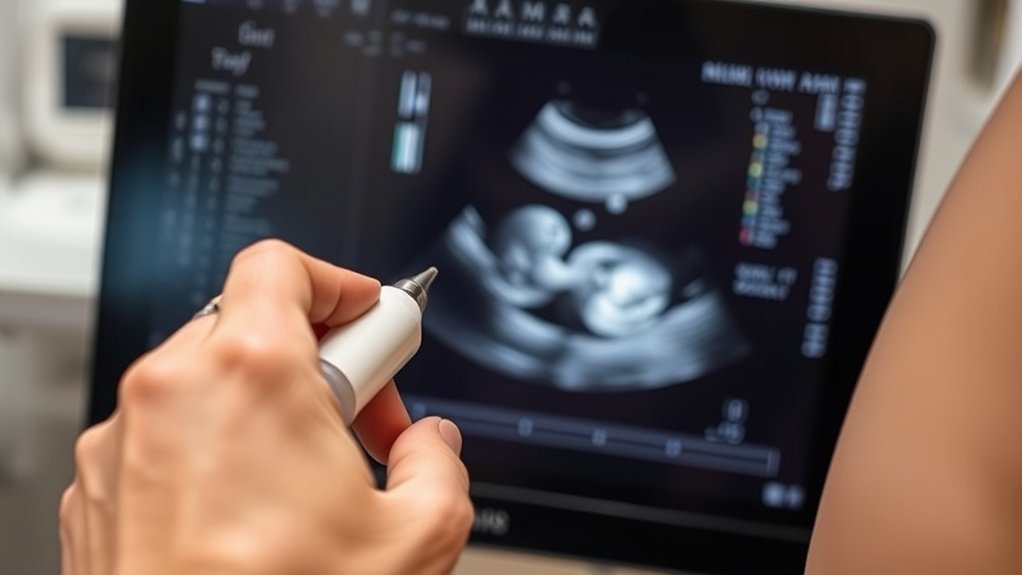
Finding out you may be carrying twins can bring excitement, questions, and worry at the same time. An ultrasound can often detect twins as early as 6 weeks of pregnancy, usually with a transvaginal scan, but results become more reliable later in the first trimester and during the 12- to 20-week scan. At 6 to 9 weeks, your clinician looks for two gestational sacs, yolk sacs, embryos, or heartbeats. Early scans can miss twins because embryos are tiny, position matters, and one baby may hide behind the other.
What’s in This Article
- How Early Can Ultrasound Detect Twins?
- What Doctors Look for on a Twin Ultrasound at 6 to 9 Weeks
- Transvaginal vs. Abdominal Twin Ultrasound
- Why Twins Can Be Missed on Early Ultrasound Scans
- Signs You May Be Pregnant With Twins
- Can Ultrasound Tell Identical and Fraternal Twins Apart?
- What the 12- to 20-Week Scan Shows for Twins
- How Doctors Monitor Twin Pregnancies After Detection
- When to Call Your Clinician After a Twin Scan
- Frequently Asked Questions
- Conclusion
Quick Answer
A transvaginal ultrasound may detect twins around 6 weeks, especially if two sacs or two heartbeats appear. A single early scan can still miss twins, so your clinician may repeat the scan. The 12- to 20-week scan gives a clearer view of both babies, their sacs, placentas, growth, and anatomy.
Key Takeaways
- Twins may appear on ultrasound as early as 6 weeks, but early results can change.
- Doctors look for two gestational sacs, yolk sacs, embryos, or heartbeats during early scans.
- A transvaginal scan usually gives clearer early images than an abdominal scan.
- Symptoms and higher hCG can raise suspicion, but ultrasound confirms twins.
- Twin pregnancies often need closer monitoring after detection.
How Early Can Ultrasound Detect Twins?

Twins can often show on ultrasound as early as 6 weeks of gestation. The exact timing depends on embryo position, scan type, image quality, and how clearly the sacs appear.
At this stage, your clinician may see two gestational sacs or yolk sacs. Those signs can suggest multiple pregnancies in the first trimester, but they do not always give the full picture.
If one twin sits behind the other, the scan can miss it. You shouldn’t treat one early image as final if your symptoms, bloodwork, or later scan suggests something different.
Follow-up scans help confirm the number of babies and give you clearer information as pregnancy advances. Detection becomes more reliable during the first trimester and clearer by the 12- to 20-week scan, when fetal anatomy and growth become easier to assess.
In twin pregnancies, regular ultrasound monitoring often supports growth checks and helps your care team watch for complications. Your clinician will choose the schedule based on your twin type, health history, and scan findings.
What Doctors Look for on a Twin Ultrasound at 6 to 9 Weeks
At 6 to 9 weeks, your clinician checks for two gestational sacs or yolk sacs. These findings help confirm twins and may show early clues about whether the babies share pregnancy structures.
The scan also checks each embryo’s size and early heartbeat. At this stage, the embryos are very small, so clear imaging matters.
Your clinician combines these findings with scan quality, gestational age, and technician skill. Together, these details help identify the twin type as accurately as possible.
Gestational Sacs And Yolk Sacs
During a twin ultrasound at 6 to 9 weeks, doctors usually look for two distinct gestational sacs. Two sacs can suggest that two embryos are developing in the uterus.
- Look for a yolk sac, which supports the embryo before the placenta takes over.
- Check the size and shape of each sac to assess early development.
- Compare the sac pattern because twin structure can affect pregnancy monitoring.
A precise twin ultrasound doesn’t define your pregnancy alone, but it gives you useful information. If the scan looks unclear, your care team can repeat it later.
Embryo Size And Heartbeats
Once doctors identify two gestational sacs or yolk sacs, they also check embryo size and cardiac activity. These details help show how the pregnancy is developing.
At 6 weeks in early pregnancy, each embryo may measure only a few millimeters, so ultrasound can have limits. In twin pregnancies, a skilled clinician may use transvaginal ultrasound to improve detail and look for two separate heartbeats.
Seeing both embryo size and heartbeats helps confirm ongoing development. It also supports timely follow-up when one baby appears smaller or harder to see.
Twin Type And Placenta
Between 6 and 9 weeks, your ultrasound may show whether your twins have separate gestational sacs or shared structures. This information can help your clinician plan monitoring.
Your doctor uses this early pregnancy scan to assess twin type, check growth and development, and look for potential complications. Early results may need confirmation as the pregnancy develops.
- Two placentas usually suggest dichorionic twins, which are often fraternal but can also be identical.
- One placenta usually suggests monochorionic twins, which are identical.
- The scan can also flag concerns such as uneven growth or a possible vanishing twin.
This information helps you plan care with more clarity. Regular follow-up lets your team monitor both babies closely and respond early if anything changes.
Transvaginal vs. Abdominal Twin Ultrasound
For early twin detection, transvaginal ultrasound often gives clearer first-trimester images. The probe sits closer to the uterus, so it can show small early structures with more detail.
An abdominal ultrasound also uses high-frequency sound waves. It often works better a little later, when twin pregnancies are easier to see and fetal development has advanced.
You’ll usually lie back while a clinician applies gel to your abdomen for an abdominal scan. During a transvaginal scan, the clinician places a slim transducer into the vagina.
Both ultrasound types are safe and useful when trained medical staff perform them. Your care team may use one or both to confirm twin pregnancies, track fetal development, and watch for complications. Safe sleep practices are essential for new parents to understand, as they can affect infant health.
You deserve clear, respectful care. The right scan can support informed choices and reduce uncertainty.
Why Twins Can Be Missed on Early Ultrasound Scans
Even at about 6 weeks of gestation, twins can be easy to miss on ultrasound. The embryos are still very small, and one baby may not appear clearly.
In early ultrasound scans, detecting twins can be limited by small size, embryo position, and sac visibility. One twin may hide behind the other, or only one sac may appear in the image.
- Ultrasound equipment quality affects image clarity.
- The operator’s skill shapes what the scan can show.
- Follow-up ultrasounds improve detection as fetal development advances.
A missed detection early on doesn’t mean your pregnancy was misread forever. It often reflects the limits of early imaging.
As pregnancy progresses, structures become easier to identify, and twins are more likely to appear clearly. You deserve accurate answers, and repeat scans can provide them.
Signs You May Be Pregnant With Twins
You may notice stronger early pregnancy symptoms, including more intense nausea, vomiting, breast tenderness, and fatigue. Twin pregnancies can produce higher human chorionic gonadotropin (hCG) levels, which may make symptoms feel stronger.
You might also gain weight more quickly than expected, and your appetite can increase earlier in pregnancy. These signs don’t confirm twins on their own, but they can raise suspicion and lead to further evaluation.
Heightened sensitivity to tastes and smells during pregnancy may also affect appetite and food preferences.
Stronger Early Symptoms
Stronger early pregnancy symptoms can sometimes point to twins, but they’re not a reliable diagnosis on their own. In the first trimester, your pregnancy may feel more intense, but only an ultrasound can confirm a twin pregnancy.
Higher hCG levels can contribute to severe morning sickness. Some expecting parents also notice unusual fatigue or stronger early symptoms sooner than expected.
- Nausea: Severe morning sickness may feel more intense and sometimes needs medical care.
- Appetite and energy: You may feel hungrier and more tired as your body supports two babies.
- Fetal movement: Later in pregnancy, you may notice movement in different areas of your abdomen.
Rapid weight gain can happen, but it isn’t the key sign. Track changes with your clinician so you can get guidance based on your health.
Rapid Weight Gain
You may notice weight gain in the first trimester, along with a stronger appetite. Your body’s energy needs rise as it supports two babies.
In twin pregnancies, some expectant parents gain weight faster than they would with one baby. Total recommended gain depends on your pre-pregnancy weight, overall health, and clinician’s guidance.
That pattern can be an early clue, but it isn’t diagnostic. Only an ultrasound can confirm twins.
Track your symptoms and weight with your clinician. Gaining too little or too much can signal a concern, so steady monitoring helps protect your health and your babies’ growth.
Higher hCG Clues
Higher levels of hCG in early bloodwork can be a clue that more than one baby is developing. Twin pregnancies often produce higher hormone levels than singleton pregnancies.
In the first trimester, your blood test may show higher hCG than expected for one baby. This can suggest a multiple pregnancy, but it doesn’t prove it.
- Watch for symptoms of twins, including stronger nausea or severe morning sickness.
- Remember that normal singleton hCG ranges can vary widely.
- Ask your clinician what your bloodwork means for your exact gestational age.
These clues can feel uncertain, but they help guide timely care. Your clinician will usually use ultrasound for confirmation.
Can Ultrasound Tell Identical and Fraternal Twins Apart?
Ultrasound can sometimes suggest whether twins are identical or fraternal, but it may not prove it. Sonographers look at gestational sacs, amniotic sacs, placentas, and fetal sex when the scan is far enough along.
Fraternal twins usually have separate placentas and sacs. Identical twins may share a placenta or sac, depending on when the embryo split.
Still, ultrasound doesn’t always confirm the type with certainty. For a definitive answer, genetic testing may be needed.
A family history of anxiety disorders can affect how some parents respond to the news of a twin pregnancy. If the news feels overwhelming, tell your clinician so they can connect you with support.
Advanced imaging and experienced sonographers improve accuracy, especially early in pregnancy. Your care team can explain what the scan shows and what it doesn’t.
What the 12- to 20-Week Scan Shows for Twins

Between 12 and 20 weeks, the ultrasound gives a much clearer view of your twins’ anatomy, growth, and development. This scan helps you and your clinician confirm how both babies are progressing.
- Your provider measures fetal growth, checks body structures, and compares both babies.
- The scan looks for placentas and amniotic sacs, which helps guide twin pregnancy care.
- It confirms both heartbeats and gives a clearer look at each baby’s position.
Your clinician also reviews the uterus, placenta, fluid levels, and related structures for potential complications. Twin pregnancies may need closer checks for issues such as growth differences, high blood pressure, or gestational diabetes.
If the scan shows a concern in fetal development, you can discuss next steps right away. This visit gives you clear information, so you can make informed decisions with confidence.
How Doctors Monitor Twin Pregnancies After Detection
After twins are detected, your clinician will usually increase surveillance. Follow-up may include ultrasounds to monitor each baby’s growth, amniotic fluid levels, placenta health, and heartbeats.
These follow-up ultrasounds help you and your care team track two babies individually. They also help your clinician respond quickly if growth, fluid, or placenta findings change.
You’ll also have regular checkups to watch for complications such as gestational diabetes or high blood pressure. These conditions can affect twin pregnancies more often than singleton pregnancies.
At each visit, your clinician measures growth, compares trends, and reviews fetal anatomy and overall well-being. The 20-week anatomy scan remains a key milestone because it gives a detailed look at structure and development.
This consistent monitoring supports early recognition of issues unique to twin pregnancies. It also helps you make informed decisions with clear, timely guidance.
When to Call Your Clinician After a Twin Scan
Call your clinician if you have bleeding, severe cramping, strong one-sided pain, fever, or repeated vomiting. You should also call if symptoms suddenly change in a way that worries you.
After a twin scan, ask what type of twins your provider suspects and when you need your next ultrasound. Also ask whether your pregnancy needs care from a maternal-fetal medicine specialist.
Warning: Seek urgent medical care for heavy bleeding, severe pain, fainting, or symptoms that feel sudden and serious.
Frequently Asked Questions
Can a 5 Week Ultrasound Detect Twins?
A 5-week ultrasound may show signs of twins, but it often cannot confirm them reliably. Your clinician may see sacs, but embryos and heartbeats may not appear clearly yet.
Can They Miss Twins at a 7 Week Ultrasound?
Yes, a 7-week ultrasound can miss twins, although better imaging reduces that chance. Embryo position, scan type, and image clarity can affect what your clinician sees.
Is 6 Weeks Too Early for a Twin Scan?
No, 6 weeks isn’t always too early for a twin scan. A transvaginal ultrasound may show two sacs or two heartbeats, but a follow-up scan may still be needed.
What Is the First Indicator of Twins?
The first clue may come from stronger symptoms, higher hCG levels, family history, or a larger-than-expected uterus. These clues can raise suspicion, but ultrasound provides confirmation.
Does Higher hCG Always Mean Twins?
No, higher hCG does not always mean twins. hCG ranges vary widely, so your clinician will interpret bloodwork with your dates, symptoms, and ultrasound findings.
Medical Disclaimer: This article is for informational purposes only and does not constitute professional medical advice. Always consult a qualified doctor, midwife, or pregnancy care clinician before making decisions based on this information.
Conclusion
Ultrasound can often detect twins early, but one early scan may not tell the full story. If your first scan seems unclear, ask when you should return for follow-up imaging. Keep track of your symptoms, attend your prenatal visits, and share concerns with your clinician. With careful monitoring, your care team can track both babies closely and help you move through your twin pregnancy with more confidence.

