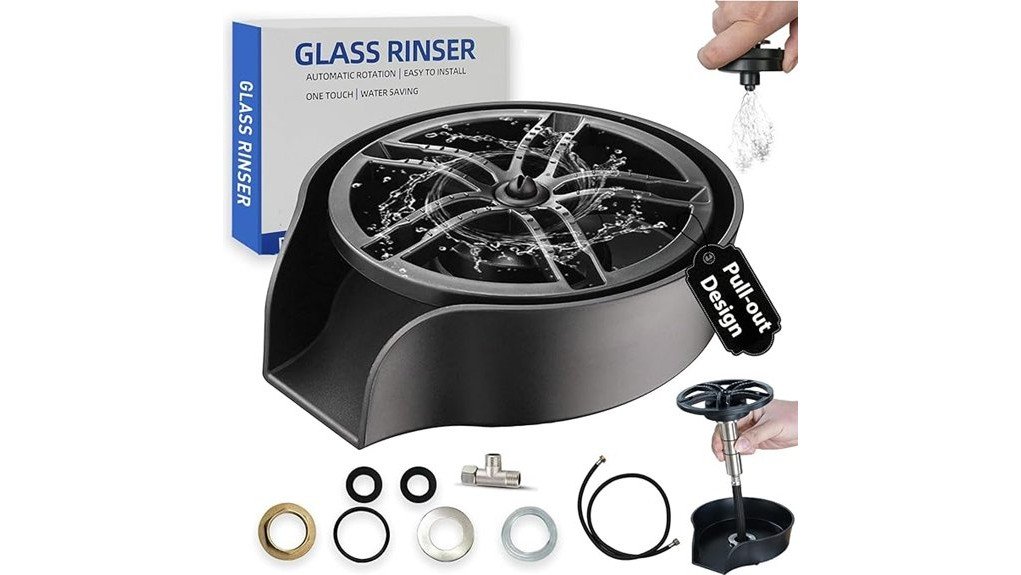
A glass rinser for kitchen sink use is a simple add-on that can change daily cleanup. It uses a 360° spray to rinse cups, bottles, and glasses with less effort than hand washing. Built from ABS and copper, it aims to resist rust and wear. The key question is whether its size, performance, and sink compatibility make it practical for most kitchens, and the answer depends on a few details.
Key Takeaways
- A glass rinser speeds cleanup by quickly flushing cups, wine glasses, and bottles with hands-free water jets.
- Its 360° spray and rotating spout help reach rims, bases, and narrow curves without extra scrubbing.
- A pull-out nozzle extending 80 cm improves access to awkward sink corners and harder-to-clean drinkware.
- Durable ABS and copper construction offers rust resistance, strength, and better long-term daily use.
- Before buying, confirm sink hole size, faucet clearance, and cabinet space for proper installation.
What Is a Glass Rinser?
A glass rinser is a sink-mounted cleaning device designed to quickly wash out cups, wine glasses, and similar drinkware with a targeted spray of water.
It supports efficient glass cleaning by reducing the need for soaking or repeated hand rinsing. As one of the more practical kitchen accessories, it fits beside a faucet and uses pressure to flush out residue from interiors and rims.
In busy households or service settings, it can save time and limit contact with dirty surfaces. The design offers a straightforward path toward faster cleanup and less routine labor.
Glass Rinser Features That Matter Most
Several features determine whether a glass rinser feels genuinely useful in daily use, and this model centers on speed, reach, and ease of operation.
Its pull-out nozzle extends 80 cm, helping users access awkward corners without struggle, while the 360° rotating spout supports strong cleaning efficiency for cups, wine glasses, and baby bottles.
The ABS base and copper body add durability without feeling excessive, and the simple sink connection improves user experience by reducing setup friction.
The ABS base and copper body add durability, while the simple sink connection reduces setup friction.
For households or small service counters, these features promote cleaner routines, less handling, and more freedom from repetitive scrubbing.
How the 360° Spray Cleans Glass Fast
The 360° spray is designed to speed up cleaning by directing water jets across the entire interior surface of a glass, reducing the need for manual scrubbing or repeated rinsing.
Its rotating action reaches rims, bases, and narrow curves in one motion, improving spray efficiency and helping loosen residue quickly.
This direct coverage supports higher cleaning speed, especially for cups, wine glasses, and baby bottles with tight openings.
The user can simply press the glass downward, let the jets work, and lift it away.
The result is a practical, hands-free process that saves time and reduces effort in daily kitchen cleanup.
Materials and Durability
Beyond spray performance, the rinser’s build quality plays a major role in everyday use. The chassis uses high-quality ABS, offering rust resistance and reducing the chance of chipping delicate glass.
Its copper main body, finished with electroplating, adds strength and a refined surface that resists daily wear. These materials create design advantages in kitchens and small beverage setups where dependable operation matters.
For maintenance tips, a quick wipe after use helps preserve the finish, while periodic checks of removable parts keep movement smooth.
Will It Fit Your Sink?
Fit matters as much as spray power, and this rinser is designed for straightforward sink compatibility in many common setups.
Fit matters as much as spray power, with a compact design suited to many common sink setups.
Its compact footprint and pull-out design suit standard kitchen sinks, bar sinks, and many utility basins, provided there is space for a mounting hole and access beneath the counter.
Before purchase, checking faucet clearance, deck thickness, and nearby plumbing is essential.
Helpful installation tips include confirming hole diameter, measuring the underside cabinet space, and verifying hose reach.
With those basics covered, the unit can integrate cleanly, giving users practical freedom without demanding a major sink overhaul.
Frequently Asked Questions
How Difficult Is the Installation Process for Beginners?
It is generally easy for beginners, since it connects directly to a kitchen sink without special tools. Practical installation tips include checking fit and tightening carefully; common beginner mistakes are skipping measurements or overtightening connections.
Does It Work Well With Baby Bottles and Narrow-Neck Containers?
Yes, it demonstrates strong baby bottle compatibility and narrow neck efficiency, thanks to its high-pressure 360° jets and pull-out nozzle. It rinses residue quickly, supporting practical, time-saving cleaning for homes seeking greater autonomy.
Can the Pull-Out Spray Handle Hard-To-Reach Sink Corners?
Yes, the pull-out spray handle can reach hard-to-reach sink corners, extending 80 cm for broad coverage. Its spray handle versatility improves sink corner access, while 360-degree rotation and practical design support thorough, efficient rinsing.
Is the Water Pressure Adjustable for Delicate Glassware?
Water pressure is not described as adjustable; the unit relies on strong jets and water flow for quick rinsing. For delicate glassware, glass safety may depend on careful use rather than pressure control.
How Easy Is It to Clean and Maintain Over Time?
It is easy to clean and maintain, though a routine remains. Cleaning frequency should be modest, with periodic rinsing of removable parts. Maintenance tips include wiping the ABS base, checking jets, and avoiding mineral buildup.
Conclusion
In the final tally, the glass rinser for kitchen sink stands as a compact tool with an unexpectedly wide reach. Its 360° spray forms a quick, shimmering ring of water that clears residue in seconds, while ABS and copper promise steady resistance to wear. The real question is fit: for the right sink, it slips into place and changes cleanup almost silently. For many kitchens, that quiet efficiency may be the detail that lingers.