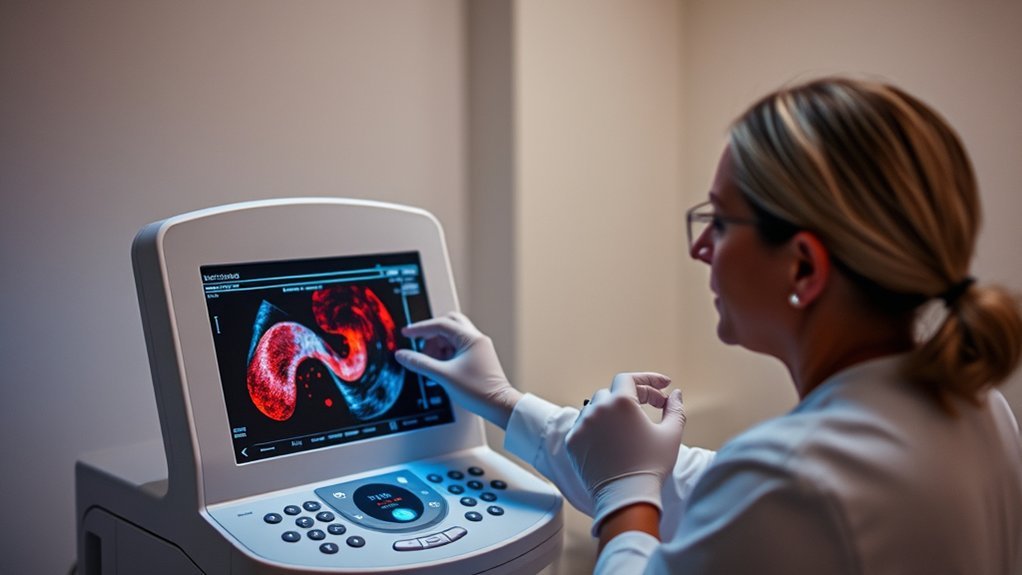
Doppler ultrasound can sound more intense than it is. You may picture radiation, pregnancy scans, or a painful test, but Doppler ultrasound uses sound waves to check how blood moves through your body. This guide explains how it works, what it can and can’t show, and how to prepare for a safer, clearer exam.
Quick Answer
Doppler ultrasound uses high-frequency sound waves, not ionizing radiation, to measure blood flow. It can help your clinician check narrowed arteries, blood clots, heart valve problems, and circulation during pregnancy. It works best when a trained professional performs the scan and your clinician reviews the results with your symptoms and other tests.
Key Takeaways
- Doppler ultrasound uses sound waves rather than X-rays or computed tomography radiation.
- Clinicians use it to check blood speed, blood direction, vessel narrowing, and possible clots.
- Test accuracy depends on operator skill, equipment settings, scan angle, and patient movement.
- Doppler ultrasound can support a diagnosis, but it does not replace a full medical evaluation.
- Pregnancy Doppler scans should follow medical guidance and avoid non-medical keepsake use.
How Doppler Ultrasound Works
When you learn about Doppler ultrasound, start with how it differs from traditional ultrasound.
Traditional ultrasound creates images of organs and tissues. Doppler ultrasound adds information about motion, especially blood flow through veins, arteries, and the heart.
Doppler ultrasound uses the Doppler effect. The machine sends sound waves into your body, then measures frequency changes as those waves bounce off moving red blood cells.
Those frequency changes help your clinician estimate the speed and direction of blood flow. That information can help identify vascular conditions, reduced circulation, or abnormal flow patterns.
Does Doppler Ultrasound Expose You to Radiation?
A common myth says Doppler ultrasound exposes you to radiation. It doesn’t.
Doppler ultrasound uses sound waves, not ionizing radiation like X-rays or computed tomography (CT) scans. The transducer sends high-frequency sound waves into your body and receives returning echoes.
Doppler ultrasound uses sound waves, not radiation, to show blood flow in real time.
According to the U.S. Food and Drug Administration, diagnostic ultrasound has an excellent safety record when trained professionals use it properly. You should still use it for a medical reason, especially during pregnancy.
What Blood Flow Problems Can Doppler Ultrasound Help Diagnose?
Doppler ultrasound gives your clinician useful information about how blood moves through your circulatory system. It can help check blood vessel health, detect abnormal flow, and guide treatment plans.
Clinicians often use it to evaluate possible arterial narrowing, venous insufficiency, deep vein thrombosis, and reduced blood flow to organs or limbs. It can also support heart tests that assess valve function and blood movement through the heart.
| Doppler Type | Key Application | Benefit |
|---|---|---|
| Continuous Wave | High-speed blood flow | Helps identify stenosis |
| Pulsed Wave | Specific location focus | Checks flow in one chosen area |
| Color Doppler | Visual flow representation | Shows flow direction and patterns quickly |
| Power Doppler | Sensitive flow detection | Detects slower or smaller-volume flow |
What to Expect During a Doppler Ultrasound
Your scan usually starts with gel placed on your skin. The gel helps the transducer send and receive sound waves without air blocking the signal.
The technologist or clinician moves the transducer over the area being checked. You may hear pulsing sounds, which come from the machine’s blood flow signal.
Most Doppler ultrasound exams feel painless. You may feel light pressure if the scan area feels tender or if the clinician needs a better view of a deep vessel.
How Accurate Are Doppler Ultrasound Results?
To understand Doppler ultrasound results, you need to know what the test measures and what can affect those measurements.
Doppler ultrasound can provide strong information about blood speed, direction, and flow pattern. Still, your clinician should interpret the results with your symptoms, exam findings, and any other tests you need.
Understanding Doppler Mechanics
A key part of Doppler ultrasound mechanics involves measuring the velocity of blood flow. The Doppler effect detects frequency shifts when ultrasound waves reflect from moving red blood cells.
The machine uses those shifts to estimate blood flow speed and direction. Modern systems may also use color flow mapping, which helps your clinician see flow patterns more clearly.
The angle between the ultrasound beam and blood flow can affect accuracy. Many vascular exams aim to keep the Doppler angle at 60 degrees or less when measuring velocity.
Interpreting Ultrasound Results
When your clinician reviews Doppler ultrasound results, they look at more than one image. They may assess spectral waveforms, color flow images, flow direction, and blood velocity.
Accuracy can vary with the operator’s skill and the machine’s settings. Your clinician should connect the scan findings with your medical history and symptoms.
Angle correction matters because poor angle setup can skew velocity measurements. Clear training, proper equipment checks, and careful technique improve result quality.
Factors That Can Affect Accuracy
Several factors can affect how reliable your Doppler ultrasound results are. The most common factors include:
- Operator skill and experience.
- Equipment quality and calibration.
- Patient movement during the scan.
- Body tissue depth or vessel location.
- Scan angle and transducer position.
These factors do not make Doppler ultrasound unreliable. They explain why trained professionals and proper technique matter.
Safety Considerations Before a Doppler Ultrasound
Doppler ultrasound has a strong safety record as a non-invasive procedure. It uses sound waves instead of ionizing radiation, so it avoids the radiation risks linked with X-rays and CT scans.
You usually don’t need incisions, injections, or sedation. Most people can return to normal activities right after the test.
Warning: Tell your healthcare provider about implantable devices, wounds, severe pain, or pregnancy before the scan so they can choose the safest approach.
Trained professionals use machine settings that limit unnecessary ultrasound energy. The American Institute of Ultrasound in Medicine advises using ultrasound only when medically needed and for the shortest time that gives useful results.
Common Misconceptions About Doppler Ultrasound in Pregnancy
Misconceptions about Doppler ultrasound in pregnancy can cause needless worry. One common myth says Doppler ultrasound emits harmful radiation that can hurt the fetus.
In reality, Doppler ultrasound uses sound waves, not radiation. When a trained medical professional uses it for a clear medical reason, it can help assess fetal blood flow and pregnancy health.
Doppler ultrasound uses sound waves, not radiation, and medical use should follow professional guidance.
Doppler ultrasound does not replace routine prenatal care. It adds information when your healthcare provider needs to check blood flow in the placenta, umbilical cord, fetal vessels, or maternal blood vessels.
Some people also worry that frequent Doppler scans may heat fetal tissues. Medical professionals manage this risk by using the lowest useful output and avoiding unnecessary scanning time.
Doppler ultrasound also can’t detect every fetal abnormality. It helps evaluate blood flow, but your clinician may use other tests to check anatomy, growth, or genetic risk.
When Doppler Ultrasound May Not Be Enough
Doppler ultrasound gives useful blood flow information, but it can’t answer every medical question. It may not show deep structures clearly in every patient or confirm the exact cause of a complex problem.
Your clinician may order magnetic resonance imaging (MRI), CT angiography, standard ultrasound, blood tests, or a biopsy depending on your symptoms. The right next test depends on what your healthcare team needs to rule in or rule out.
Frequently Asked Questions
Can Doppler Ultrasound Detect Tumors or Cancerous Growths?
Doppler ultrasound can’t directly diagnose tumors or cancerous growths. It can show abnormal blood flow patterns that sometimes appear near tumors. For a clear diagnosis, your clinician may need MRI, CT, standard ultrasound, lab tests, or a biopsy.
How Does Doppler Ultrasound Differ From a Standard Ultrasound?
Doppler ultrasound measures blood flow velocity and direction by using the Doppler effect. Standard ultrasound focuses more on the shape and structure of organs, tissues, and other anatomy.
Can Doppler Ultrasound Monitor Heart Conditions?
Yes, clinicians can use Doppler ultrasound as part of heart condition monitoring. In an echocardiogram, Doppler measurements can help evaluate valve function, abnormal flow, and pressure-related changes.
What Affects the Cost of a Doppler Ultrasound?
Cost depends on your location, the body area scanned, your healthcare provider, facility fees, and insurance coverage. Ask your provider or insurer for an estimate before the exam so you know your expected out-of-pocket cost.
What Imaging Tests Can Be Used Instead of Doppler Ultrasound?
Alternatives may include MRI, CT angiography, standard ultrasound, or catheter-based angiography. Each test has different benefits, limits, risks, and costs, so your clinician should match the test to your medical question.
Medical Disclaimer: This article is for informational purposes only and does not constitute professional medical advice. Always consult a qualified doctor before making decisions based on this information.
Conclusion
Doppler ultrasound uses sound waves to show how blood moves, not radiation. That makes it a useful tool for checking vascular health, pregnancy blood flow, and some heart-related concerns.
If your clinician recommends a Doppler ultrasound, ask what they want to learn from the test and how the results will guide your care. Clear questions help you understand the scan and make better healthcare decisions.
Used for the right reason and performed by trained professionals, Doppler ultrasound can reveal important clues while keeping the exam safe and non-invasive.
References
- Ultrasound Imaging — U.S. Food and Drug Administration
- Prudent Use and Clinical Safety — American Institute of Ultrasound in Medicine
- Doppler Ultrasound — RadiologyInfo.org
- Doppler Ultrasound — MedlinePlus

