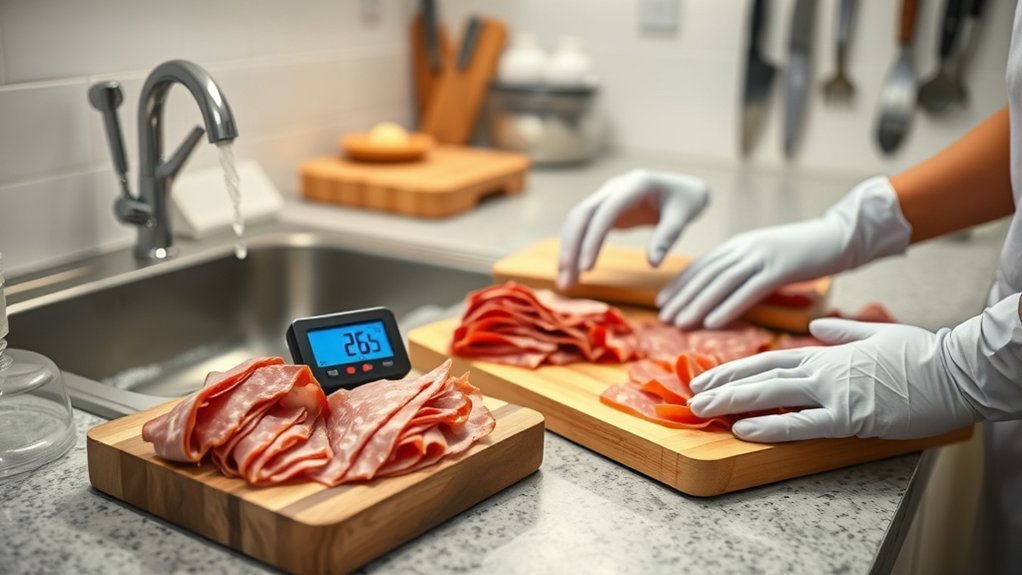
Deli meat safety depends on four things: keeping the meat cold, using it within the recommended storage window, preventing cross-contamination, and knowing when extra Listeria precautions apply. Smell and appearance can help identify spoilage, but they cannot prove that deli meat is free of harmful bacteria. Use storage time, temperature, package instructions, recalls, and risk-group guidance together.
Quick Answer
Keep deli meat at 40°F (4°C) or below. Eat opened packages and deli-sliced meat within 3–5 days; unopened luncheon meat generally keeps about 2 weeks. Freeze it for 1–2 months for best quality. People at higher risk for Listeria should avoid unheated deli meat or reheat it to 165°F or steaming hot.
Key Takeaways
- Opened packages and meat sliced at the deli counter have a much shorter refrigerator life than unopened packages.
- A “Best if Used By,” “Sell-By,” or most “Use-By” dates are generally about quality, not a guarantee of food safety.
- Listeria can survive and grow at refrigerator temperatures, so normal smell or appearance does not guarantee safety.
- Pregnant people, adults 65 or older, and people with weakened immune systems need extra precautions with deli meat.
- Freezer recommendations for luncheon meat mainly concern quality; freezing does not make contaminated food safe.
What Do Deli Meat Date Labels Mean?
A date printed on deli meat does not automatically tell you the exact day the product becomes unsafe. In the United States, phrases such as “Best if Used By,” “Sell-By,” and most “Use-By” dates generally describe product quality or inventory rather than serving as universal food-safety deadlines.
The USDA Food Safety and Inspection Service explains food date labels this way: “Best if Used By” refers to best flavor or quality, “Sell-By” helps stores manage inventory, and “Use-By” normally identifies the manufacturer’s recommended period for peak quality.
That does not mean you should ignore storage time. Once an ordinary package of luncheon meat is opened, or meat is sliced at a deli counter, the shorter refrigerator-storage window applies even if a printed date is later.
Write the opening or purchase date on the package if you may forget it. Also follow any storage and handling instructions printed by the manufacturer.
How Long Does Deli Meat Last in the Fridge or Freezer?
For most refrigerated luncheon meat, the key dividing line is whether the package is still sealed. According to the FoodSafety.gov Cold Food Storage Chart, opened packages and deli-sliced luncheon meat should generally be used within 3–5 days at 40°F (4°C) or below.
| Deli Meat Situation | Refrigerator at 40°F (4°C) or Below | Freezer at 0°F (-18°C) or Below |
|---|---|---|
| Opened package | 3–5 days | 1–2 months for best quality |
| Deli-counter sliced | 3–5 days | 1–2 months for best quality |
| Unopened package | About 2 weeks | 1–2 months for best quality |
Keep deli meat in its original package when practical, or place opened meat in a clean, tightly closed container or wrapping that limits exposure and prevents contact with other foods. Store it in a reliably cold part of the refrigerator rather than leaving it on the counter between meals.
Freezing can extend storage, but the 1–2 month guideline is mainly about maintaining good quality. FoodSafety.gov notes that food kept continuously frozen at 0°F (-18°C) or below remains safe indefinitely, although texture and flavor may decline.
How Should You Handle Deli Meat Safely?
Deli meat is usually ready to eat, so the main handling goal is to keep germs from your hands, raw foods, utensils, or surfaces from reaching it. Clean preparation matters because the meat may receive no further cooking before you eat it.
- Wash your hands. Use soap and water for at least 20 seconds before preparing food and after touching raw meat, poultry, seafood, or eggs.
- Use clean utensils and surfaces. Wash knives, plates, cutting boards, and countertops before preparing a ready-to-eat sandwich.
- Keep raw foods separate. Do not place deli meat on a board or plate that held raw meat or poultry unless it has been thoroughly washed.
- Keep the meat cold. Return the package to the refrigerator promptly rather than leaving it out through an entire meal or gathering.
- Discard temperature-abused meat. Do not leave perishable food at room temperature for more than 2 hours, or more than 1 hour when the surrounding temperature is above 90°F (32°C).
These time, handwashing, separation, and chilling recommendations follow the CDC’s four food-safety steps: Clean, Separate, Cook, and Chill.
Do You Need to Heat Deli Meat Before Eating It?
Not everyone needs to cook ready-to-eat deli meat before eating it. The important exception involves people at increased risk from Listeria monocytogenes, a bacterium that can cause serious illness and can grow at refrigerator temperatures.
The CDC recommends extra Listeria precautions for pregnant people, adults age 65 or older, and people with weakened immune systems. People in these groups should avoid unheated deli meat, cold cuts, hot dogs, and fermented or dry sausages, or reheat them to an internal temperature of 165°F (74°C) or until steaming hot.
Warning: If you are pregnant, 65 or older, or have a weakened immune system, do not rely on refrigeration alone to control Listeria risk. Follow the CDC recommendation to avoid unheated deli meat or heat it to 165°F or until steaming hot before eating.
You can heat slices in a skillet, microwave, steamer, or oven. The appliance and thickness of the slices affect heating time, so use a food thermometer when you need to confirm 165°F rather than relying only on appearance.
If you prefer a cold sandwich and are in a higher-risk group, the CDC says reheated deli meat can be allowed to cool before you eat it. Keep it protected from contamination after heating.
Note: If you are in a higher-risk group and develop symptoms after eating recalled or potentially contaminated deli meat, contact a healthcare professional for individualized advice.
How Can You Tell If Deli Meat Has Gone Bad?
Spoiled deli meat often develops noticeable changes in smell, texture, or appearance, and those changes are good reasons to discard it. However, passing a smell or visual check does not prove that the meat is microbiologically safe.
Use sensory checks as one part of the decision. Also consider how long the package has been open, whether it stayed at 40°F (4°C) or below, whether it sat out too long, and whether the product is subject to a recall.
What Visual Changes Matter?
Visible mold or obvious deterioration means the deli meat should be discarded. A damaged, leaking, or abnormally swollen package is also a reason not to use the product.
- Mold: Discard the affected deli meat rather than trimming away the visible spot.
- Unusual surface film: A persistent slick or sticky coating along with other changes suggests spoilage.
- Major appearance changes: Treat unusual changes together with smell, texture, age, and storage history.
- Color alone: Do not use color as the only test. Meat color can change for reasons other than spoilage.
What Do Smell and Texture Changes Mean?
A sour, rancid, or otherwise abnormal odor is a reason to discard deli meat. A slimy or unusually sticky surface is another common warning sign, especially when it appears after several days of refrigerated storage.
| What You Notice | What to Do |
|---|---|
| Sour, rancid, or clearly abnormal odor | Discard it |
| Slimy or unusually sticky texture | Discard it |
| Visible mold | Discard it |
| Looks and smells normal but has exceeded its safe storage window | Do not use sensory checks to override the storage guideline |
| Product is recalled | Do not eat it, even if it looks normal |
The last two situations are important because disease-causing bacteria do not always create a bad odor, slime, or obvious discoloration. Do not taste questionable deli meat to test whether it is safe.
How to Prepare a Deli Meat Sandwich Safely
A safe sandwich starts with cold deli meat, clean hands, and clean equipment. Because the filling is ready to eat, prevent raw foods and dirty surfaces from contaminating it during assembly.
- Check the storage time first. Make sure opened or deli-sliced meat is still within its recommended refrigerator window.
- Wash your hands. Clean hands before touching bread, vegetables, cheese, condiments, or deli meat.
- Use clean equipment. Prepare the sandwich on a clean plate or cutting board with a clean knife.
- Keep raw foods separate. Do not reuse a surface that held raw meat, poultry, seafood, or eggs without washing it first.
- Return leftovers to the refrigerator. Seal the deli meat after serving and refrigerate it promptly.
- Watch time away from refrigeration. If a sandwich will travel to work, school, or a picnic, keep it properly chilled rather than leaving it at room temperature for hours.
Pro Tip: Write the opening date directly on a resealable package or removable label. That makes the 3–5 day refrigerator window much easier to track than trying to remember when you first opened it.
Frequently Asked Questions
Can Deli Meat Be Frozen for Long-Term Storage?
Yes. Luncheon meat can be frozen, and the recommended freezer period is 1–2 months for best quality. Food kept continuously frozen at 0°F (-18°C) or below remains safe longer, but flavor and texture may decline, so wrap the meat tightly and freeze portions you can use conveniently.
What Are Common Allergens Found in Deli Meats?
There is no single allergen profile for deli meat. Processed meat and poultry products can contain ingredients derived from milk, soy, wheat, or other major allergens, so read the complete ingredient statement each time you buy a product, even if you have purchased the same brand before.
Are There Healthier Deli Meat Options Available?
Yes, but the best choice depends on your nutritional needs. Compare the Nutrition Facts and ingredient lists rather than judging by the meat type alone. Lean turkey or chicken may have less fat than some products, but sodium and other ingredients can still vary widely between brands and varieties.
How Can I Tell if Deli Meat Is Nitrate-Free?
Read the full label rather than relying only on a “no nitrates or nitrites added” statement. Some uncured products use ingredients that naturally supply nitrate or nitrite, such as celery powder, and the label may qualify the claim by stating that naturally occurring nitrates or nitrites are present.
Do Deli Meats Contain Gluten?
Some deli meats can contain gluten-related ingredients even though plain meat itself does not contain gluten. If you have celiac disease or need to avoid gluten strictly, read the ingredient list and look for a gluten-free claim rather than assuming every processed meat is gluten-free.
For allergen-sensitive shoppers, the USDA’s guidance on the nine major food allergens explains that processed meat and poultry can contain allergenic ingredients and that the ingredient statement should be checked carefully.
For products marketed with uncured or “no nitrates or nitrites added” wording, FSIS labeling guidance for ready-to-eat cured products explains that products using natural nitrite sources may require a qualifier such as “except for those naturally occurring” in the named ingredient.
For gluten, askFSIS guidance on gluten-free labeling claims explains that FSIS applies the FDA requirements for voluntary gluten-free claims to meat and poultry products bearing that claim.
Conclusion
Safe deli meat is less about guessing from one date or one sniff and more about controlling time and temperature. Keep it at 40°F (4°C) or below, use opened and deli-sliced meat within 3–5 days, prevent cross-contamination, and discard products with clear spoilage or unsafe storage history.
If you are pregnant, 65 or older, or have a weakened immune system, add the CDC’s Listeria precaution: avoid unheated deli meat or reheat it to 165°F or until steaming hot before eating.
Sources
- FoodSafety.gov Cold Food Storage Chart: Refrigerator and freezer storage times for luncheon meat.
- USDA FSIS Food Product Dating: Meaning of Best if Used By, Sell-By, Use-By, and other date labels.
- CDC Preventing Food Poisoning: Handwashing, cross-contamination prevention, refrigeration, and the 2-hour/1-hour rule.
- CDC Preventing Listeria Infection: Higher-risk groups and reheating deli meat to 165°F or until steaming hot.
- USDA FSIS Food Allergies: The Big 9: Allergens and ingredient labeling in processed meat and poultry.
- USDA FSIS Ready-to-Eat Fermented, Salt-Cured, and Dried Products Guideline: Nitrate and nitrite labeling for products using natural sources.
- askFSIS Gluten Free Labeling Claims: Gluten-free labeling requirements applied to FSIS-regulated products.