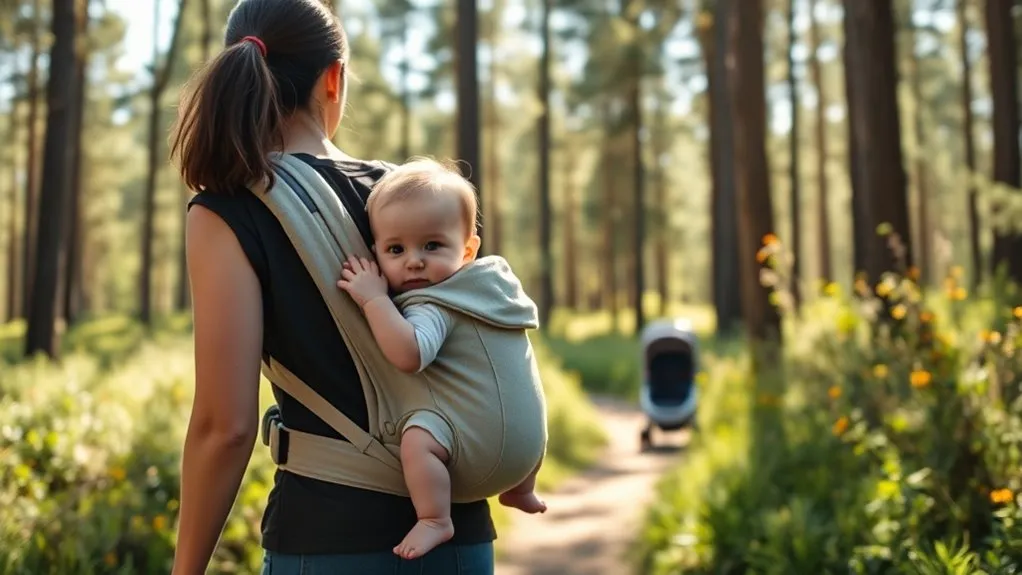
Walking outside with your baby can add useful sensory experiences, shared attention, natural light, and age-appropriate opportunities to move and explore. The benefits of walking outside with baby are most convincing when outdoor time complements active floor play, safe sleep, responsive caregiving, and sensible sun and weather protection. A stroller ride alone is not a workout for your baby, but a well-planned outing can still support a healthy daily rhythm.
Quick Answer
Walking outside with your baby can provide changing sights, sounds, natural light, shared attention, and opportunities for age-appropriate movement. The strongest evidence supports outdoor sensory experiences, active play, caregiver interaction, and healthy light-dark cues—not claims that stroller walks alone build muscle or boost immunity. Keep outings weather-safe and use stroller or carrier gear correctly.
Key Takeaways
- Outdoor walks give babies new sights, sounds, textures, and opportunities for responsive interaction with you.
- Natural daytime light can contribute to developing light-dark and sleep-wake cues, but a walk should not be treated as a sleep treatment.
- Motor development comes mainly from active, supervised movement such as floor play, tummy time, reaching, crawling, and later walking—not from sitting in a stroller.
- Strollers and carriers are useful for outings, but positioning, harness use, airway safety, sun protection, temperature, and safe sleep rules matter.
- There is no evidence-based 5-3-3 or 3-6-9 outdoor-time rule that babies need to follow.
Why Baby Walks Support Development
Baby walks support development mainly by changing what your baby can see, hear, smell, and interact with. The American Academy of Pediatrics includes outdoor stroller walks or infant-carrier walks among everyday activities that can show babies new things.
That sensory variety matters because babies learn through repeated interaction with their surroundings. You can point to a tree, name a passing dog, imitate a bird sound, or simply let your baby watch leaves move in the wind. These simple exchanges combine sensory input with language and social attention.
Outdoor walks are most useful as a changing environment for seeing, hearing, interacting, and learning—not as a shortcut to faster development.
It is also important not to overstate the evidence. Much of the broader research on outdoor developmental benefits comes from older children, while direct research on infants remains more limited. A 2024 study of mother-infant outdoor habits specifically noted that the developmental effects of outdoor walking during infancy still need more research.
Outdoor exposure should also not be presented as a proven way to “train” a baby’s immune system or prevent common illnesses. A walk can be a healthy family activity without making that stronger medical claim.
[Products Worth Considering]

This parent-focused guide explains how babies and toddlers learn cause and effect through everyday play, routines, and simple experiments. It covers age-by-age milestones from early sensory responses to predicting outcomes and understanding rules. You’ll also find kid-friendly activity ideas and practical strategies that support cognitive growth, early language skills, and emotional regulation.

This parent-focused guide explains how babies and toddlers learn cause and effect through everyday play, routines, and simple experiments. It covers age-by-age milestones from early sensory responses to predicting outcomes and understanding rules. You’ll also find kid-friendly activity ideas and practical strategies that support cognitive growth, early language skills, and emotional regulation.

This parent-focused guide explains how babies and toddlers learn cause and effect through everyday play, routines, and simple experiments. It covers age-by-age milestones from early sensory responses to predicting outcomes and understanding rules. You’ll also find kid-friendly activity ideas and practical strategies that support cognitive growth, early language skills, and emotional regulation.
Outdoor Walks and Baby Sleep
Outdoor walks may help reinforce daytime cues because light is one of the signals involved in developing circadian rhythms. Research in young infants has found an association between greater daytime light exposure and more nighttime sleep, although that does not mean a walk will reliably make every baby sleep longer.
One study of babies aged 6 to 12 weeks found that infants who slept better at night had received more light in the early afternoon. The researchers concluded that normal environmental light may influence development of the circadian system. You can read the infant light and sleep study on PubMed.
A consistent walk can also become part of a predictable daytime routine. Feeding, talking, outdoor time, play, and bedtime cues can gradually help your baby distinguish daytime activity from nighttime rest.
The original research behind the outdoor-sleep figures needs context. A survey of 1,275 mothers found that about 29% regularly placed their infants outdoors to sleep, averaging about four hours of outdoor sleep per week. That study described family behavior; it did not establish outdoor sleeping as safer or better. The same mother-infant outdoor activity study called for further research on developmental effects.
Warning: A stroller, car seat, swing, infant carrier, or sling should not be used as a routine sleep surface. If your baby falls asleep in one, the American Academy of Pediatrics recommends moving them to a firm, flat, non-inclined sleep surface on their back as soon as it is safe and practical.
The AAP safe-sleep recommendations are more important than trying to time walks around stroller naps.
How Outdoor Walks Build Physical Skills
Outdoor time can support physical development when your baby gets safe opportunities to move. Sitting or lying in a stroller does not itself strengthen the same muscles as tummy time, reaching, rolling, crawling, pulling up, or walking.
The World Health Organization recommends that infants be physically active several times each day, especially through interactive floor-based play. For babies who are not yet mobile, this includes supervised tummy time spread through the day. The WHO infant activity guidance also advises against keeping infants restrained in a stroller, high chair, or carrier for more than one hour at a time.
You can combine a walk with active play. In a safe shaded area, for example, place your awake baby on a clean blanket for reaching, kicking, supervised tummy time, or sitting practice appropriate to their stage.
A stroller gets your baby outdoors; active, supervised movement is what builds motor skills.
Later, when your child can crawl, stand, and walk, safe outdoor surfaces can offer more movement variety. Grass, gentle slopes, and firm paths can change the balance and coordination demands, but stay within your child’s current abilities and supervise closely.
What Babies Learn Outside
Outside, babies encounter sensory information that changes constantly. Wind, birds, traffic sounds, shadows, leaves, faces, animals, and changing light give you many natural opportunities to help your baby notice and learn.
You can turn a simple walk into language practice by naming what your baby looks at. Say “tree,” “red car,” or “bird,” pause when your baby vocalizes, and respond to what seems to hold their attention. This kind of back-and-forth interaction is more meaningful than simply exposing a baby to more stimulation.
For an older baby, a safe outdoor blanket can add supervised reaching, grasping, sitting, or crawling. The goal is not to push milestones. It is to create age-appropriate opportunities to explore.
Outdoor time can also introduce predictable environmental patterns. Daylight, evening dimness, weather, and familiar routes become part of your baby’s growing understanding of daily life.
How Outdoor Walks Strengthen Bonding
Walking gives you uninterrupted time to watch your baby’s cues, talk, point things out, and respond. Those repeated interactions can support connection even though researchers cannot say that outdoor walking by itself creates stronger attachment.
There is emerging research on short-term stress responses during walks. A 2026 randomized crossover study had mother-infant pairs complete walks in both natural and urban residential settings. Salivary cortisol decreased after both kinds of walks, while mothers reported feeling calmer and more pleasant afterward. The researchers did not find that the natural route produced a clear physiological advantage over the urban route.
This matters because it suggests that the shared act of taking a walk may be useful even when you do not live near a large park. A quiet neighborhood loop can still provide movement, a change of setting, and focused time together.
The strongest bonding opportunity comes from what you do during the outing: noticing your baby’s signals, talking, comforting, smiling, and responding rather than trying to achieve a particular number of minutes outdoors.
How to Keep Baby Walks Safe
Safe baby walks depend more on positioning, weather, sun exposure, equipment, and route choice than on reaching a particular duration. Check your baby frequently and adjust the outing when conditions change.
Note: If your baby was born prematurely, has breathing or temperature-regulation problems, or has another medical condition, ask your pediatrician whether you need additional precautions for carriers, weather, or longer outings.
Choosing Safe Walking Routes
Choose routes where you can control the main hazards. Smooth paths, lower traffic, good visibility, shade, and easy access back home can make an outing simpler and safer.
Use the stroller harness every time, apply the brake when stopped, and make sure the stroller is fully locked open before placing your baby inside. Avoid hanging heavy bags from handles if they could affect stability.
If you plan to stop for active play, choose an area away from traffic, standing water, sharp objects, animal waste, and surfaces that are excessively hot or cold.
Weather, Gear, and Shade
Babies need more protection from sun and temperature extremes than adults. For infants younger than 6 months, the American Academy of Pediatrics recommends keeping them out of direct sunlight and using shade, lightweight covering clothing, and a hat as the main protection.
If adequate shade and clothing are not available, the AAP says sunscreen may be used on small exposed areas of a baby younger than 6 months. For older babies, use appropriate sunscreen on exposed skin along with shade and protective clothing. See the AAP sun-safety guidance.
Do not turn a stroller into a closed tent with a blanket. Keep airflow around your baby, use the stroller’s designed canopy or sunshade, and check frequently for overheating or chilling.
Easy Ways to Start Walking Outside With Baby
You do not need a complicated schedule to make outdoor walks useful. Start with a route that feels manageable, use safe equipment, and fit outings around feeding, changing, weather, and your baby’s mood.
A 2024 survey found that mother-infant pairs averaged about 201 minutes of walking each week. That number describes the participating families; it is not a recommended weekly target or a minimum needed for development.
Pick Short Daily Routes
A short route near home makes it easier to end the walk when your baby becomes hungry, tired, too hot, too cold, or overstimulated. There is no evidence-based requirement that a baby walk must last 15, 30, or any other fixed number of minutes.
Instead, use your baby’s comfort and the conditions outside as your guide. A walk around the block can provide new sights and sounds without turning the outing into a major event.
As the routine becomes easier, you can vary the route or add a stop for supervised active play.
Use Stroller Or Carrier
A stroller and a baby carrier can both work well, but each has different safety considerations. Follow the manufacturer’s age, weight, recline, and positioning instructions for the exact product you use.
With a stroller, secure the harness and use the brake whenever you stop. With a sling or soft carrier, pay special attention to breathing position.
The U.S. Consumer Product Safety Commission warns that an infant’s face should remain visible, the nose and mouth must stay unobstructed, and the baby’s chin should not curl down against the chest. These points are especially important for very young infants. Review the CPSC sling-carrier safety advice.
Remember that stroller and carrier time should not replace opportunities for your baby to move freely while awake.
Time Walks With Naps
You can schedule a walk near a normal nap if that timing makes family life easier, but do not rely on a stroller or carrier as the baby’s regular sleep location. A baby who falls asleep during a walk still needs safe positioning and supervision.
Once practical, transfer a sleeping infant to an appropriate firm, flat sleep surface according to AAP safe-sleep guidance. The movement of a stroller may be soothing, but soothing is not the same as providing a safe sleep environment.
Daytime outdoor light can contribute to light-dark cues, but sunlight should not be used as a way to supply your baby’s vitamin D. The CDC states that children younger than 12 months need 400 IU of vitamin D per day, and breastfed or partially breastfed babies generally need supplementation beginning shortly after birth. See the CDC vitamin D guidance.
How to Walk Outside With Baby in Any Weather
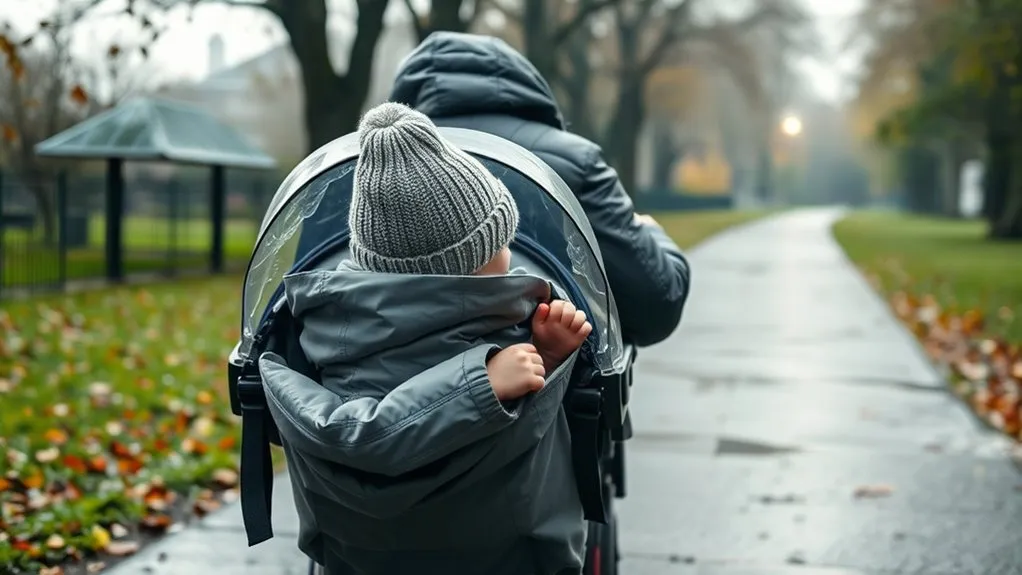
Walking in different seasons is possible when conditions are safe, but “any weather” should not mean pushing through dangerous heat, cold, storms, smoke, or poor air quality. Adjust the route, timing, clothing, and length to the conditions.
- Check the forecast and outdoor conditions before leaving.
- Use lightweight, breathable clothing in heat and appropriate layers in cooler weather.
- Keep babies younger than 6 months out of direct sunlight as much as possible.
- Use a stroller or carrier according to its instructions and your baby’s developmental stage.
- Keep your baby’s face and airway visible in a carrier.
- Watch for unusual sleepiness, heavy sweating, flushed or very cold skin, breathing difficulty, or other signs that your baby is not tolerating the conditions.
- Shorten or skip the walk when conditions are unsafe.
Flexibility is more useful than maintaining a perfect streak. Moving an outing to a cooler part of the day, choosing a shaded route, or staying indoors during hazardous conditions does not reduce the value of your overall routine.
Frequently Asked Questions
Are Walks Outside Good for Babies?
Yes, outdoor walks can be good for babies when they are safe and age-appropriate. They provide changing sensory experiences, natural daytime light, opportunities for interaction with you, and an easy way to combine family movement with supervised outdoor play.
What Is the 5-3-3 Rule for Babies?
There is no recognized 5-3-3 rule that tells parents how many days, hours, or environments a baby should spend outside. The phrase is used online for different sleep routines, so it should not be treated as an American Academy of Pediatrics, CDC, or WHO outdoor-time recommendation.
What Is the 3-6-9 Rule for Babies?
There is no official 3-6-9 outdoor rule requiring three hours at 3 months, six hours at 6 months, and nine hours at 9 months. Pediatric and public-health guidance focuses instead on safe active play, avoiding excessive restraint, healthy sleep, and protection from environmental hazards.
How Long Should a Baby Stay in a Stroller or Carrier?
There is no required length for a baby walk, but WHO guidance says infants should not be restrained in a stroller, high chair, or on a caregiver’s back for more than one hour at a time. Break up longer outings with feeding, changing, holding, or safe active movement when appropriate.
Can My Baby Nap in the Stroller During a Walk?
A baby may fall asleep during a walk, but a stroller should not be used as the baby’s routine sleep surface. The AAP recommends moving a sleeping infant to a firm, flat, non-inclined sleep surface on their back as soon as it is safe and practical.
Conclusion
Outdoor walks can be a useful part of your baby’s day because they create opportunities for sensory learning, responsive interaction, daylight exposure, and family movement. Pair stroller or carrier outings with active floor play, follow safe-sleep and sun guidance, and let weather and your baby’s comfort determine the pace. A simple, safe routine matters more than reaching a made-up outdoor-time target.
Sources
- American Academy of Pediatrics: How Active Is Your Baby?: Supports outdoor walks, interaction, and age-appropriate infant activity.
- World Health Organization: Physical Activity, Sedentary Behaviour and Sleep Guidance: Supports active floor play and the one-hour restraint recommendation.
- Infant Care: Predictors of Outdoor Walking, Infant Carrying and Infant Outdoor Sleeping: Supports the 201-minute walking average, carrier use, and outdoor-sleep prevalence figures.
- PubMed: Daytime Light Exposure and Night-Time Sleep in Infants: Supports the discussion of daytime light and developing infant sleep-wake rhythms.
- American Academy of Pediatrics: 2022 Safe Sleep Recommendations: Supports guidance on strollers, carriers, sitting devices, and firm flat sleep surfaces.
- American Academy of Pediatrics: Sun Safety: Supports shade, clothing, sunscreen, and sun protection for babies.
- U.S. Consumer Product Safety Commission: Infant Sling Carrier Safety: Supports airway and positioning precautions for infant carriers.
- CDC: Vitamin D for Infants and Toddlers: Supports current infant vitamin D intake and supplementation guidance.