Disclosure: As an Amazon Associate, we earn from qualifying purchases. If you buy through links on this page, we may earn a small commission at no extra cost to you.
By Editorial Team | Updated October 9, 2026
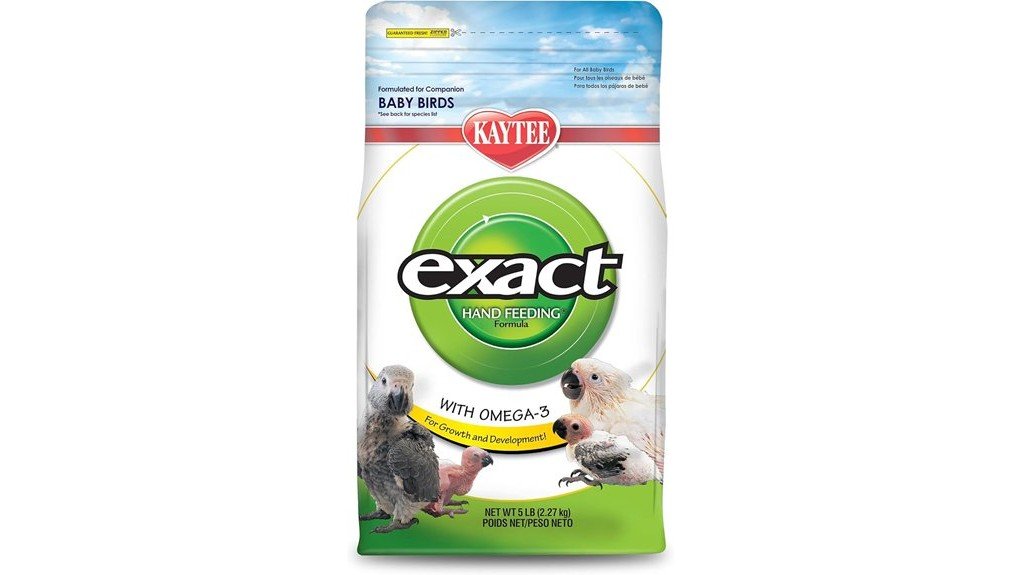
Kaytee Exact Baby Bird Food is a powdered hand-feeding formula designed for growing parrots, parakeets, lovebirds, cockatiels, and other suitable young birds. It provides at least 22% crude protein and 9% crude fat, along with probiotics, digestive enzymes, vitamins, and minerals.
Its main advantages are its formulated nutrition and clear preparation instructions. However, safe hand-feeding takes training, accurate temperature checks, and careful monitoring. This review explains what the formula offers, where it falls short, and whether the 5-pound package linked here makes sense for your needs.
Quick Verdict
Editorial Rating: 4/5
Source-based editorial assessment, not a hands-on feeding test.
9% min. fat
Added probiotics
Digestive enzymes
5-pound linked package
Best for: Experienced bird breeders and trained caregivers feeding compatible baby birds under an established care plan.
Skip if: You have no hand-feeding training, need food for an unidentified wild bird, or cannot use a large package before it loses freshness.
Bottom line: Kaytee Exact offers a documented nutritional formula for hand-rearing, but it cannot replace safe feeding skills or veterinary guidance.
Before You Buy
- Package size: The existing Amazon link currently identifies a 5-pound package. Check the selected size before ordering.
- Freshness: Kaytee recommends using opened dry powder within 30 to 45 days unless extended storage measures are used.
- Safety: Formula that is too hot, too cold, too thick, or delivered incorrectly can seriously harm a chick.
- Species: Broad compatibility claims do not mean the same formula or feeding routine suits every bird.
Contents: Jump to a Section
Key Takeaways
- Kaytee Exact is a hand-feeding formula for young birds that require carefully managed nutrition.
- The published formula contains a minimum of 22% protein, 9% fat, and 0.5% omega-3 fatty acids.
- Added probiotics and digestive enzymes are intended to support digestive function.
- Kaytee specifies mixing with water at approximately 120°F, then cooling the prepared food to around 105°F before feeding.
- Prepared formula must be discarded after each feeding, not saved for later.
- The linked 5-pound size is likely more practical for regular or multi-bird feeding than occasional use with one chick.
What Is Kaytee Exact Baby Food?
Kaytee Exact Baby Bird Food, officially called Kaytee Exact Hand Feeding Formula, is a complete powdered diet intended for hand-rearing compatible baby birds. It is mixed with clean water and delivered using a suitable feeding method by someone trained in the procedure.
Kaytee lists baby parrots, including parakeets, lovebirds, cockatiels, conures, cockatoos, macaws, Amazons, and African greys, along with baby passerines, among the intended users.
The formula contains ground grains, plant and egg protein ingredients, added fats, vitamins, minerals, probiotics, and digestive enzymes. According to Kaytee’s official product information, it is formulated to support growth, feather development, and the transition toward independent eating.
Those are manufacturer-stated benefits, not a guarantee that every chick will grow faster or wean earlier. Nutrition, species, age, brooder conditions, and feeding technique all affect the outcome.
Kaytee Exact Specifications
The most useful specifications are the guaranteed nutrient percentages and the preparation requirements. The table below separates the nutritional analysis from the Amazon package details.
| Specification | Published Information |
|---|---|
| Brand | Kaytee |
| Product | Exact Hand Feeding Formula |
| Form | Dry powder mixed with water |
| Crude protein | 22% minimum |
| Crude fat | 9% minimum |
| Crude fiber | 5% maximum |
| Moisture | 10% maximum |
| Omega-3 fatty acids | 0.5% minimum |
| Probiotic content | 250,000 CFU/g minimum total Bacillus species |
| Mixing water | Approximately 120°F (49°C), before cooling |
| Feeding temperature | Approximately 105°F (40.5°C); Kaytee lists 102°F to 110°F |
| Amazon package linked | 5 pounds |
| Model number | 100036946 |
| Amazon ASIN | B0002565FM |
Understanding the analysis: These percentages describe the dry formula, not the diluted mixture in a feeding syringe. They are guaranteed minimum or maximum values, rather than laboratory measurements of an individual package.
What’s in the Package?
The linked product listing identifies a 5-pound package of Kaytee Exact hand-feeding powder. It does not identify a thermometer, gram scale, syringe, or brooder as included equipment.
Those supplies are important for safe hand-rearing and should be arranged separately. Always inspect the actual package and confirm the size, seal, ingredients, expiration date, and included items when it arrives.
Kaytee Exact Baby Bird Food Pros and Cons
The strongest reasons to choose this formula are its published nutrient profile, digestive additives, and established preparation guidance. The biggest drawbacks involve the risks of hand-feeding and the effort required to maintain freshness.
Pros
- Published nutrient analysis for a formulated chick diet
- Added probiotics and digestive enzymes
- Clear manufacturer mixing and storage guidance
- Suitable for several listed companion-bird species
Cons
- Hand-feeding mistakes can cause serious injury
- Fresh formula must be mixed for every meal
- Five-pound linked package may be wasteful for one chick
- Not suitable for every species or sick bird
Kaytee Exact Baby Food Benefits
Kaytee Exact combines a formulated nutrient base with ingredients intended to support digestion and chick development. Its main benefits are nutritional consistency and suitability for supervised hand-rearing, rather than any independently proven promise of faster growth.
1. Protein and Energy for Growth
Growing chicks need adequate protein and energy to develop tissues, muscles, and feathers. Kaytee Exact provides a minimum of 22% crude protein and 9% crude fat in its dry formula.
Kaytee promotes the formula as supporting faster growth, earlier weaning, and brighter plumage. These remain brand claims. A bird’s actual development also depends on feeding amounts, temperature, health, and environmental conditions.
2. Probiotics and Digestive Enzymes
Kaytee includes Bacillus-based probiotics and fermentation-derived digestive enzymes. The manufacturer says these ingredients help maintain intestinal microorganisms and support the digestion of carbohydrates and proteins.
That is a useful feature for a developing digestive system, but it should not be treated as a cure for crop problems, bacterial infections, or digestive disease.
A chick with abnormal crop emptying, regurgitation, or a weak feeding response needs veterinary assessment rather than relying on a probiotic-containing formula alone.
3. Omega-3 Fatty Acids and Added Micronutrients
The formula contains ground flaxseed as a source of omega-3 fatty acids, along with added vitamins and minerals. Kaytee guarantees at least 0.5% omega-3 fatty acids in the dry powder.
These nutrients form part of the formula’s overall nutritional design. However, more is not automatically better. Kaytee advises against adding separate vitamin or mineral supplements to its complete formula without a specific reason.
4. Convenient Powder Preparation
Powdered food is easier to portion than preparing a homemade nutritional mixture from scratch. Kaytee provides age-based dilution instructions, giving trained caregivers a repeatable preparation method.
The trade-off is that each meal requires a fresh batch. Accurate weighing, mixing, temperature testing, and equipment cleaning remain essential.
How to Mix and Feed Kaytee Exact
Kaytee Exact must be mixed at the correct concentration and cooled to a safe feeding temperature. The manufacturer’s instructions use water heated to approximately 120°F for mixing, followed by cooling to approximately 105°F before feeding.
Important: Hand-feeding baby birds is a skilled procedure. The following summarizes published guidance and is not a substitute for supervised training or a bird-specific feeding plan.
Feeding Safety Warning: Excessively hot food may burn a chick’s crop, the pouch near the base of the neck where food is held before digestion. Incorrect syringe feeding can push formula into the airway and cause aspiration pneumonia. Never force-feed a chick that is weak, refusing food, or breathing abnormally.
Step-by-Step Preparation
- Wash and sanitize your equipment. Prepare a clean mixing container, accurate gram scale, thermometer, and an appropriate feeding tool.
- Measure the correct concentration. Follow the current package’s age-based mixing chart and your avian veterinarian’s instructions. Weighing powder and water is more accurate than estimating by volume.
- Add clean hot water. Kaytee specifies approximately 120°F (49°C) water for preparation.
- Mix thoroughly. Stir until hydrated and allow the mixture to stand for about one minute. Stir again to distribute the powder evenly.
- Check the feeding temperature. Cool the mixture to around 105°F (40.5°C), testing it with a thermometer. Avoid hot spots and never judge temperature by touch alone.
- Feed only when appropriate. A trained caregiver should confirm the chick has a normal feeding response and its crop has emptied sufficiently before the next feeding.
- Discard and clean. Throw away all mixed leftovers after the meal. Clean and disinfect feeding utensils before their next use.
Kaytee’s Age-Based Mixing Chart
Kaytee’s published educational reference guide gives the following volume ratios. These are manufacturer guidelines, not a feeding prescription for an unidentified or sick bird.
| Chick Age | Powder to Water by Volume | Preparation Note |
|---|---|---|
| Hatch to 2 days | 1 part powder to 6 parts water | Very dilute; stir often because separation may occur |
| 2 to 5 days | 1 part powder to 2–3 parts water | Concentration increases as the chick develops |
| 5 days to weaning | 1 part powder to 1⅓–2 parts water | Typically approaches a creamy-pudding consistency |
For the full preparation details, read Kaytee’s educational hand-feeding reference guide. Follow your veterinarian’s individualized instructions if they differ from the general age chart.
Kaytee’s feeding-temperature range is 102°F to 110°F. VCA Animal Hospitals recommends the narrower range of 102°F to 106°F. A target close to 105°F is consistent with both sources.
How Much and How Often?
Kaytee’s general feeding guideline describes a meal volume around 10% to 12% of the chick’s body weight. This is not a reason to force a fixed volume into every bird. The crop’s condition, feeding response, and veterinary plan determine what is appropriate.
Newly hatched birds need more frequent meals than older chicks. VCA provides general guidance of 6 to 10 feedings daily for chicks younger than one week, with feeding frequency decreasing during development.
Keep a daily log of body weight, feeding amounts, crop emptying, and droppings. Kaytee recommends weighing each chick before its first morning feeding to help detect feeding or growth problems early.
Common Feeding Mistakes
| Step | Target | Effect |
|---|---|---|
| Mix | Correct concentration and smooth slurry | Helps maintain consistent nutrition and texture |
| Feed | Measured temperature and normal feeding response | Reduces avoidable feeding risks |
| Clean | Fresh batch and sanitized utensils | Limits contamination risk |
Avoid microwaving formula because uneven heating can create dangerously hot areas. Do not use saved mixed formula, feed into an already overfilled crop, or attempt to manage crop stasis at home without veterinary direction.
What Baby Birds Can Use Kaytee Exact?
Kaytee Exact is marketed for several species of baby parrots and certain baby passerines. Even among the listed birds, feeding routines differ with age, crop development, and individual health.
- Parrots and parakeets: Included among the formula’s intended species, with feeding amounts adjusted to age and condition.
- Lovebirds and cockatiels: Common companion birds requiring careful portion control and monitoring during hand-rearing.
- Conures, cockatoos, macaws, Amazons, and African greys: Listed by Kaytee, although larger species may have different energy requirements.
- Baby passerines: Listed as potential users by the manufacturer, but not all passerines have the same dietary needs.
For an unidentified wild nestling, contact a licensed wildlife rehabilitator or veterinarian before offering food or water. An inappropriate diet or incorrect feeding technique may cause serious harm.
Best Use: Supervised Hand-Rearing
Experienced caregivers with an established brooder, scale, thermometer, and feeding plan are the clearest match. They can follow the bird’s growth and adjust care before small problems become emergencies.
Best Use: The Transition Toward Weaning
As chicks begin exploring solid food, hand-feeding may continue while appropriate transition or adult diets are gradually introduced. Kaytee recommends offering suitable Exact Conversion or adult diets as birds develop.
Weaning should be guided by independent food intake, stable health, and body-weight trends, not a fixed deadline.
Veterinary Use: Nutritional Support
A veterinarian may choose a hand-feeding formula for some birds needing nutritional support during recovery. However, sick birds can have crop motility problems, dehydration, infections, or injuries that make ordinary feeding routines unsafe.
Do not use this product to treat an ill bird without a veterinary feeding plan.
Kaytee Exact Baby Food Limits and Best Uses
Kaytee Exact’s biggest limitation is not a missing nutrient claim. It is the skill needed to prepare and deliver food safely to a fragile young bird.
The formula may be well suited to experienced hand-rearing, but it is a poor substitute for parent feeding or professional care when those options are available and appropriate.
Temperature and Crop Problems
Formula that is too hot can burn the crop. Formula that is too thick or too cold, along with poor environmental conditions, can contribute to delayed crop emptying.
The Merck Veterinary Manual’s guidance on diseases of young birds identifies crop burns, crop stasis, and aspiration pneumonia as important complications of hand-feeding.
Warning signs include weak feeding responses, breathing trouble, a crop that does not empty normally, regurgitation, and poor weight gain. These require prompt veterinary attention.
Hygiene and Short Mixed-Formula Life
Prepared formula should not be kept for a second meal. Kaytee specifically directs caregivers to discard all mixed leftovers, even if they appear clean.
Dry powder has different storage rules. Kaytee recommends tightly resealing the opened package and using it within 30 to 45 days for best freshness, with refrigeration or freezing as options for longer dry-product storage.
When to Skip This Formula
- You have no training in hand-feeding baby birds.
- The chick has breathing problems, abnormal crop emptying, oral injuries, or severe weakness.
- The species has not been identified or its dietary needs are unknown.
- You expect to use prepared formula over multiple meals.
- You need a different nutrient profile recommended by your avian veterinarian.
Professional guidance matters most when a bird is sick. Do not attempt feeding tubes, force-feeding, crop massage, or other treatment techniques without suitable clinical training.
What Owners Report About Kaytee Exact
Published owner feedback is generally positive about ease of mixing and use with young birds. However, individual experiences cannot establish that a formula is medically appropriate for every species or feeding situation.
What Owners Like
Several reviewers on Chewy’s Kaytee Exact review page describe long-term use, straightforward mixing, and a smooth consistency suitable for their feeding equipment.
Some owners also report using the formula successfully for parrots and other birds. Those comments describe personal outcomes, not controlled comparisons against other formulas.
Common Watch-Outs
Not every owner is satisfied. Individual reviews mention concerns such as receiving packages with less remaining shelf life than expected.
Feedback on Petco’s Kaytee Exact listing also includes mixed opinions about whether it is the preferred formula for experienced breeders.
Package freshness deserves particular attention when purchasing a large quantity. Check the expiration date as soon as your order arrives, and avoid assuming that a larger package always represents better value.
Owner-feedback takeaway: Mixing convenience and familiarity are recurring strengths, but consistent outcomes depend heavily on the individual bird and the caregiver’s technique. These reports do not replace veterinary evidence or hands-on product testing.
Kaytee Exact vs. Other Hand-Feeding Formulas
Three alternatives worth comparing are Kaytee Exact High Fat, Harrison’s Juvenile Hand-Feeding Formula, and Tropican Hand-Feeding Formula. Their published nutrient profiles differ, so the right choice depends on the species and care plan.
| Formula | Protein Min. | Fat Min. | Main Distinction |
|---|---|---|---|
| Kaytee Exact Standard | 22% | 9% | Standard formula with probiotics and enzymes |
| Kaytee Exact High Fat | 22% | 16% | Higher-fat nutrient profile |
| Harrison’s Juvenile | 18% | 11% | Certified-organic grain and legume formula |
| Tropican Hand-Feeding | 22% | 11% | Micro-ground extruded formula for baby parrots |
All percentages are manufacturers’ guaranteed minimum values for the dry formulas. They do not establish equivalent performance across bird species.
Kaytee Exact High Fat
Kaytee Exact High Fat has a 16% minimum crude fat level compared with 9% in the standard formula. It may be relevant when an avian professional recommends a higher-fat diet for a particular bird.
It should not be substituted simply because more fat sounds better. Review the manufacturer’s High Fat formula details before considering a change.
Harrison’s Juvenile Hand-Feeding Formula
Harrison’s offers a certified-organic formula using whole grains and legumes. Its published analysis lists 18% minimum protein and 11% minimum fat.
The product also has specific age and species guidance. For example, Harrison’s directions do not recommend beginning its Juvenile formula at the same age for every parrot species. See the official Harrison’s Juvenile formula instructions before choosing it.
Tropican Hand-Feeding Formula
Tropican uses a micro-ground extruded formula designed for baby parrots. Its guaranteed analysis lists at least 22% crude protein and 11% crude fat.
It contains peanut-derived ingredients and offers a different formulation approach. The HARI Tropican product information provides its ingredients, nutrient analysis, and intended feeding applications.
Which should you choose? There is no universal winner based only on protein and fat percentages. Ask your avian veterinarian or experienced aviculturist which formula fits the bird’s species, age, health, and existing diet. Sudden formula changes can disrupt feeding and crop function.
Is Kaytee Exact Worth the Price?
Kaytee Exact is a reasonable product to consider when you already have the skills and equipment for safe hand-rearing. Its published nutritional information and established preparation instructions make it easier to evaluate than a poorly documented formula.
The value depends heavily on how much you actually need. The preserved Amazon link points to a 5-pound package, which may suit a breeder caring for multiple chicks but could be excessive for one small bird.
Since Kaytee recommends using opened dry powder within 30 to 45 days under normal storage guidance, unused product can reduce the value of a bulk purchase. Consider the expiration date, storage conditions, and expected feeding period rather than package size alone.
Our assessment: The formula offers a credible nutritional option for trained users, but it is not a beginner-friendly shortcut. That balance supports the 4/5 editorial rating.
How We Evaluated Kaytee Exact
This review is based on published product information, manufacturer preparation instructions, veterinary hand-feeding guidance, and publicly available owner feedback. No hands-on feeding test, laboratory analysis, or independent growth trial was performed for this article.
The editorial rating considers nutrient transparency, preparation instructions, intended uses, safety limitations, and practical buying concerns. Manufacturer-promoted benefits are distinguished from veterinary guidance and individual owner reports.
Frequently Asked Questions
How long can mixed Kaytee Exact stay safe before feeding?
Kaytee says to discard every unused portion immediately after a feeding. Prepare a fresh batch for the next meal rather than leaving mixed formula at room temperature. Bacteria and yeast can multiply in saved formula. Clean feeding utensils between meals.
Can Kaytee Exact be refrigerated after mixing?
Do not refrigerate mixed Kaytee Exact for reuse. The manufacturer’s instructions say not to reuse prepared formula, even if it was chilled. Refrigeration applies to the dry product for longer storage after opening, not to mixed leftovers. Use a clean batch at every feeding.
What water temperature works best for mixing Kaytee Exact?
Kaytee directs you to combine the powder with clean water at about 120°F (49°C), stir, and let it stand for one minute. Then cool the food to about 105°F (40.5°C) before feeding. Check the entire mixture with a thermometer.
How often should baby birds be fed Kaytee Exact daily?
There is no safe one-size-fits-all schedule. VCA says chicks younger than one week may need 6–10 feedings a day, with fewer as they grow, but age, species, growth, and crop emptying matter. Get a chick-specific plan from an avian veterinarian.
Can Kaytee Exact be used with spoon-feeding or syringes?
Yes, Kaytee lists clean syringes and spoons as feeding options. However, delivering food without training can push formula into the airway. Use the method an avian professional has shown you, follow the chick’s natural feeding response, and stop if breathing or swallowing looks abnormal.
Which baby birds can use Kaytee Exact?
Kaytee lists baby parrots such as cockatiels, parakeets, conures, lovebirds, and macaws, along with baby passerines, as intended users. That does not mean the formula suits every wild nestling. Species identification and any illness or injury should be reviewed by a veterinarian or licensed wildlife rehabilitator first.
Can Kaytee Exact be given to adult birds?
This formula is designed chiefly for growing chicks. An avian veterinarian may sometimes choose a hand-feeding formula for nutritional support of a sick or recovering adult bird, but that is a clinical decision. It is not intended to replace a healthy adult’s normal long-term diet.
How should the dry Kaytee Exact powder be stored?
Kaytee says to reseal the dry powder tightly and store it in a cool, dry place. Its published guidance recommends using an opened package within 30–45 days; refrigeration or freezing can extend storage. Check the expiration date and manufacturer instructions on your actual package.
When should a baby bird stop eating hand-feeding formula?
Begin offering an appropriate adult or transition diet when the chick is exploring food, then reduce hand-feedings as it reliably eats on its own. Kaytee warns against extending formula feeding beyond normal weaning. Track weight and get species-specific guidance rather than following a fixed age.
What feeding problems require a veterinarian?
Poor feeding response, breathing trouble, regurgitation, slow crop emptying, declining weight, or wetness over the crop are warning signs. Stop trying to feed a distressed chick and contact an avian veterinarian urgently. Do not massage a swollen crop or attempt tube feeding without professional instruction.
The Bottom Line
Kaytee Exact Baby Bird Food provides a documented nutritional formula with probiotics, digestive enzymes, and clear manufacturer feeding instructions. Its main strengths are its formulated nutrient profile and suitability for trained caregivers raising compatible baby birds.
Its limitations are equally important. Preparation mistakes can injure a chick, prepared food cannot be reused, and the linked 5-pound package may be more than a single-bird household needs.
Final verdict: Kaytee Exact is worth considering for structured, professionally guided hand-rearing. Confirm that the formula and package size suit your bird, and obtain hands-on feeding guidance before using it.
Considering Kaytee Exact?
Review the package size, product details, and current offer before ordering.