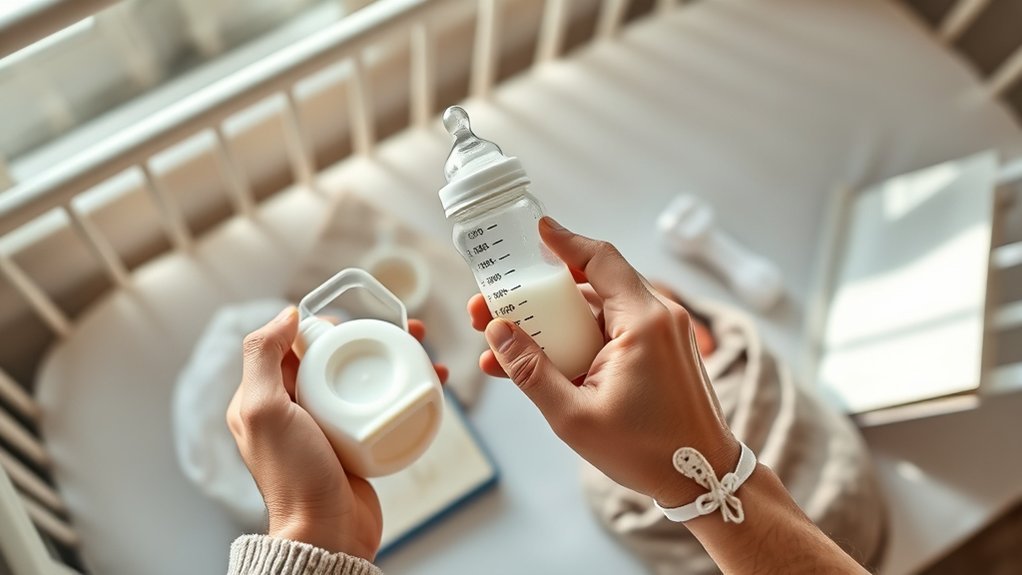
You can track baby feeding ounces accurately for bottles by recording how much milk or formula you offer and how much your baby actually drinks. Breastfeeding is different: minutes at the breast and which side you use are useful to log, but they do not tell you the exact number of ounces transferred. A good feeding log also includes diapers, pumping, solids when appropriate, and growth checks.
Quick Answer
For bottles, record the time, milk type, amount offered, and amount your baby drinks. For direct breastfeeding, log the start time, side or sides used, and general feeding duration instead of estimating ounces. Diaper output, weight gain, and hunger or fullness cues give important context.
At a Glance
| Tools Needed | Bottle markings plus a notebook, spreadsheet, or baby-tracker app |
| Difficulty | Simple once every caregiver uses the same logging method |
How to Track Baby Feeding Ounces
)
The easiest method is to use one feeding log for everyone caring for your baby. A notebook works, or you can use a baby tracker such as Baby Tracker or Glow Baby if you prefer automatic totals and timers.
- Record the start time. This helps you see how often your baby feeds and prevents confusion between caregivers.
- Choose the feeding type. Note direct breastfeeding, expressed breast milk, infant formula, or solids when your baby is old enough for them.
- For bottles, record offered and consumed ounces separately. A 4-ounce bottle does not mean your baby drank all 4 ounces.
- For nursing, record side and duration. Do not convert nursing minutes into estimated ounces.
- Add useful context. Wet or dirty diapers, pumping amounts, unusual spit-up, strong hunger cues, or early fullness cues can help explain a change in the feeding pattern.
The CDC’s hunger and fullness guidance recommends watching your baby rather than relying only on a clock. Early hunger signs can include bringing hands to the mouth, turning toward the breast or bottle, and lip movements. Turning away or closing the mouth can signal fullness.
Keep entries factual. “7:15 a.m., formula, 3 ounces offered, 2.5 ounces taken” is more useful than writing that your baby “ate poorly.” Consistent records make tracking feeds consistently easier and give your pediatrician clearer information if a concern develops.
A feeding log is most useful when it records what actually happened rather than forcing every feeding to match a preset target.
Measure Ounces for Bottle Feeds
For bottle feeding, use the measurement markings on the bottle and record the amount your baby actually consumes. Feed amounts normally change with age, growth, and your baby’s individual hunger cues, so a log should show trends rather than pressure you to make every bottle identical.
| Feeding stage | General guidance |
|---|---|
| First days, formula-fed newborn | Offer about 1–2 oz every 2–3 hours |
| By the end of the first month | Many babies take about 3–4 oz per feed |
| Around 6 months | Many formula-fed babies take 6–8 oz at 4–5 feeds per day |
| Every bottle | Record amount offered, amount consumed, and feeding cues |
The CDC recommends starting formula-fed newborns with about 1 to 2 ounces every 2 to 3 hours in the first days of life. The American Academy of Pediatrics also explains that intake gradually increases as babies grow.
By the end of the first month, many bottle-fed babies take about 3 to 4 ounces every 3 to 4 hours. Around 6 months, the AAP feeding guidance says many babies take 6 to 8 ounces at each of four or five feedings per day. These are general ranges, not requirements for every baby.
Pro Tip: If your baby leaves milk in the bottle, log both the amount offered and the amount left. That gives you the true amount consumed without guessing.
Follow your baby’s fullness cues rather than encouraging them to finish a bottle. The CDC advises stopping when a baby shows they are full, even when milk remains.
If you prepare infant formula, follow the product’s mixing directions exactly. Accurate formula measurements matter because adding too much or too little water changes the intended concentration.
Log Breastfeeding and Pumped Milk
Direct breastfeeding and pumping should be tracked differently. Pumped milk can be measured in ounces or milliliters, but you normally cannot determine how many ounces a baby took at the breast by timing a nursing session.
The American Academy of Pediatrics explains that parents cannot measure the exact amount a directly breastfed newborn takes. Weight gain, diaper output, feeding frequency, swallowing, and how satisfied the baby seems are more useful signs.
A feeding record can still make breastfeeding patterns easier to discuss with a pediatrician or lactation professional.
Log Nursing Sides
Record the time a nursing session starts, which breast your baby begins on, whether you switch sides, and the approximate duration. These details help you remember the previous feed and may reveal repeated preference for one side.
Do not treat nursing duration as a measure of milk volume. One baby may transfer milk efficiently in a shorter feed, while another may feed longer. The same baby can also take different amounts at different sessions.
If there is a medical reason to measure milk transfer, a clinician or lactation consultant can sometimes use a precise pre-feed and post-feed weight. Johns Hopkins describes this test-weighing approach for babies with weight-gain concerns, while noting that intake can vary between feeds.
Record Pumped Milk Oz
After pumping, record how much milk you collected, along with the date and time. Pump output tells you how much you expressed during that pumping session; it does not necessarily equal how much your baby would have transferred during direct breastfeeding.
Label stored milk clearly so caregivers know when it was expressed. The CDC breast-milk storage guidance recommends labeling milk with the date it was expressed and storing it in appropriate breast-milk bags or clean food-grade containers.
Your feeding tracker can separately record:
- ounces or milliliters pumped;
- ounces placed into storage;
- ounces later offered in a bottle; and
- ounces the baby actually drank.
Keeping those amounts separate prevents stored-milk totals from being confused with the baby’s actual intake.
Note: If you are worried about poor weight gain, fewer wet diapers, a painful latch, dehydration, or whether your baby is transferring enough milk, contact your pediatrician or a qualified lactation professional rather than relying only on an app or feeding timer.
Track Diapers, Solids, and Growth
A feeding log becomes more useful when you add diaper output and growth information. These measures provide context that ounces alone cannot give, especially for directly breastfed newborns.
In the first few days, diaper counts rise as feeding becomes established. According to the AAP, after the first 4 to 5 days a newborn should generally have at least 5 to 6 wet diapers per day. For breastfed newborns, the AAP notes that by 5 to 7 days, 6 or more wet diapers per day is a reassuring sign.
Stool patterns need more context than a single daily target. Breastfed newborns may have at least 3 to 4 yellow stools per day by 5 to 7 days, but stool frequency can change as babies get older and differs between feeding methods. Record what happens rather than assuming every infant should have the same number.
Weight trend matters too. Babies normally lose some weight during the first days after birth. Johns Hopkins notes that a full-term baby who has not regained birth weight by about 10 to 14 days should be assessed in the context of feeding and overall growth.
Once solids begin, add the food, approximate amount offered, and any notable reaction. The CDC recommends introducing complementary foods at about 6 months when a baby is developmentally ready and advises against introducing solids before 4 months.
Breast milk or infant formula remains the main source of nutrition from 6 to 12 months while solids gradually become a larger part of the diet. Record growth measurements from pediatric visits rather than weighing your baby obsessively at home unless a healthcare professional has recommended closer monitoring.
Share a Feeding App With Caregivers
)
A shared feeding log can reduce missed entries and duplicate feeds when more than one person cares for your baby. Apps such as Baby Tracker, Glow Baby, and Huckleberry offer different tracking or sharing features, although exact sharing options can depend on the app and plan.
The most important part is not which app you choose. It is that every caregiver records feeds in the same place, uses the same units, and updates the log promptly.
A consistent log also makes it easier to compare feeding amounts with hunger and satiety cues instead of relying only on rigid feeding times.
Shared Access Setup
If your chosen app supports multiple caregivers or device syncing, set it up before another person takes over a feeding shift. The exact menus vary, so use the app’s own sharing or synchronization controls.
| Step | What to do |
|---|---|
| 1 | Open the app’s sharing or sync settings |
| 2 | Add or connect the other caregiver |
| 3 | Confirm both devices show the same recent entries |
| 4 | Agree on ounces or milliliters and the fields everyone will record |
| 5 | Review the log when care shifts change |
Before relying on synchronization, enter one test feed on one device and confirm it appears correctly for the other caregiver. This simple check can prevent gaps in the record.
Dual Logging Benefits
Shared logging gives everyone one feeding history instead of several text messages, scraps of paper, or separate notes. A caregiver can see when the previous bottle or nursing session happened and how much was consumed without guessing.
It also makes patterns easier to review. For example, several smaller bottles in the evening may look unusual when viewed alone but make more sense when you can see the full day’s feeding history.
Apps such as Huckleberry can help keep sleep, feeding, and diaper records together. Whatever tool you choose, avoid treating its predicted schedule or statistics as a substitute for your baby’s actual hunger and fullness cues.
Caregiver Sync Tips
Good caregiver tracking depends more on consistent habits than complicated app features. Use a short set of rules that everyone can follow even during overnight feeds.
| Tip | Why it helps | Result |
|---|---|---|
| Log right after the feed | Reduces forgotten entries | More accurate history |
| Use the same unit | Avoids mixing ounces and milliliters | Clearer totals |
| Review at handoff | Shows the latest feed and diaper clearly | Fewer duplicate feeds |
When a pediatric visit is coming up, review the record beforehand and note any clear change in feeding, diapers, or growth that you want to discuss.
Find Feeding Patterns Over Time
Feeding logs are most useful for seeing trends, not judging a single bottle or nursing session. Compare several feeds or several days while also watching your baby’s behavior, diaper output, and growth.
A common mistake is treating 24 to 32 ounces per day as a universal target for every infant. It is not. Formula needs change with age and body size, directly breastfed intake is not normally measured feed by feed, and babies can vary from day to day.
The AAP notes that formula-fed babies should usually drink no more than an average of about 32 ounces of formula in 24 hours, but that figure is a general upper guideline rather than a goal every baby should reach. Younger newborns normally take much less.
When reviewing your records, look for:
- Changes from your baby’s own normal pattern. A sudden sustained drop in bottle intake or feeding frequency matters more than whether one feed was smaller than expected.
- Hunger and fullness behavior. Log whether your baby continues rooting or sucking after a feed, or instead turns away and relaxes.
- Diaper changes. A noticeable fall in wet diapers deserves more attention than a small change in ounces alone.
- Growth over time. Pediatric growth measurements are more useful than comparing your baby with another baby’s intake.
- Context. Illness, changes in routine, starting solids, or a different caregiver may explain temporary changes in feeding.
Reviewing feeding metrics in context helps you avoid reacting to one isolated number. Bring the log to your baby’s clinician if the pattern raises questions about intake or growth.
Key Takeaways
- Bottle ounces can be measured directly; breastfeeding minutes cannot be reliably converted into ounces.
- For bottles, record both the amount offered and the amount actually consumed.
- Diaper output and weight trends provide important evidence about feeding adequacy, especially for breastfed newborns.
- A shared log works best when every caregiver uses the same units and enters feeds promptly.
- Do not force daily intake to match an internet rule or a single ounce target; watch your baby’s individual cues and growth.
Frequently Asked Questions
What Is the 5-3-3 Rule for Babies?
The 5-3-3 rule is not a standard pediatric rule for deciding how many ounces a baby should eat. The phrase is used mainly in informal sleep or night-feeding discussions and has different meanings depending on the source. Use your baby’s hunger cues, age, growth, and your clinician’s advice instead.
How to Track Newborn Feeding?
Track each newborn feed by recording the start time, feeding type, bottle amount if measurable, nursing side and duration if breastfeeding, and relevant diaper changes. Review the pattern together with weight gain and hunger or fullness cues rather than judging one feeding by itself.
What Is the 3-6-9 Rule for Babies?
There is no standard medical 3-6-9 feeding rule that says babies should drink fixed daily ounce totals at 3, 6, and 9 months. The phrase is used inconsistently online for development, growth spurts, feeding, or sleep. Follow age-appropriate pediatric feeding guidance instead of a shorthand formula.
How to Know How Many Ounces to Feed a Newborn?
For a formula-fed newborn in the first days, a common starting amount is about 1 to 2 ounces every 2 to 3 hours. Needs rise as the baby grows, so watch hunger and fullness cues and discuss unusually high, low, or changing intake with your baby’s healthcare professional.
Can You Measure Breastfeeding in Ounces?
You generally cannot measure exact breastfeeding ounces during a normal nursing session. Time at the breast does not reliably show milk volume. If milk transfer must be measured because of a feeding or weight concern, a healthcare or lactation professional may use precise before-and-after feeding weights.
When Should You Call the Pediatrician About Feeding?
Call your baby’s healthcare professional when feeding concerns are accompanied by poor weight gain, noticeably fewer wet diapers, signs of dehydration, unusual sleepiness, difficulty feeding, or a major sustained change from the baby’s normal pattern. Newborn feeding concerns deserve prompt assessment rather than relying only on an app.
Conclusion
Tracking baby feeding ounces works best when you record measurable bottle intake without trying to turn every nursing session into an ounce estimate. Keep one simple log for feeds, pumping, diapers, solids when appropriate, and growth information, then use the pattern alongside your baby’s hunger and fullness cues.
If your records show a persistent change in intake, diaper output, or weight gain, share the log with your baby’s healthcare professional. The purpose of tracking is to make feeding easier to understand, not to make every feed match the same number.
Sources
- American Academy of Pediatrics: How Often and How Much Should Your Baby Eat?: General bottle-feeding amounts, feeding frequency, diaper output, growth, and feeding cues.
- CDC: How Much and How Often to Feed Infant Formula: Newborn formula amounts and feeding frequency.
- American Academy of Pediatrics: How to Tell if Your Breastfed Baby Is Getting Enough Milk: Breastfeeding intake assessment, diapers, feeding frequency, and weight.
- Johns Hopkins Medicine: Managing Poor Weight Gain in Your Breastfed Infant: Test weighing and evaluation of poor milk transfer or weight gain.
- CDC: Breast Milk Storage and Preparation: Labeling and storing expressed breast milk.
- CDC: Signs Your Child Is Hungry or Full: Hunger and fullness cues and responsive feeding.
- CDC: When, What, and How to Introduce Solid Foods: Timing and developmental readiness for complementary foods.