
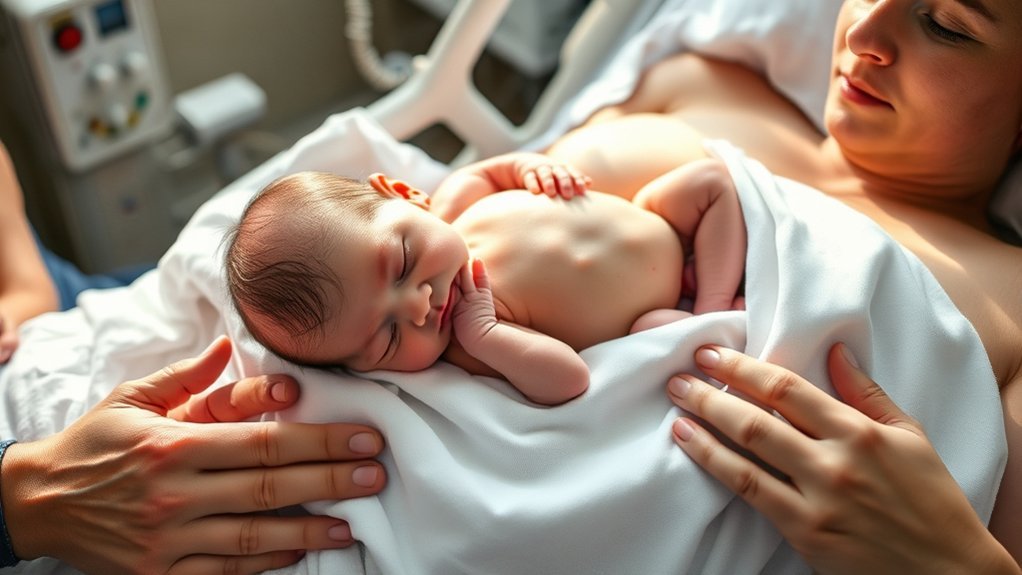
Skin-to-skin contact after birth means placing your baby, belly-down, on your bare chest right away. It helps regulate heart rate, breathing, and temperature, supports breastfeeding, and strengthens bonding after vaginal or cesarean birth. It’s safe when you stay semi-reclined, keep baby’s airway clear, and monitor breathing and color. Fathers and other caregivers can do it too, and it won’t spoil your baby. The facts go further, and they’re worth knowing.
What Is Skin-to-Skin Contact After Birth?

Skin-to-skin contact after birth, often called kangaroo care, means placing your newborn belly-down on your bare chest immediately after delivery. This direct contact lets you and your baby stay connected without barriers, and it supports physiological stability by helping regulate heart rate, breathing, and temperature.
The practice applies to mothers and babies after vaginal or cesarean birth, and it’s recommended for full-term and preterm infants. You can use it to support early breastfeeding, because immediate contact often improves breastfeeding initiation in the first hour. Additionally, establishing a routine that includes skin-to-skin contact can enhance breastfeeding frequency and strengthen the bond between you and your baby.
Clinically, the benefits for babies include steadier adjustment to life outside the uterus and stronger early bonding. For you, kangaroo care can also improve attachment and affirm your role as the primary source of safety and comfort.
Kangaroo care helps babies adjust to life outside the womb while deepening early bonding and maternal attachment.
This isn’t optional tenderness; it’s evidence-based care that honors both bodies and strengthens the start of life together.
Why Skin-to-Skin Contact Matters
You should recognize skin-to-skin contact as a clinically important intervention that supports bonding and comfort immediately after birth.
It helps stabilize your baby’s heart rate and breathing, supports breastfeeding, and can reduce infection risk and other complications.
It also promotes beneficial bacterial colonization and strengthens emotional attachment over time. Additionally, postpartum anxiety can impact a mother’s ability to engage in skin-to-skin contact, highlighting the importance of addressing mental health during this period.
Bonding And Comfort
Immediately after birth, close body contact helps trigger a maternal hormonal surge that strengthens emotional bonding between mother and baby. You can use skin-to-skin to support bonding, reduce stress, and create a calm, responsive start. For mothers, the benefits include a stronger emotional connection and more confidence in caregiving.
- Your baby settles more quickly.
- You and your baby share less stress.
- Breastfeeding often starts more smoothly.
- Your touch supports baby’s health and comfort.
This direct contact helps your baby orient toward you, crawl toward the breast, and self-attach.
That early contact also supports familiarity with your bacteria, which supports immune development.
If you want a liberated, evidence-based start, skin-to-skin gives you a precise, low-intervention way to protect bonding and breastfeeding.
Health Benefits For Baby
Because a newborn is still adapting to life outside the womb, skin-to-skin contact helps stabilize heart rate and breathing, supporting early physiological regulation.
When you place babies directly on your chest, you promote health benefits that extend beyond comfort: their stress decreases, their feeding reflexes activate, and breastfeeding often begins more smoothly.
This contact also supports colonization with the mother’s body flora, which can lower infection risk.
Clinically, the evidence shows that consistent skin-to-skin care improves neurobehavioral stability, emotional regulation, and later cognitive development.
You’re not just soothing your baby; you’re actively supporting physiologic resilience and attachment.
For families seeking autonomy in care, this simple practice offers measurable benefits without complex intervention.
What Happens During Skin-to-Skin Contact?
During skin-to-skin contact, your newborn often gives a distinctive birth cry, then relaxes as it responds to your voice and cues.
You may also see instinctual crawling toward the breast, which supports self-attachment and early feeding.
This sequence helps establish effective breastfeeding and reflects the infant’s organized behavioral response.
Birth Cry And Relaxation
As the newborn’s first cry marks the change to independent breathing, skin-to-skin contact helps clear residual amniotic fluid, supports instinctual survival behaviors, and begins a rapid settling response.
During birth, you place your baby skin-to-skin, and the infant can relax, respond to your voice, and stabilize with less stress. This contact regulates heart rate and breathing, promoting physiological stability and a calmer state.
- You’ll see instinctual movements toward the breast.
- You support early self-attachment without force.
- Your baby’s body can relax and conserve energy.
- You reinforce breastfeeding readiness through close contact.
At the same time, your body releases hormones that strengthen bonding and emotional connection.
The result is a precise, biologically guided shift that supports recovery, security, and freedom from unnecessary separation.
Self-Attachment And Feeding
Once your baby has settled on your chest after birth, skin-to-skin contact often triggers instinctive feeding behaviors. You may see crawling, rooting, and head turning as your baby seeks the breast.
These instinctive behaviors support self-attachment, because your baby can use scent and warmth to orient and latch without force. During the first hour, the golden hour, you should let this process unfold naturally, since rushing can interrupt early feeding cues.
Research shows that skin-to-skin improves the chance of successful breastfeeding by increasing engagement and stabilizing feeding behavior. When you stay calm and keep your baby close, you’re supporting efficient feeding, better intake, and stronger weight gain in the weeks ahead.
How to Practice Skin-to-Skin Safely
To practice skin-to-skin safely, place the newborn upright against the mother’s bare chest with the head turned to one side so the airway stays clear and breathing remains unobstructed.
Keep the mother semi-reclined, relaxed, and supported so you reduce fall risk and preserve comfort during the first hours.
- Cover the baby with a warm blanket, but keep the face visible.
- Watch the baby’s breathing, color, and temperature continuously.
- Check that the skin-to-skin position stays secure and that the mother can stay awake.
- Use medications cautiously, because analgesics may blunt alertness and reflexes.
This approach protects safety without separating you from the newborn. Additionally, monitoring the baby’s sleep environment helps support stable physiology, calmer shift, and stronger bonding.
When you maintain close monitoring, you support stable physiology, calmer shift, and stronger bonding. Skin-to-skin works best when you stay attentive, protect the mother’s chest contact, and respond quickly to any change.
Skin-to-Skin Contact Myths Parents Hear
Skin-to-skin contact isn’t limited to the minutes after delivery; it can support bonding and breastfeeding throughout the postpartum period.
You may hear misconceptions that only biological mothers can provide skin-to-skin benefits, but fathers, adoptive parents, and other caregivers can do it effectively.
Another myth says skin-to-skin is only for premature infants. Evidence from more than 160 studies shows clear benefits for full-term newborns, too.
You’re not spoiling your baby by responding promptly during skin-to-skin; meeting needs builds emotional security and stronger bonding.
Don’t assume connection starts only at birth. Babies can recognize a mother’s voice by 31 weeks’ gestation, so attachment often begins before delivery.
When you trust these facts, you can use skin-to-skin as a practical, liberating tool for newborns and families, supporting breastfeeding, stability, and healthy development without unnecessary limits or guilt. Additionally, establishing a consistent routine helps both mother and baby feel secure during this bonding process.
How Baby Friendly Care Supports Skin-to-Skin
Baby-Friendly care turns skin-to-skin contact into standard practice, not an optional extra. You’re entitled to immediate skin-to-skin after birth, because this evidence-based approach supports breastfeeding, maternal-infant attachment, and better health outcomes. If your baby needs the neonatal intensive care unit, staff should still help you use touch and comfort as soon as it’s safe.
- Place your baby on your chest right after delivery.
- Keep the first feed in skin-to-skin contact when possible.
- Ask for support if separation delays contact.
- Expect trained staff to guide prolonged skin contact.
This care model helps you read your baby’s cues, regulate warmth, and strengthen emotional bonding. It also protects your ability to care for your baby with confidence. When providers know the protocol, they can act quickly, reduce barriers, and support your autonomy. Baby-Friendly standards don’t just permit skin-to-skin; they make it a clinical priority.
Additionally, maintaining adequate hydration during skin-to-skin can further enhance your baby’s comfort and digestive health.
Frequently Asked Questions
How Long Should Each Skin-To-Skin Session Last?
You should aim for at least 60 minutes per session, longer if you can, to maximize skin benefits, bonding benefits, temperature regulation, emotional connection, immune support, breastfeeding initiation, and newborn reflexes.
Can Fathers Do Skin-To-Skin After Birth?
Yes—fathers can do skin-to-skin after birth; like a 2023 NICU study, you’ll see paternal bonding, temperature regulation, emotional connection, infant calming, hormonal benefits, breastfeeding support, and developmental advantages improve.
Is Skin-To-Skin Safe After a C-Section?
Yes, skin-to-skin after a c section’s usually safe if your healthcare provider approves; it supports c section benefits, bonding experience, temperature regulation, infant cues, recovery support, and your emotional wellbeing, too.
What if My Baby Cries During Skin-To-Skin?
Like a brief storm, crying usually signals hunger, discomfort, or need for warmth. You can use soothing techniques, adjust timing strategies, and protect temperature regulation; skin sensitivity rarely matters. Don’t let parental anxiety block bonding benefits.
Can Skin-To-Skin Help With Breastfeeding Pain?
Yes, you can get some pain relief: skin-to-skin supports breastfeeding benefits, hormone regulation, and a stronger bonding experience. You’ll often find latching techniques improve with comfort measures and emotional support, reducing discomfort.
Conclusion
So, after birth, the most “natural” intervention is often the one people still overcomplicate. Skin-to-skin contact isn’t a trendy extra; it’s a clinically supported practice that helps regulate your baby and supports bonding, feeding, and stability. If you’ve heard it’s risky, weak, or optional, the facts say otherwise. When you keep your baby close, you’re not doing less care—you’re doing better care, with fewer barriers and more benefit.
