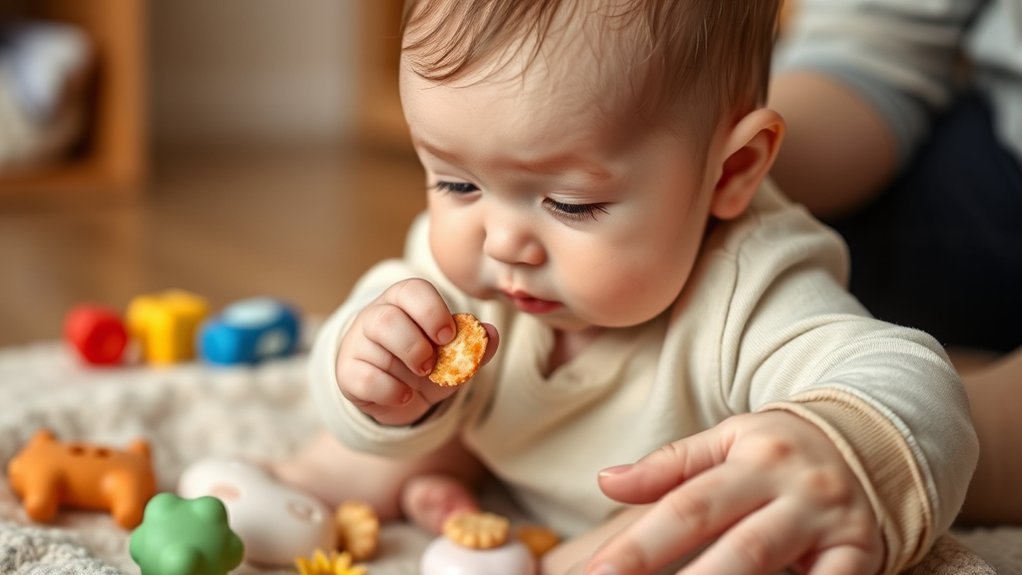
At 9 months, you may see the beginning of an inferior pincer grasp, where your baby uses the thumb and index finger to pick up small objects. If this skill isn’t emerging yet, it can still be within normal range, but it’s worth watching closely. By 12 months, a true pincer grasp should appear. If delay continues, your pediatrician can assess development and guide next steps, including helpful activities and therapy options that support progress.
What Is the Pincer Grasp at 9 Months?
The pincer grasp at 9 months is a fine motor milestone in which your baby uses the thumb and index finger tips to pick up small objects. This pincer grasp reflects advancing fine motor development and a shift from a palmar grasp to a more precise hold.
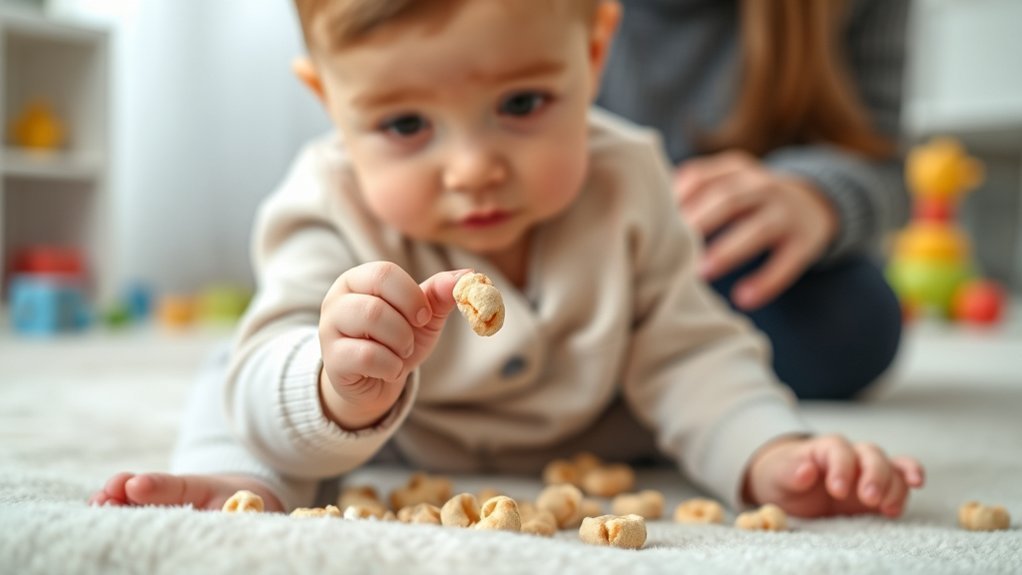
At 9 months, your baby may show growing skill in picking up small objects such as cereal or peas, which supports self-feeding and everyday independence. This is one of the key development milestones you can watch for as your baby gains control over their hands and explores the world.
If your baby isn’t interested in picking up objects, or if delayed development continues beyond 12 months, talk with a healthcare provider. Early evaluation can identify concerns and guide intervention when needed, helping you protect your child’s developmental freedom and progress.
Pincer Grasp Milestones From 8 to 12 Months
From 8 to 12 months, your baby’s grasp typically shifts from a crude raking motion to a more refined pincer grasp.
At 8 to 9 months, you’ll often see a whole-hand grasping motion that helps your baby move toward small objects, even if pickup is still clumsy.
By 9 to 10 months, the inferior pincer grasp usually appears, with the thumb working against the middle or ring finger. This is an important developmental milestone for fine motor skills.
Between 10 and 12 months, your baby often masters the true pincer grasp, using the thumb and index finger tips to pick up cereal or peas with greater control.
Watching this progression can help you understand normal development and support your baby’s growing independence. Additionally, being aware of nutritional needs during pregnancy can contribute to overall developmental health.
If you don’t see a clear pincer grasp by 12 months, consider consultation with a healthcare provider, since delayed development may need review.
Signs Your Baby May Be Behind
By 9 months, you’d usually expect to see your baby begin an inferior pincer grasp, using the thumb against the middle or ring finger, along with an interest in picking up and manipulating small objects.
If you don’t see these pincer grasp signs at 9 months, watch for signs of delay in fine motor skills and broader delayed development. A lack of interest in picking up small items, or little effort at manipulating objects, can point to developmental concerns.
By 12 months, no true pincer grasp deserves professional assessment. You should also notice clapping hands and banging objects; if those milestones lag too, the pattern may suggest more than one area of concern.
Early occupational therapy can support skill-building and preserve your child’s autonomy. This isn’t about alarm; it’s about clear observation, timely support, and making sure your baby gets the right developmental help when needed.
Common Reasons for a Late Pincer Grasp
You may notice that pincer grasp timing varies, and some babies reach this milestone a little later than others.
In other cases, motor skill delays can make it harder for your baby to coordinate the precise finger movement this skill needs.
If you’re concerned, watch for steady progress over time and mention persistent delays to your healthcare provider.
Normal Development Variation
A pincer grasp can emerge anywhere along a normal range, with some infants showing readiness as early as 6 months and others not refining it until closer to 12 months. Your pincer grasp reflects normal development variation, not failure, and your child’s motor skills may simply be unfolding on a different schedule.
- Individual temperament can affect practice.
- Fine motor activities help build control.
- Observation of milestones shows broader progress.
- A healthcare provider can guide you if needed.
If your infant’s grasp looks late at 9 months, stay calm and watch for raking, play, and reaching. These signs often show steady growth.
If the pincer grasp still isn’t present by 12 months, ask for help; early intervention can support skill development and protect your sense of choice.
Motor Skill Delays
Sometimes, a late pincer grasp reflects a motor skill delay rather than simple variation. You may see delayed development when your baby has weak core strength, limited hand-eye coordination, or fewer chances for fine motor practice. Developmental coordination disorder can also affect how your child organizes movement and uses motor skills to reach milestones.
| Possible factor | What it can affect |
|---|---|
| Core weakness | Stable reaching and sitting |
| Poor hand-eye coordination | Picking up small objects |
| Limited practice | Fine motor control |
If your baby isn’t interested in picking up objects by 12 months, ask a healthcare provider. If delays continue past 15 months, evaluation can guide support. With early attention, you can protect your child’s development and keep progress moving forward.
Easy Activities to Build Pincer Grasp

Simple, everyday play can help your 9-month-old strengthen the pincer grasp. You can use everyday activities to build fine motor control and confidence without pressure.
Try these activities to encourage pincer development:
- Cheerio picking: Let your baby practice the pincer by picking up small cereal pieces one at a time. This helps develop a pincer grasp and hand-eye coordination.
- Pea practice: Offer soft-cooked peas so babies practice grasping small objects with growing finger dexterity.
- Raisin transfers: Invite your baby to move raisins from one cup to another, which supports precise release and grasp.
- Stacking blocks and finger puppets: Use blocks for careful placement, and finger puppets to encourage individual finger movement.
Keep sessions brief, calm, and responsive. You’re not training a performance; you’re supporting your baby’s emerging fine motor skills.
With repeated play, these small, joyful moments can help build coordination and autonomy. If your baby seems frustrated, pause and try again later.
Safe Foods and Toys for Pincer Grasp Practice
For pincer grasp practice, offer your baby soft, easy-to-pick-up foods such as small pieces of banana, cooked carrots, or peas, which support self-feeding and fine motor control. These safe foods let your baby explore with confidence while building independence.
| Safe foods | Purpose |
|---|---|
| Banana, peas | Practice grasping |
| Blocks, finger puppets | Fine motor skills |
| Puffed rice, play coins | Engaging activities |
You can also offer toys like lightweight blocks, large beads, and finger puppets to encourage precise finger use. Small items, such as play coins or marbles, help your baby isolate each grasp during pincer grasp practice. Try pouring or transferring puffed rice between bowls for a calm, engaging activity that strengthens coordination.
Use close supervision whenever you present foods or toys with small parts. This keeps play safe and reduces choking hazards while you support exploration. When you choose age-appropriate soft foods and toys, you give your baby room to practice, learn, and grow.
When to Call Your Pediatrician
Call your pediatrician if your baby isn’t showing interest in picking up objects by 9 months, because this can signal a delay in fine motor development.
By 9 to 10 months, you’d expect an inferior pincer grasp, and a true pincer grasp should follow soon after. If your child skips grasping tasks, loses fine motor skills, or seems less engaged with toys, ask for an evaluation.
These changes can point to developmental concerns or motor skill delays, but they don’t define your child’s future.
- No interest in picking up small items by 9 months
- No pincer grasp by 12 months
- Regression in fine motor skills
- Persistent avoidance of grasping tasks
Your pediatrician can review milestones, check for delayed development, and guide next steps with confidence. Additionally, they can assess proper healing to ensure there are no underlying issues affecting your child’s development.
If needed, occupational therapy may be recommended to support skill growth. Reaching out early helps you protect your child’s freedom to explore, play, and build strong fine motor skills.
How Occupational Therapy Can Help
If your baby needs extra support with grasping skills, occupational therapy can help build pincer grasp development through targeted, play-based activities.
In occupational therapy, the therapist assesses fine motor skills and designs tailored interventions to help your baby move from whole-hand grasping toward a more precise pincer grasp. They may use adaptive toys, simple object-picking games, and sensory integration strategies to increase engagement and support developmental milestones.
Regular sessions can also reveal underlying motor challenges early, so you can address delays with confidence rather than uncertainty. You’ll get practical guidance on home-based practices, such as placing small safe objects in reach, offering textured toys, and repeating short practice moments during daily routines.
Regular sessions can uncover early motor challenges, while home practice builds confidence and supports your baby’s growth.
This support helps you create an affirming environment where your baby can explore, practice, and grow at their own pace. With consistent occupational therapy, you can strengthen skills while honoring your child’s developmental rhythm and emerging independence.
Frequently Asked Questions
Should I Worry About a Late Pincer Grasp?
Not usually at 9 months; pincer grasp often emerges later. Keep tracking developmental milestones, fine motor skills, and baby development through grasping objects and sensory play. If concerns persist by 12 months, seek pediatric assessments and early intervention.
What Are Signs of Developmental Delay at 9 Months?
You might notice skipped growth milestones, weak fine motor skills, limited social interaction, and delayed cognitive skills—like Mia, who rarely reached for toys. Watch tummy time, sensory play, feeding habits, vision development, auditory response, and parental engagement.
What Are the Early Signs of Giftedness in Babies?
You may notice early milestones like advanced cognitive skills, playful behavior, strong language development, rich social interactions, problem solving, sensory exploration, high curiosity levels, precise fine motor control, and sensitive emotional expression.
What Are the First Signs of Cerebral Palsy in Babies?
Early signs can be a storm cloud: you may notice weak motor skills, unusual muscle tone, poor reflex responses, limited head control, visual tracking, social engagement, hand coordination, crawling patterns, feeding abilities, or auditory responses.
Conclusion
If your baby isn’t using a pincer grasp at 9 months yet, don’t panic. Many babies develop this skill between 8 and 12 months, and small differences are common. Think of it like planting seeds: one sprout may appear sooner, but the garden still grows on schedule. Keep offering safe toys and foods, and watch for steady progress. If you’re still concerned, your pediatrician or an occupational therapist can help you next.
