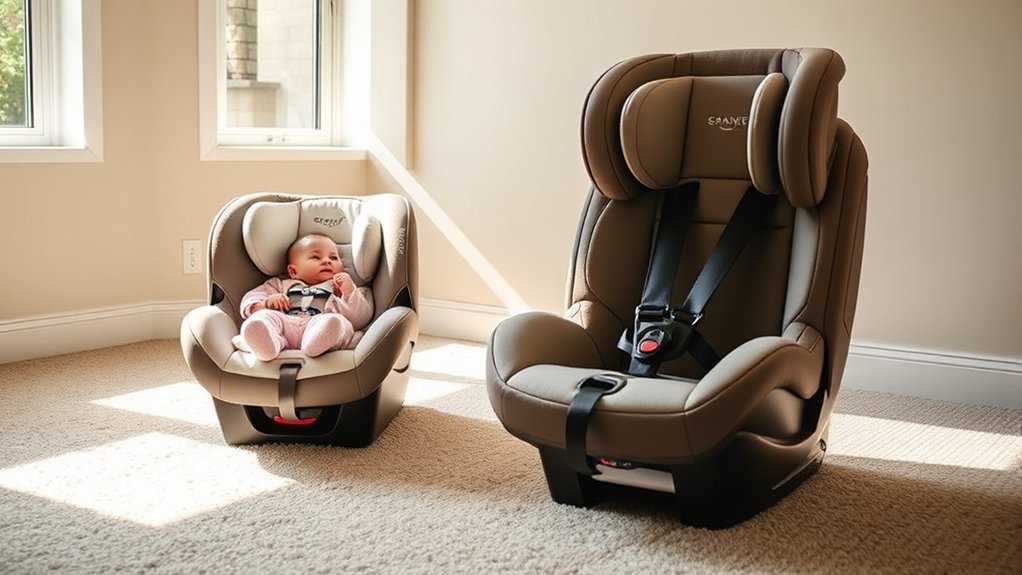
There’s a common belief that infant car seats are always the best choice for newborns, while convertible seats are more versatile. But is that really the whole story? Understanding the differences between these two types of car seats can help you make an informed decision that fits your family’s needs. Let’s explore the key features, safety aspects, and practical considerations that might influence your choice.
What Is an Infant Car Seat?
An infant car seat is a specialized safety device designed to protect your newborn during travel.
These seats are rear-facing, providing optimal safety for your little one, as they support their delicate neck and spine. They’re typically equipped with harness systems to keep your baby securely in place, and many models include added features like side-impact protection and adjustable bases for an ideal fit in your vehicle.
You’ll appreciate the convenience of being able to detach the car seat from its base, allowing for easy shifts when you’re on the go.
What Is a Convertible Car Seat?
Convertible car seats are versatile safety devices designed to grow with your child. They can be used in both rear-facing and forward-facing positions, making them a long-term investment for your family. With a convertible car seat, you won’t have to switch seats as your child grows, ensuring their safety throughout different stages of development.
- Rear-facing for infants and toddlers, providing added neck and spine support.
- Forward-facing for older children, accommodating higher weight limits.
- Typically features adjustable harness systems for a snug fit.
Choosing a convertible car seat means prioritizing your child’s safety while enjoying the convenience of one seat that adapts to their needs, giving you peace of mind on every journey.
What Are the Age and Weight Limits for Infant Car Seats?
When it comes to infant car seats, knowing the age and weight limits is essential for your baby’s safety.
Typically, these seats are designed for infants up to around 30 pounds and 30 inches in height, but always check the specific guidelines for your model.
As your little one grows, you’ll want to think about moving to a convertible seat to guarantee they remain secure and comfortable on every ride.
Infant Car Seat Limits
Understanding the limits of infant car seats is essential for guaranteeing your baby’s safety during travel. Typically, infant car seats are designed for babies weighing up to 30-35 pounds and up to 32 inches tall. You should always check your specific car seat’s manual, as limits can vary by model.
Here are some key points to keep in mind:
- Age Range: Most infants can use these seats from birth until around 12 months.
- Weight Limit: Make sure your baby doesn’t exceed the seat’s weight capacity.
- Height Limit: Pay attention to the height restrictions, as it may be time to shift to a convertible seat if your baby is too tall.
Monitoring these limits helps keep your little one secure on the road.
Growth and Safety Standards
Choosing the right car seat for your baby involves knowing the growth and safety standards that apply to infant car seats. Typically, these seats are designed for infants weighing between 4 to 35 pounds and up to 30 inches tall.
It’s essential to follow the manufacturer’s guidelines to guarantee your baby’s safety. Generally, infants should remain in a rear-facing position until they reach the upper weight or height limit specified by the seat.
Remember, each baby grows at their own pace, so keep an eye on their growth and adjust accordingly. Prioritizing these standards not only keeps your little one safe but also gives you peace of mind while traveling.
Always stay informed to make the best choices for your baby’s safety.
Transitioning to Convertible Seats
As your baby grows, knowing when to change from an infant car seat to a convertible one is essential for their safety and comfort.
Infant car seats are typically designed for babies up to 30-35 pounds and 30-32 inches tall. Once your little one exceeds these limits or starts showing signs of discomfort, it’s time to think about a convertible seat.
Here are key factors to look for:
- Weight Limits: Convertible seats often accommodate children up to 65 pounds or more.
- Height Restrictions: Check the height limits, as they can vary between models.
- Age Recommendations: Many experts suggest changing around 1 year and at least 20 pounds.
Making this switch guarantees your child remains safe and secure on the road.
What Are the Age and Weight Limits for Convertible Car Seats?
When choosing a convertible car seat, it’s essential to understand the standard weight requirements and age recommendations.
Typically, these seats accommodate children from about 5 to 65 pounds, allowing for extended use as your child grows.
Knowing these limits helps guarantee your little one’s safety during every car ride.
Standard Weight Requirements
Understanding the standard weight requirements for convertible car seats is crucial for guaranteeing your child’s safety during car rides. Convertible seats typically accommodate a wider weight range than infant seats, allowing your child to grow with them.
Here are some key points to remember:
- Most convertible car seats support weights between 5 to 65 pounds, depending on the model.
- It’s essential to check the specific seat’s manual for exact limits, as they can vary considerably.
- Always verify your child meets both the weight and height requirements before shifting to a forward-facing position.
Age Recommendations Overview
Convertible car seats are designed to accommodate children from infancy through toddlerhood, making them a versatile choice for parents. Typically, these seats can be used from birth, often starting around 5 to 10 pounds, and can accommodate children up to 40 to 65 pounds, depending on the specific model.
You should keep your child in a rear-facing position for as long as possible, ideally until they reach the maximum weight or height limit. This is vital for safety. Once they outgrow the rear-facing limits, you can shift them to a forward-facing position.
Always check the manufacturer’s guidelines for age and weight limits to guarantee your child’s safety and comfort as they grow.
How Long Can My Baby Use an Infant Car Seat?
How long can you expect your baby to use an infant car seat? Typically, you can use an infant car seat until your baby reaches either the weight limit, which is usually around 30 to 35 pounds, or the height limit, often around 30 to 32 inches.
You can use an infant car seat until your baby reaches 30-35 pounds or 30-32 inches in height.
It’s essential to check your specific seat’s manual for exact measurements.
Here are some key points to take into account:
- Age Range: Most infants can safely use these seats from birth until about 12 to 18 months.
- Growth Monitoring: Regularly check your baby’s growth to determine when it’s time to shift.
- Safety Standards: Always adhere to safety guidelines to guarantee your baby’s protection while traveling.
Stay informed to keep your little one safe!
Can a Convertible Car Seat Be Used From Birth?
While many parents are familiar with infant car seats, you might wonder if a convertible car seat can be used from birth. The answer is yes, but it depends on the specific model.
Many convertible seats are designed to accommodate newborns, with features like a lower weight limit and appropriate recline angles. However, it’s essential to check the manufacturer’s guidelines to confirm your chosen seat is suitable for your baby’s size and age.
If your convertible seat has the necessary specifications, it can be a safe option from day one. Just remember, a proper installation and fit are critical for your baby’s safety, so take the time to follow the instructions carefully when setting it up.
What Are the Safety Features to Consider in Both Types?
Choosing the right car seat goes beyond just deciding between infant and convertible options; safety features play a pivotal role in ensuring your child’s protection on the road.
Selecting the appropriate car seat involves more than just choosing between types; prioritizing safety features is essential for your child’s security.
When evaluating both types, consider the following safety features:
- Five-point harness system: This secures your child at their shoulders, hips, and between the legs, providing ideal restraint.
- Side-impact protection: Look for seats designed with energy-absorbing foam or specific structures to reduce injury risk during a side collision.
- Steel-reinforced frame: A sturdy frame enhances the seat’s durability and stability, offering better protection in the event of an accident.
How Do Installation Methods Differ Between Infant and Convertible Seats?
When it comes to installing infant and convertible car seats, the methods can vary considerably.
Infant seats typically use a base that remains in your car, allowing for easy clicks in and out, while convertible seats often require more adjustments as your child grows.
Additionally, the safety harness systems differ, with infant seats designed for smaller babies and convertible seats offering more versatility as your child evolves.
Installation Techniques Overview
Understanding the differences in installation techniques between infant and convertible car seats is essential for guaranteeing your child’s safety.
Infant seats typically use a base that stays in the car, allowing for easy transfer. In contrast, convertible seats can be installed in both rear-facing and forward-facing positions, often requiring more adjustments.
Here are a few key points to reflect on:
- Base Installation: Infant seats have a dedicated base for easier installation, while convertible seats rely on the car’s seat belt or LATCH system.
- Positioning: Convertible seats can switch from rear to forward-facing, requiring additional steps for proper setup.
- Adjustability: Convertible seats often have more recline options, guaranteeing a snug fit as your child grows.
Make sure to follow the manufacturer’s instructions for both types to guarantee maximum safety.
Safety Harness Differences
While both infant and convertible car seats prioritize your child’s safety, their safety harness systems differ considerably.
Infant car seats typically feature a five-point harness designed specifically for your newborn’s smaller frame. This system secures your baby at the shoulders, hips, and between the legs, providing a snug fit that’s essential for their safety.
On the other hand, convertible seats also use a five-point harness but are adjustable to accommodate your growing child. They allow you to modify the harness height and tension as your child develops, ensuring a secure fit.
Understanding these differences helps you choose the right seat and adjust it correctly, giving you confidence in your child’s safety on every journey.
What Are the Pros and Cons of Infant Car Seats?
Infant car seats are essential for ensuring your baby’s safety during travel, but they come with both advantages and disadvantages.
Pros:
- Safety: Designed specifically for infants, these seats provide superior protection and support.
- Portability: Lightweight and easy to carry, you can effortlessly move your baby from car to stroller.
- Reclining Feature: The adjustable angle helps keep your baby comfortable and secure during rides.
Cons:
- Limited Use: They usually accommodate babies only up to around 30-35 pounds, requiring a switch to a convertible seat sooner.
- Bulkiness: Some models can be heavy and cumbersome to transport.
- Cost: Investing in a separate seat can be expensive, especially if you need multiple for different vehicles.
Understanding these pros and cons can help you make an informed choice for your baby’s safety.
What Are the Pros and Cons of Convertible Car Seats?
When considering car seat options for your growing child, convertible car seats offer a versatile solution that can adapt as your little one develops.
One major pro is their longevity; they can be used from infancy through toddlerhood, often lasting several years. This means fewer purchases over time, which is budget-friendly. Additionally, many convertible seats have higher weight limits for harnessed use, enhancing safety.
Convertible car seats offer longevity and budget-friendly options, adapting from infancy to toddlerhood with enhanced safety features.
However, they can be bulky and less portable than infant seats, making them harder to transfer between vehicles.
Installation can also be complex, requiring more time and effort.
Ultimately, while convertible car seats provide great value and safety, you’ll need to weigh their convenience against your family’s lifestyle and travel needs.
Frequently Asked Questions
Can I Use a Second-Hand Car Seat Safely?
You can use a second-hand car seat safely if you know its history. Check for recalls, expiration dates, and damage. Always verify it meets current safety standards, and consider purchasing a new seat for peace of mind.
How Do I Clean and Maintain My Car Seat?
Did you know 85% of car seats are improperly installed? To clean yours, remove the cover and wash it according to the manufacturer’s instructions. Regularly inspect and tighten any loose parts to guarantee safety.
What Should I Do if My Car Seat Is Recalled?
If your car seat’s recalled, stop using it immediately. Check the manufacturer’s website for details, follow their instructions for returning or replacing the seat, and stay updated on safety recalls to guarantee your child’s safety.
Are Travel Systems Compatible With All Car Seats?
Not all travel systems are compatible with every car seat. You should check the manufacturer’s specifications to verify compatibility. This guarantees safety and convenience when shifting between your car and stroller. Always prioritize your child’s safety.
How Do I Know if My Child Has Outgrown Their Car Seat?
You’ll know your child has outgrown their car seat when their shoulders reach the highest harness slots or their head is less than an inch from the top. Always follow the manufacturer’s guidelines for safety.
Conclusion
Choosing between an infant and convertible car seat can feel overwhelming, but understanding their differences helps you make the best choice for your family. Did you know that nearly 73% of car seats are installed incorrectly? With the right information, you can guarantee your baby’s safety on the road. Ultimately, weigh your family’s needs, travel habits, and budget to select the seat that offers the best mix of safety, convenience, and longevity for your child.
