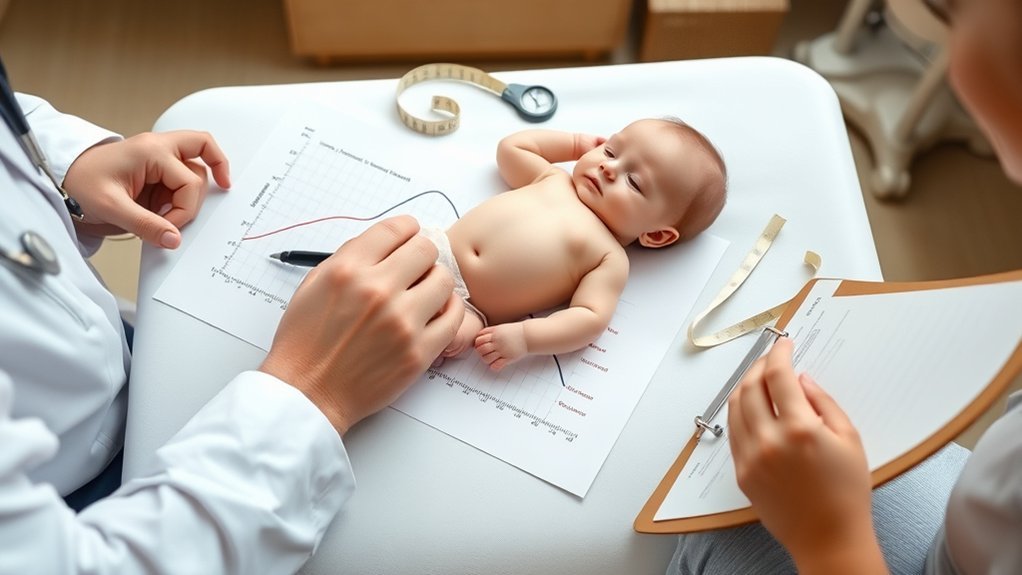
To read your baby’s growth chart, match age and measurement to the percentile curves for the correct chart: WHO from birth to age 2, then CDC after age 2. The 50th percentile is average, but healthy babies can track anywhere along the lines. Focus on steady growth over time, not one point. Use weight, length, and head circumference correctly, and ask your pediatrician if percentiles drop or jump suddenly for more context.
Choose the Right Baby Growth Chart

To choose the right baby growth chart, start with your child’s age: WHO charts are recommended from birth to 2 years, while CDC charts are used for children 2 years and older. You should also use separate charts for boys and girls, since early growth patterns differ.
Pick the baby growth chart that matches your child’s sex and age, then focus on the measurements that matter most: weight, length, head circumference, or BMI, depending on health needs.
These charts display percentiles, which help you compare tracking your child’s growth with peers in a standard, clinically useful way.
During pediatric visits, review the chart regularly so you can see the growth trajectory clearly and act early if something looks off. This approach supports informed care, not judgment, and it gives you a precise tool for understanding your child’s development.
What Growth Chart Percentiles Mean
Growth chart percentiles show how your child’s measurements compare with a reference group of same-age peers, with the 50th percentile representing the average. You can use them to understand growth without judgment, and they help you and your pediatrician protect your child’s health.
- A 5th percentile weight means your child weighs less than 95% of peers.
- A 90th percentile weight means your child weighs more than 90% of peers.
- Percentiles come from large populations, so they can shift over time.
- Consistent growth matters more than any single percentile.
Most children stay within a healthy range even when they’re not near the middle. Your child’s percentile isn’t a goal to chase; it’s a tool to track measurements and spot changes.
Most children stay healthy even away from the middle; percentiles are for tracking growth, not chasing a target.
Pediatricians watch trends across visits, because a stable pattern often tells you more than one number. Very low or very high percentiles, especially near the 2nd or 98th, can signal a health concern that deserves review.
How to Read Baby Growth Chart Lines
You’ll read the chart by matching your baby’s age on the top or bottom axis with length on the left and weight on the right.
The curved percentile lines show how your baby compares with peers, and you can find the correct line by tracing across from age and up from weight.
Over time, watch the pattern of movement along these curves, since steady upward tracking matters more than any single percentile number.
Chart Axes And Scales
A baby growth chart uses two main axes: the horizontal axis shows age, usually from birth to 36 months, and the vertical axis shows weight, length, or head circumference, depending on the chart. These chart axes help you read measurements clearly and track growth trends without confusion.
- Use the horizontal line for your baby’s measurement.
- Use the vertical line for your baby’s age.
- Find where they meet to locate percentiles.
- Follow percentile lines to compare measurements over time.
Each percentile line marks a reference point, not a judgment. You can focus on whether your baby stays near the same line, which suggests steady growth.
This simple scale lets you read the chart with confidence and support informed, calm decisions about your baby’s development.
Percentile Curves Explained
Percentile curves show how your baby’s measurements compare with a reference group of children the same age and sex. On growth charts, each curved line marks a percentile, from 1 to 100. If your baby lands on the 50th percentile, they’re near average; the 5th percentile means they’re smaller than most peers.
| Percentile | Meaning | Note |
|---|---|---|
| 5th | Smaller | Still normal |
| 50th | Average | Common range |
| 95th | Larger | Still may be healthy |
You read weight and height where age meets the line. Don’t focus on one number alone. Look for consistency in growth patterns, because your child’s overall trend matters more than any single point. Healthy children can sit anywhere on growth charts, and a stable curve often reassures you that health problems aren’t likely.
Tracking Growth Over Time
To track growth over time, use the chart’s age axis along the top and bottom and its weight and height axes on the left and right. Plot your child’s weight and length at each visit to see the percentile number where the lines meet. The Centers for Disease Control growth percentiles help you compare tracking your child’s measurements with peers.
- Mark each visit clearly.
- Watch the growth trend, not one point.
- Note steady rises or dips.
- Ask your pediatrician about sudden changes.
A stable line usually supports healthy overall health and nutrition. Movement across percentiles can be normal, but sharp shifts deserve attention.
You’re not chasing perfection; you’re reading patterns. Use the chart to understand your baby’s pace and to advocate for informed care without fear.
How to Measure Baby Weight, Length, and Head Circumference
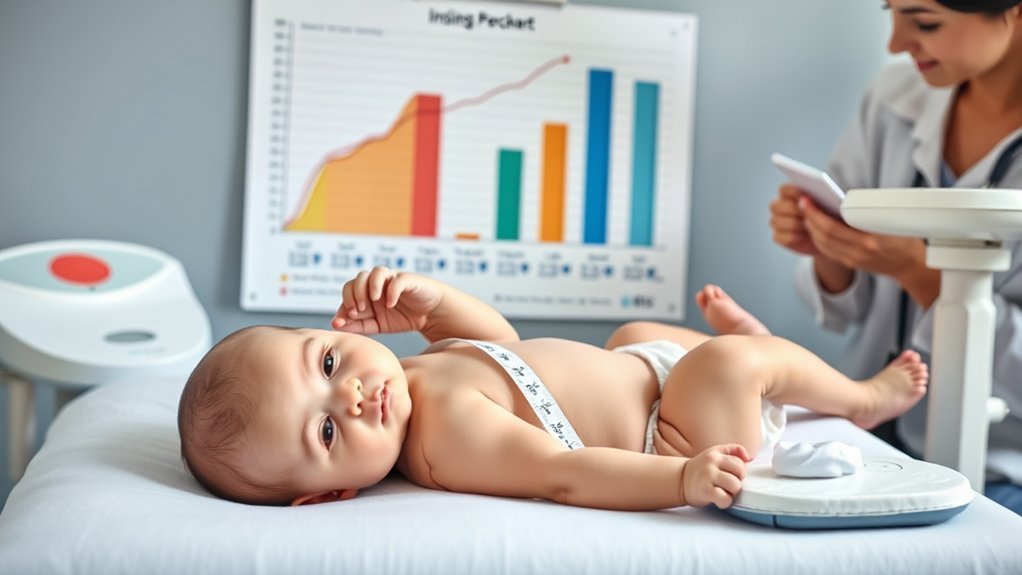
Accurate growth measurements start with the right technique, so use an infant scale for weight, a flat surface for length, and a flexible tape measure for head circumference.
For weight measurements, place your baby undressed on the infant scale; if they’re under 20 kg, lie them down for stability.
For length-for-age, lay your baby straight on a flat surface, head against the wall, with no clothing to improve accurate measurement.
To measure head circumference, wrap the tape around the largest part of the head, just above the eyebrows and ears.
Newborns should be measured lying down; children over 2 years can stand in light clothing.
These measuring techniques support precise growth patterns and make each reading easier to compare over time. Additionally, consistent measurements can help identify potential nutritional needs that may be influenced by socioeconomic factors.
When you use the same method consistently, you protect the meaning of the chart and keep your child’s care grounded in clear, reliable data.
Why Growth Trends Matter More Than One Number
You’ll get the clearest picture of your baby’s health by looking at growth over time, not just one percentile.
A steady pattern in weight and length matters more than a single number, because consistent changes usually reflect normal development.
Even a low or high percentile can be reassuring if your baby’s trajectory stays gradual and stable.
Growth Over Time
Growth trends tell you more about a child’s overall health than any single percentile, because consistency in rate matters more than one isolated measurement.
You can track your child’s growth across growth measurements on a weight-for-age chart and height measurements to see how healthy children come into view over time. Percentiles give context, but your child’s position may shift as patterns and at different ages change.
What matters is the steady line, not the exact rank.
- Review several visits, not one point.
- Watch for significant changes in weight or length.
- Compare weight and height together.
- Ask your pediatrician if the curve drops or diverges.
When you follow trends, you gain clearer, calmer insight and room to act early, without being ruled by a single number.
Patterns Beat Percentiles
A single percentile can look reassuring or alarming on its own, but it doesn’t tell the whole story. You need to look at growth patterns over time.
Pediatricians focus on consistent patterns in weight and height because they reveal your child’s overall development and health trajectory more accurately than one number. A child who tracks steadily at the 10th percentile may be thriving, while one who swings between the 50th and 90th percentiles may need closer review.
Genetics, nutrition, and environment all shape growth, so context matters. Monitoring trends helps you notice real change early, especially during infancy and puberty, when variation is normal.
When you follow the curve, you gain clearer insight, more confidence, and a better sense of when to act.
When Growth Chart Percentiles Need a Doctor’s Review
If your baby’s growth percentile suddenly drops, rises sharply, or moves below the 5th percentile or above the 95th percentile, a pediatrician should review the chart to check for possible health concerns. You can trust that most children’s percentiles reflect normal variation, but abrupt shifts deserve attention.
- Watch for weight and height percentiles that don’t match.
- Note growth patterns that break from the child’s usual curve.
- Ask for consultation if the chart suggests nutritional or medical problems.
- Keep regular visits so a pediatrician can compare changes over time.
When your child’s percentiles change quickly, the goal isn’t alarm; it’s clarity. A review can help identify health problems, growth patterns, or hidden medical problems early, while preserving your family’s freedom to make informed choices.
Bring the record to each appointment, and speak up if anything seems off. Consistent monitoring gives you and your clinician a precise view of development and supports timely care.
When to Switch From WHO to CDC Charts
Around age 2, your pediatrician usually switches your child from WHO growth charts to CDC charts, because WHO charts track weight-for-length from birth to 2 years, while CDC charts track BMI-for-age and growth through age 18.
This shift is standard and helps keep growth monitoring consistent as your child gets taller and more mobile. Before the switch, WHO growth charts use recumbent length; after age 2, CDC growth charts use standing height, so percentiles may shift even when growth is normal.
Ask for accurate measurements and confirm your child’s exact age, since even small timing errors can change interpretation.
The WHO uses the 2nd and 98th percentiles as cutoffs for abnormal growth, which can help guide review before you move to CDC charts.
You don’t need to manage this alone; your clinician will interpret the curve, explain any change in percentile, and support your child’s healthy trajectory with clear, data-based care.
How Feeding and Genetics Affect Growth

Feeding method and family genetics both shape how your baby grows, so a percentile on its own doesn’t tell the full story. Your feeding type influences growth patterns: breastfeeding often supports steady early gains, while formula feeding may produce different curves. Your baby’s genetics also set a range for height, weight, and body shape, reflecting family history.
- Watch for consistent growth, not a single point
- Compare infancy trends with your pediatrician’s chart
- Prioritize nutrition that matches your baby’s needs
- Note rapid gains, which may raise later obesity risk
Exclusively breastfed infants often grow at a different pace than formula-fed infants, and that’s usually normal. What matters most is whether your baby stays on a healthy curve, feeds well, and develops appropriately.
When genetics and nutrition align, you’ll often see reliable growth patterns over time. If your baby’s curve changes sharply, ask your clinician to review intake, health, and overall development.
Frequently Asked Questions
How Often Should I Check My Baby’s Growth Chart?
You should check your baby’s growth chart at pediatrician visits, not daily; routine tracking progress supports growth milestones, feeding habits, and developmental stages, while reducing parental anxiety and catching health concerns early.
What if My Baby’s Measurements Vary Between Visits?
Like a tide line, your baby’s numbers can rise and dip between visits; you’re seeing growth fluctuations, not always health concerns. Focus on tracking consistency, feeding practices, developmental milestones, and understanding averages; follow pediatrician advice.
Are Growth Charts Different for Premature Babies?
Yes—you’ll use premature growth charts and adjusted age for your baby. You can track developmental milestones, feeding patterns, and medical assessments; clinicians’ll watch for long term effects and address parental concerns with reassuring, precise guidance.
Can Teething Affect My Baby’s Weight Gain?
Yes—teething can briefly affect your baby’s weight gain. You might notice teething symptoms, weight fluctuations, or changes in feeding habits and sleep patterns. Growth spurts and developmental milestones still vary; seek pediatric advice if concerns persist.
Should I Compare My Baby to Siblings’ Growth Patterns?
No—you shouldn’t compare your baby to siblings’ growth patterns; each child’s chart is a unique map, shaped by sibling growth, individual differences, health factors, nutrition impact, family genetics, developmental milestones, and pediatric advice.
Conclusion
By reading your baby’s growth chart carefully, you can see more than a single number—you can track a pattern. A percentile only tells you how your baby compares with others; the curve shows whether growth is steady. Isn’t it reassuring to see those lines rise in their own way? If your baby follows a consistent trend, that’s usually what matters most. If something changes suddenly, your pediatrician can help you interpret it.
