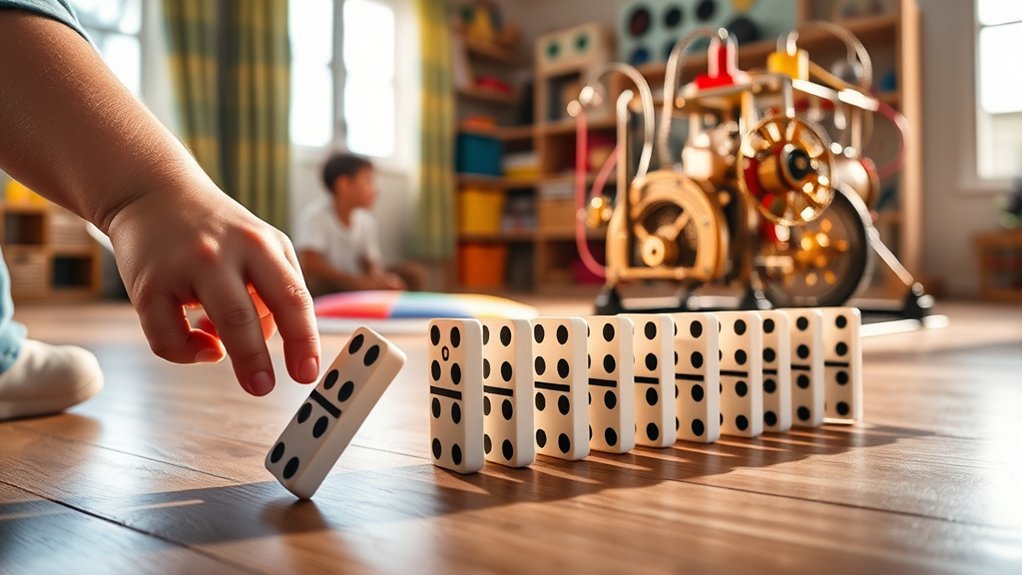
When your child pops a balloon and watches it burst, they’re experiencing a basic principle of cause and effect. This simple act sparks curiosity and encourages exploration. Understanding how actions lead to outcomes is essential for their development. You’ll find activities, age-by-age milestones, toy picks, and practical strategies below — all designed to make cause and effect play both enjoyable and educational.
Quick Answer
- Children begin showing cause-and-effect behavior as early as 6–8 months (shaking rattles, kicking mobiles).
- By age 2, most kids can connect simple actions to outcomes in play and daily routines.
- Everyday moments — cooking, block play, flipping light switches — are some of the best teaching opportunities.
- If your child seems to be struggling past expected age ranges, speaking with your pediatrician early makes a real difference.
Understanding Cause and Effect in Child Development
As you explore the world of child development, you’ll find that understanding cause and effect is essential for nurturing a child’s cognitive growth. This concept helps children grasp how their actions influence outcomes.
When a toddler drops a toy and sees it fall, they begin to recognize predictable outcomes — a key part of early object permanence and executive function development. Recognizing these connections builds problem-solving skills and critical thinking. Encouraging children to ask questions about their environment deepens their understanding.
When toddlers drop toys and watch them fall, they begin connecting actions to outcomes — building the foundation for problem-solving and critical thinking through hands-on exploration.
As they experiment, they begin to predict what will happen next. That prediction process is where a lot of the real learning happens. By giving them a safe space to explore these relationships, you’re strengthening their cognitive abilities and boosting their confidence at the same time.
It’s a key milestone in their growth — and it starts much earlier than most parents expect.
Cause and Effect Development: What to Expect at Each Age
Cause and effect understanding doesn’t start at age two — it begins in the first months of life. Here’s what to look for at each stage of your child’s early childhood development:
| Age | What They Understand | What You’ll Notice |
|---|---|---|
| 0–6 months | Basic sensory responses | Baby kicks legs to make a mobile move; cries to get a response |
| 6–12 months | Intentional actions and early object permanence | Shakes rattle for sound; drops objects repeatedly to watch them fall |
| 1–2 years | Connects simple actions to outcomes | Pushes button to make toy play music; understands “no touch = no burn” |
| 3–5 years | Predicts outcomes and understands consequences | Says “if I do this, then that will happen”; learns rules through trial and error |
Key takeaway: Babies as young as 6–8 months begin showing intentional cause-and-effect behavior. By age 2, most children are already in an advanced stage of this understanding — so the earlier you start play-based learning, the better. For a full breakdown of what to expect at each age, the CDC developmental milestone checklist is a reliable reference.
Fun Activities to Introduce Cause and Effect
Hands-on activities help children grasp these concepts naturally. Here are some easy activities you can try at home:
| Activity | Cause | Effect | Safety Note |
|---|---|---|---|
| Balloon Pop | Popping a balloon | Sound and surprise | ⚠️ Adult supervision required. Remove burst pieces immediately — choking hazard for under 3s |
| Water Pouring | Pouring water | Overflow or wet surface | — |
| Block Tower | Stacking blocks | Tower falls if unbalanced | — |
| Light Switch | Flipping the switch | Light turns on or off | — |
| Ball Roll | Rolling a ball | It moves forward or stops | — |
These activities build more than one skill at a time. Along with cause-and-effect thinking, they develop fine motor skills, sensory awareness, and early play-based learning habits. Watch how your child experiments, fails, and tries again — that process is where the real learning happens.
Incorporating Everyday Experiences
Everyday moments are some of the best opportunities to teach children about cause and effect in a natural and relatable way.
When you cook, invite your child to help. Talk about how mixing ingredients creates changes. If it rains, explain how an umbrella keeps you dry, then ask what happens if you don’t use one.
During playtime, connect actions to outcomes — like how pushing a toy car makes it move. These moments help your child see a clear link between what they do and what happens next.
Encourage them to ask questions and share their thoughts. This deepens their understanding and builds their confidence as independent thinkers.
Tools and Resources for Cause and Effect Play
Having the right tools keeps your child engaged. Here’s a practical guide to resources worth using:
| Tool/Resource | Description | Example |
|---|---|---|
| Everyday Objects | Simple items from around the house | Plastic cups, balls, spoons |
| Cause and Effect Toys | Toys designed to show clear reactions | Marble run, pop-up toys, busy boards |
| Interactive Apps | Age-appropriate digital learning tools | Khan Academy Kids, Sago Mini apps (ages 2–5) |
| Books | Stories that show clear cause and effect | See recommended books section below |
Best Cause and Effect Toys by Age
Not all toys are created equal when it comes to teaching cause and effect. Here are age-appropriate picks that actually deliver results:
| Age Range | Recommended Toy | Why It Works |
|---|---|---|
| 6–12 months | Baby activity gym with hanging toys | Baby kicks or bats objects and immediately sees/hears a reaction |
| 1–2 years | Pop-up animal toy / Shape sorter | Pressing a button makes something appear — instant, satisfying feedback |
| 2–3 years | Stacking rings / Busy board | Actions like stacking or switching produce visible, predictable results |
| 3–5 years | Marble run / Basic building sets | Children plan and predict outcomes, then test their thinking |
Best Books That Teach Cause and Effect
Books are a powerful and often underrated tool for teaching cause and effect. These titles do it especially well:
- “Press Here” by Hervé Tullet — Children press dots on each page and “see” the result on the next. Pure interactive cause and effect for ages 2+.
- “Mix It Up!” by Hervé Tullet — Explores color mixing through simple actions. Great for sensory play conversations.
- “If You Give a Mouse a Cookie” by Laura Numeroff — A classic circular cause-and-effect story. Perfect for ages 3–6.
- “The Very Hungry Caterpillar” by Eric Carle — Eating leads to change over time. A gentle, visual introduction to outcomes.
- “Rosie’s Walk” by Pat Hutchins — Every step Rosie takes has a consequence for the fox following her. Great for ages 3+.
Read these together and pause to ask “What do you think will happen next?” That one question turns story time into an active cognitive development exercise.
Encouraging Exploration and Curiosity
Curiosity is one of the most powerful drivers of a child’s learning. To feed that curiosity, fill your child’s environment with different toys, textures, and activities that invite exploration.
Let your child experiment with different textures, sounds, and colors. Ask open-ended questions that get them thinking, like “What do you think happens if…?” This builds problem-solving skills while keeping things fun.
Encourage your child’s exploration by introducing different textures and sounds, and keep them thinking with open-ended questions like “What happens if…?”
Let them try things — and sometimes get it wrong. That’s how real learning happens. Celebrate what they discover, no matter how small, to build their confidence. And get involved yourself. When children see you curious and engaged, they learn that asking questions is something worth doing.
Signs Your Child Understands Cause and Effect
Wondering if your child is on track? Here are clear signs that they’re developing a healthy understanding of cause and effect:
- ✅ They repeat an action to get the same result (e.g., pressing a button again and again)
- ✅ They look at you after doing something — waiting for your reaction
- ✅ They show surprise or frustration when an expected outcome doesn’t happen
- ✅ They begin to predict results before acting (e.g., covering ears before a loud noise)
- ✅ They use simple “if/then” language: “If I push this, it falls!”
- ✅ They understand basic rules and consequences (e.g., “If I throw it, it breaks”)
Every child develops at their own pace. If you have concerns about your child’s developmental milestones, speak with your pediatrician. Early support makes a significant difference.
What If My Child Is Struggling With Cause and Effect?
It’s completely normal for some children to take longer to connect actions to outcomes. If you’re noticing delays, here are practical steps you can take:
- Slow things down: Instead of rushing through activities, pause and narrate what’s happening — “You pushed the button and the music started!”
- Use consistent routines: Predictable daily routines are one of the easiest ways to teach cause and effect (e.g., bath time always leads to pajamas and bed).
- Choose simpler toys: If the activity is too complex, a child may not connect the action to the outcome. Start with single-step toys that give instant feedback.
- Reduce distractions: A busy environment can make it hard for children to focus on the connection between what they’re doing and what’s happening.
- Talk to your pediatrician: If your child consistently struggles to connect actions to outcomes past expected age ranges, bring it up at their next checkup. It may be worth exploring further with an early childhood specialist.
Getting extra support early — through play therapy, occupational therapy, or early intervention programs — can make a meaningful and lasting difference. Zero to Three is a trusted resource for parents navigating these conversations and looking for guidance on early development support.
Frequently Asked Questions
At What Age Do Children Start Understanding Cause and Effect?
Babies begin showing early cause-and-effect behavior as young as 6–8 months — for example, shaking a rattle to make sound or kicking to move a mobile. By age 2, most children are already in an advanced stage of this understanding and can connect simple actions to outcomes in play and daily routines.
How Can Parents Assess Their Child’s Understanding of Cause and Effect?
Watch how your child plays. Do they repeat actions to get the same result? Do they look at you after doing something to see your reaction? Do they show surprise when an expected outcome doesn’t happen? These behaviors are good signs of growing cause-and-effect understanding. You can also ask simple open-ended questions during play to see how they think through outcomes.
What Are Common Misconceptions About Cause and Effect in Children?
A common mistake is confusing correlation with causation — children (and adults) often assume that two things happening at the same time means one caused the other. Children may also believe their actions have no real effect on outcomes, or that every cause only has one possible result. Gentle questioning during play helps children test and correct these assumptions over time.
Can Cause and Effect Play Help With Behavioral Issues?
Yes. When children understand that their actions lead to predictable outcomes — including social ones — it supports emotional regulation, impulse control, and social skills. Children who grasp cause and effect tend to make more thoughtful choices because they can anticipate consequences before acting.
How Do Cultural Differences Influence Children’s Understanding of Cause and Effect?
Culture shapes how children learn to connect actions and outcomes. In some cultures, storytelling is the main way children learn about consequences. In others, hands-on exploration and free play take center stage. Neither approach is better — what matters is that children have regular, meaningful opportunities to test actions and observe results in a supportive environment.
What Are the Best Cause and Effect Toys for Toddlers?
For toddlers aged 1–3, the best cause-and-effect toys are ones that give an instant, clear reaction: pop-up animal toys, shape sorters, activity busy boards, stacking rings, and simple musical instruments like drums or xylophones. These teach that a specific action always produces the same result — which is the core of cause-and-effect thinking at this age.
Conclusion
Cause and effect play isn’t just a fun activity — it’s one of the most important foundations of your child’s cognitive development. From the first time a baby kicks a mobile to a five-year-old building and crashing a block tower, every action-and-reaction moment is a real learning experience.
The good news is that you don’t need special equipment or a structured lesson plan. Everyday moments — cooking together, playing in the yard, reading books, or even switching a light on and off — are all opportunities to strengthen this skill.
Start where your child is, go at their pace, and keep it playful. The more they explore, the more confident and capable they become — and that confidence carries with them far beyond childhood.
