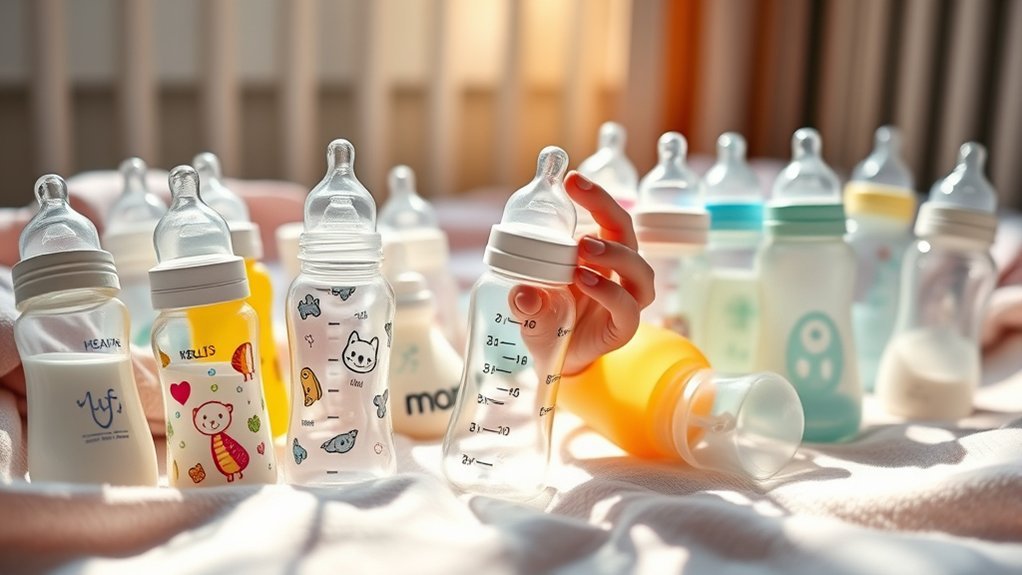
Choosing baby bottles is less about finding one “best” bottle and more about matching the material, nipple flow, shape, and cleaning needs to your baby. Babies can respond differently to the same bottle, and flow rate often matters more than marketing terms such as “breast-like” or “anti-colic.” Use your baby’s feeding cues and safe-cleaning guidance to adjust as you go.
Quick Answer
There is no single best baby bottle. Start with a safe, easy-to-clean bottle and a slow-flow nipple, then watch how your baby feeds. Material affects weight and breakability, while nipple flow affects comfort and coordination. Breast-like shapes do not guarantee easier switching, and age labels are only a starting point.
Last checked: October 7, 2026. Dates and figures were verified against official sources.
Key Takeaways
- Your baby’s comfort and feeding cues matter more than choosing a particular bottle brand or nipple shape.
- Start with a slower nipple flow and change only when your baby shows that the current flow is no longer working well.
- Glass, plastic, silicone, and stainless steel each have practical trade-offs; no single material is best for every family.
- Bottle-feeding problems blamed on “nipple confusion” may actually involve flow preference, latch, or another feeding issue.
- Clean feeding equipment after every feed, and use extra sanitizing precautions when your baby is very young or medically vulnerable.
Common Myths About Baby Bottles
Several common baby-bottle claims sound simple but leave out important details. Understanding what actually affects feeding can save you from repeatedly changing bottles when the real issue is nipple flow, feeding technique, or your baby’s individual preference.
- Myth: All baby bottles work the same. Bottle material, nipple flow, nipple shape, venting, and ease of cleaning differ. Your baby may also accept one nipple more readily than another.
- Myth: Glass bottles are unsafe. Glass bottles avoid the scratches that can develop in plastic, but they are heavier and can break if dropped. A protective sleeve may reduce breakage risk, depending on the bottle.
- Myth: A breast-shaped nipple prevents nipple confusion. No bottle nipple works exactly like a breast. Some babies switch easily, while others develop a preference for a particular flow or feeding method.
- Myth: You must move to a faster nipple at a certain age. Age recommendations are useful starting points, but your baby’s swallowing, comfort, milk leakage, coughing, and frustration are better clues.
The term “nipple confusion” can also oversimplify feeding difficulties. Cleveland Clinic’s breastfeeding guidance notes that difficulty switching between breast and bottle may involve preference, milk flow, latch, or other breastfeeding problems rather than literal confusion.
Understanding Bottle Materials
Baby bottles come in several materials, and each has practical advantages and drawbacks. Focus on safe use, durability, cleaning, weight, and how well the bottle fits your daily routine.
Plastic bottles are lightweight and resist shattering. They can become scratched or worn with repeated use, so inspect them regularly and follow the manufacturer’s care and replacement instructions.
Concerns about BPA need some context. In the United States, the FDA amended its regulations in 2012 so they no longer provide for BPA-based polycarbonate resins in baby bottles and sippy cups. The change followed evidence that industry had abandoned that use; it was not a new FDA finding that every approved use of BPA was unsafe.
Glass bottles do not contain BPA-based plastic and resist scratching, but they are heavier and can break if dropped. Check glass bottles for chips and cracks before use.
Stainless steel bottles are sturdy and will not shatter like glass. Because you cannot see through the bottle, however, checking the amount of milk inside may be less convenient.
Silicone bottles are soft and flexible. As with other materials, follow the manufacturer’s instructions for heating, cleaning, sanitizing, and checking for wear.
The MedlinePlus guide to bottles and nipples also emphasizes that the practical choice depends largely on which bottle and nipple your baby will comfortably use.
The Importance of Nipple Shape
Nipple shape can affect how comfortably your baby latches onto a bottle, but there is no universal shape that works best. Instead of choosing by appearance alone, look at how your baby seals their lips around the nipple, sucks, swallows, and handles the milk flow.
Nipple Shape Variations
Bottle nipples are sold in several shapes. Trying more than one can make sense if your baby consistently struggles with the first option.
- Standard or tapered: A traditional narrower shape that many babies use comfortably.
- Wide-base: A broader design often marketed for babies who also breastfeed. A wider shape may suit some babies, but it does not guarantee a breastfeeding-like latch.
- Orthodontic-style: A flattened or asymmetrical design. Treat “orthodontic” as a design description rather than proof that it will improve oral development for every baby.
Your baby may accept several shapes or strongly prefer one. If feeding is comfortable and effective, there is usually no reason to change shape simply because another design is advertised as more natural.
Impact on Feeding
Nipple shape is only one part of successful bottle feeding. Flow rate, feeding position, latch, and your baby’s ability to coordinate sucking, swallowing, and breathing can matter just as much or more.
A nipple that looks breast-like does not necessarily behave like breastfeeding. If you are combining breast and bottle, a slower flow and responsive feeding technique can help keep the bottle from delivering milk much faster than your baby expects at the breast.
Persistent difficulty switching between feeding methods may need more than a new nipple. A pediatrician, lactation professional, or feeding specialist can help assess latch, milk transfer, flow, and other possible causes.
Baby Preference Factors
Your baby’s behavior is one of the best guides when comparing nipples. Look at the whole feed rather than judging a bottle by its age label or shape.
- Shape: Your baby should be able to maintain a comfortable seal without repeatedly pushing the nipple away or gagging on its length.
- Flow rate: Milk should come quickly enough for comfortable feeding without causing repeated gulping, coughing, or leaking from the mouth.
- Material: Nipples are commonly made from silicone or latex. Latex is softer but may wear faster, while silicone generally holds its shape longer.
Flow Rate: What You Need to Know
Nipple flow rate describes how quickly milk moves through the nipple. A slower flow is generally a sensible starting point for a newborn, but you should adjust according to your baby’s feeding behavior rather than automatically moving up whenever the package suggests a new age.
Flow labels are not standardized across products. A study of commercially available bottle nipples found wide differences in measured milk flow and reported that package categories did not reliably predict actual flow rates.
Signs that the flow may be too fast include repeated gulping, coughing, sputtering, or milk leaking from the sides of the mouth. A baby who regularly pulls away to catch their breath may also be struggling with the flow.
A flow that is too slow may leave your baby frustrated, repeatedly sucking without getting enough milk, falling asleep before taking an adequate feed, or spending an unusually stressful amount of time trying to drink. A collapsing nipple can also mean the vent or nipple needs checking rather than automatically requiring a faster flow.
Note: If your baby repeatedly coughs or chokes during feeds, has ongoing trouble coordinating feeding, gains weight poorly, or consistently has stressful feeds, ask your pediatrician or a qualified feeding professional for individual guidance.
The Role of Bottle Size
Bottle size mainly affects convenience and capacity; it does not determine how much your baby must drink. Smaller bottles are often easier during the newborn stage, while larger bottles become more practical as the amount taken at individual feeds increases.
A 4-fluid-ounce (120 mL) bottle is a common size for newborn feeding, while 8-fluid-ounce (240 mL) bottles can be useful later. However, you should still follow your baby’s hunger and fullness cues rather than encouraging them to finish a larger bottle simply because more milk fits inside.
Consider three practical factors:
- Your baby’s usual intake: Choose enough capacity for a normal feed without treating the bottle’s maximum size as a feeding goal.
- How you feed: If you use occasional expressed milk alongside breastfeeding, smaller bottles may be convenient for smaller portions.
- Handling and cleaning: Pick a bottle you can hold comfortably and take apart completely for washing.
Transitioning From Breast to Bottle
Moving between breast and bottle can take practice, and there is no technique that guarantees immediate acceptance. Start when your baby is calm, keep the experience low-pressure, and pay attention to both nipple flow and your baby’s feeding cues.
Timing of Transition
If breastfeeding is going well and there is no medical reason to introduce a bottle earlier, the American Academy of Pediatrics’ HealthyChildren guidance describes offering expressed milk in a bottle at around 4 weeks. That is guidance, not a deadline, and individual feeding plans may differ.
The AAP’s bottle-introduction advice recommends trying when the baby is alert and interested but not extremely hungry or upset. Another caregiver may also have more success offering the first bottles because the baby does not have the usual cues to breastfeed.
If your baby needs supplementation or bottle feeding earlier for medical, growth, supply, or family reasons, follow the feeding plan recommended by your baby’s healthcare professional rather than delaying a needed feed.
Bottle Nipple Types
Choose nipple flow before worrying too much about whether a nipple looks like a breast. A wide or sloped nipple may feel comfortable for some babies, but no nipple shape guarantees that a breastfed baby will accept the bottle or move back and forth without difficulty.
Begin with a slower flow and watch what happens during the feed. If your baby manages the milk calmly and efficiently, there is no need to switch to a faster flow simply because they have reached a certain age.
Silicone and latex nipples also feel different. If you change material or shape, give your baby a little time to explore the new nipple instead of forcing it into their mouth.
Techniques for Success
A calm, responsive approach makes bottle introduction easier for many babies. The goal is to let your baby control the pace rather than making them finish a predetermined amount.
- Choose a calm time. Offer the bottle before your baby becomes frantic with hunger, but not immediately after a full feed.
- Use familiar milk when possible. For a breastfed baby, expressed breast milk gives them a familiar taste while they learn a new feeding method.
- Consider another caregiver. Some breastfed babies accept a bottle more readily from someone other than the breastfeeding parent.
- Hold your baby semi-upright. Support the head and neck and keep your baby close.
- Control the flow. Hold the bottle at an angle or nearly horizontal so milk does not pour rapidly into your baby’s mouth.
- Pause when your baby pauses. Let your baby rest, turn away, or stop when they show fullness cues.
The CDC’s bottle-feeding guidance likewise recommends letting babies take breaks, watching for fullness cues, and stopping even when milk remains in the bottle.
Tips for Choosing the Right Bottle for Your Baby
Start with the features that affect everyday feeding: material, flow, fit, capacity, and cleaning. Buying a large supply before your baby has tried the bottle can leave you with an entire set they do not comfortably use.
| Factor | Considerations | Recommendations |
|---|---|---|
| Material | Plastic, glass, silicone, or stainless steel | Choose based on weight, breakability, visibility, care instructions, and your routine |
| Nipple Flow | Flow varies by nipple and brand | Start slower and adjust to your baby’s feeding cues rather than age alone |
| Design | Straight, angled, narrow-neck, wide-neck, or vented | Prioritize comfortable feeding and easy assembly over marketing claims |
| Size | Smaller or larger capacity | Use a capacity that suits typical feeds without encouraging your baby to finish the bottle |
| Ease of Cleaning | Number of parts, openings, valves, and dishwasher compatibility | Choose a design you can fully disassemble, wash, rinse, dry, and reassemble correctly |
If your baby is feeding comfortably, swallowing without repeated coughing or leaking, taking reasonable breaks, and showing normal hunger and fullness cues, the bottle is probably doing its job. You do not need to switch simply because another bottle promises a more natural feeding experience.
Safe Bottle Feeding and Cleaning Basics
The right bottle still needs safe handling. Cleaning after feeds, controlling milk flow, and supervising every bottle matter more than many optional bottle features.
Warning: Never prop a bottle or leave your baby alone with one. The CDC warns that bottle propping can increase the risk of choking, ear infections, tooth decay, and taking more milk than your baby needs.
Clean bottles and all removable parts after every feed. The CDC cleaning and sanitizing instructions recommend taking bottles apart, washing them with soap and safe water or in a dishwasher when the items are dishwasher-safe, and allowing parts to air-dry thoroughly.
For extra germ removal, the CDC recommends daily sanitizing in particular when a baby is younger than 2 months, was born prematurely, or has a weakened immune system. For older healthy babies, daily sanitizing may not be necessary when feeding items are cleaned carefully after each use.
If the manufacturer says the items can be boiled, the CDC sanitizing method is to place disassembled items under water, bring the water to a boil, and boil for 5 minutes. Steam systems and suitable dishwasher sanitizing or heated-drying cycles are other options when compatible with the feeding equipment.
Also avoid microwaving a bottle of milk or formula to warm it. Uneven heating can create hot spots that can burn a baby’s mouth.
Frequently Asked Questions
How Often Should I Replace Baby Bottles?
There is no single replacement schedule that applies to every baby bottle. Inspect bottles regularly and replace them if you find cracks, chips, deep scratches, warping, damaged threads, or other weakness. Follow the bottle manufacturer’s instructions because replacement guidance differs by material and product.
Can I Use Regular Dish Soap to Clean Baby Bottles?
Yes, ordinary dish soap can be used to clean baby bottles. Take every removable part apart, wash with soap and hot water in a clean basin used for feeding items, rinse thoroughly, and let the pieces air-dry completely before storage.
Are All Baby Bottles Dishwasher Safe?
No, you should not assume every bottle or bottle part is dishwasher safe. Follow the manufacturer’s instructions for your specific bottle, nipple, valves, and other pieces. Dishwasher-safe small parts should be secured so they cannot fall into the dishwasher filter.
What’s the Best Way to Sterilize Baby Bottles?
There is no single best method for every bottle. Depending on the manufacturer’s instructions, CDC options include boiling cleaned items for 5 minutes, using a steam sanitizing system, or using a dishwasher with hot water and a heated drying or sanitizing cycle. Extra daily sanitizing is especially important for higher-risk infants.
Can I Mix Different Brands of Nipples and Bottles?
Only mix bottle and nipple parts when the manufacturers say those specific parts are compatible. A nipple that appears to fit can still seal, vent, or lock incorrectly. If compatibility is not stated, use the nipple, ring, and bottle system intended to work together.
How Do I Know if a Bottle Nipple Flow Is Too Fast?
A nipple may be too fast if your baby repeatedly gulps, coughs, sputters, pulls away, or leaks milk from the mouth during feeding. Try a slower flow and a more controlled bottle position. Persistent coughing or choking should be discussed with your baby’s healthcare professional.
Does a Breast-Shaped Bottle Nipple Prevent Nipple Confusion?
No bottle nipple can guarantee that a baby will switch easily between breast and bottle. Some babies adapt without difficulty, while others respond to differences in milk flow, latch, texture, or feeding technique. A slower flow and responsive feeding are often more useful than relying on nipple shape alone.
Conclusion
The right baby bottle is the one your baby can use comfortably and you can clean and handle safely. Start with a practical material and slower nipple flow, watch your baby rather than relying only on age labels or marketing claims, and adjust when feeding cues show a real need. If feeding remains difficult despite those changes, involve your pediatrician or a qualified feeding professional.
Sources
- Centers for Disease Control and Prevention: Feeding From a Bottle: responsive bottle feeding, feeding position, fullness cues, bottle propping, and bottle safety.
- Centers for Disease Control and Prevention: Cleaning Infant Feeding Items: bottle cleaning, dishwasher use, air-drying, sanitizing, and 5-minute boiling guidance.
- U.S. Food and Drug Administration: BPA in Food Contact Applications: U.S. regulatory history for BPA-based materials in baby bottles.
- PubMed: Know the Flow: measured variability among bottle-nipple flow rates and limitations of package flow categories.
- MedlinePlus: Buying and Caring for Baby Bottles and Nipples: bottle materials, nipple materials, shapes, and flow considerations.
- American Academy of Pediatrics HealthyChildren: Introducing the Bottle: practical breast-to-bottle introduction techniques.
- Cleveland Clinic: Nipple Confusion Myths: breast-to-bottle switching, flow preference, latch issues, and paced bottle feeding.