Disclosure: As an Amazon Associate, we earn from qualifying purchases. If you buy through links on this page, we may earn a small commission at no extra cost to you.
By Editorial Team | Updated October 8, 2026 | Research-based product review
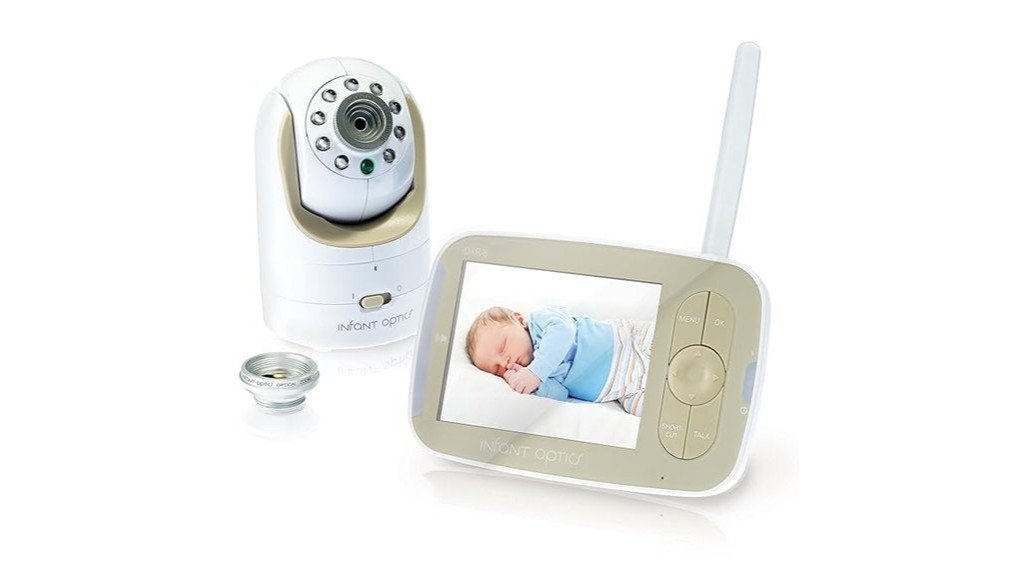
The Infant Optics DXR-8 is a non-WiFi video baby monitor designed for parents who want to see and hear their baby without using a smartphone app or internet connection. It features a 3.5-inch color display, remote camera movement, infrared night vision, two-way audio, and interchangeable lenses.
Its main advantages are a dedicated parent screen and a direct wireless connection. However, the original DXR-8 has a modest 320 × 240 display resolution, limited indoor range in some homes, and fewer advanced features than newer monitors. This review examines its specifications, limitations, and value using manufacturer documentation and published independent testing.
Research-based assessment, not a hands-on test score.
320 × 240 Pixels
Non-WiFi FHSS
Up to 700 ft
Up to 4 Cameras
Two-Way Audio
Best for: Parents who prefer a dedicated baby monitor without WiFi, an app, or a subscription.
Skip if: You need smartphone access, high-definition video, built-in video recording, or simultaneous split-screen viewing.
Bottom line: The DXR-8 remains a practical option for straightforward home monitoring. Its interchangeable lenses and remote camera controls are useful, but its display and feature set are dated compared with newer models.
Check the exact model and included accessories before ordering.
Before You Buy
- Check the model: The original DXR-8 and DXR-8 PRO have different displays and incompatible camera units.
- Expect standard-definition video: The original DXR-8 uses a 320 × 240 display, not a 480p or 720p screen.
- Plan camera placement: The advertised range assumes a clear line of sight. Walls and interference can reduce performance.
- Know the accessories: The optical zoom lens is included in the standard kit, while the wide-angle lens is sold separately.
Jump to Review Sections
Key Takeaways
- The Infant Optics DXR-8 uses a direct non-WiFi FHSS connection, removing the need for an internet account or cloud-based video service.
- Its interchangeable lens system supports different camera placements, including closer views and optional wide-angle coverage.
- The 3.5-inch display has a confirmed resolution of 320 × 240 pixels. It is suitable for basic observation but cannot match HD screens for detail.
- Remote pan, tilt, digital zoom, infrared night vision, and two-way audio support everyday nursery monitoring.
- The manufacturer rates the parent unit for approximately 6 hours with the screen on or 10 hours in standby mode.
- The system supports up to four compatible cameras but does not provide simultaneous split-screen viewing.
- Parents needing larger screens, active noise reduction, or dual-room viewing should compare newer alternatives before buying.
How the DXR-8 Ensures Privacy and Security
The Infant Optics DXR-8 uses Frequency Hopping Spread Spectrum (FHSS) technology to send video and audio directly between the camera and parent unit. Unlike a WiFi monitor, it does not require a router, online account, smartphone application, or cloud connection.
This design avoids common risks associated with internet-connected cameras, including compromised cloud accounts and exposed remote-access settings.
However, no wireless system should be described as completely impossible to intercept or interfere with. FHSS improves the privacy of the local connection, but it is not an absolute security guarantee.
Does Non-WiFi Monitoring Prevent Every Connection Problem?
No. The DXR-8 does not depend on internet service, but it still uses radio signals in the 2.4 GHz band. Other wireless equipment and physical obstacles can affect reception.
For most parents, the practical benefit is that monitoring can continue during a home internet outage, provided the camera and parent unit have power and remain within working range.
The camera does not provide remote viewing outside the local wireless connection. That makes it a better fit for home monitoring than for checking a nursery while away.
Key Features of the Infant Optics DXR-8 Baby Monitor
The Infant Optics DXR-8 combines basic monitoring functions with controls that help parents adjust the camera without entering the nursery. Its most distinctive feature is the interchangeable optical lens system.
The parent unit also offers camera movement, digital zoom, a temperature display, and visual sound indicators.
Infant Optics DXR-8 Specifications
| Specification | Infant Optics DXR-8 |
|---|---|
| Display | 3.5-inch color TFT LCD |
| Display resolution | 320 × 240 pixels (QVGA) |
| Wireless connection | 2.4 GHz FHSS, non-WiFi |
| Advertised range | Up to 700 feet, unobstructed line of sight |
| Maximum cameras | 4 compatible camera units |
| Camera controls | Remote pan, tilt, and 2x digital zoom |
| Night vision | Automatic infrared night vision |
| Audio | Two-way talk and sound-level LED indicators |
| Room temperature | Camera temperature sensor with screen display |
| Parent-unit battery | Rechargeable, user-replaceable lithium-ion |
| Rated battery runtime | 6 hours screen on; 10 hours standby |
| Full charging time | Approximately 7 hours |
| Manufacturer warranty | One-year limited warranty, subject to terms |
These specifications come from the Infant Optics user manual and support documentation. Published specifications represent manufacturer ratings rather than results from testing conducted for this review.
Interchangeable Lenses and Camera Movement
The DXR-8 uses a removable lens system so parents can change the camera’s field of view without replacing the entire monitor.
- Standard lens: Provides a normal view of the nursery.
- Optical zoom lens: Included with the standard kit and useful when the camera must be placed farther from the crib.
- Wide-angle lens: Sold separately and intended for viewing a larger area of the room.
Remote pan and tilt controls let you adjust the camera direction from the parent unit. This is useful when a toddler moves around the room or when the camera does not initially point toward the desired area.
Optical and digital zoom work differently. The optical lens changes the camera’s view, while digital zoom enlarges the existing image. Digital enlargement cannot add detail beyond the original resolution.
What’s Included in the Box?
The manufacturer’s standard DXR-8 package lists the following components:
- 3.5-inch parent monitor unit
- One camera unit with standard lens hood
- One optical zoom lens
- Rechargeable lithium-ion battery
- Power adapters for the camera and monitor
- USB power cable
- Mounting screw and anchor
- Operating instructions
Retail bundles can differ. Confirm the package contents and model number for the specific listing before placing an order.
How the Infant Optics DXR-8 Performs in Video and Audio Quality
The DXR-8 provides enough visual information for basic nursery monitoring, but its resolution is lower than that of newer HD models. The original monitor’s 320 × 240 display is designed for checking a child’s position and activity rather than capturing fine detail.
Daytime Picture Quality
In daylight, the monitor can show a baby and surrounding objects clearly enough for routine observation when the camera is positioned correctly.
However, independent testing by BabyGearLab identified limitations in fine detail and image sharpness. Textures, facial features, and small objects may appear less distinct than on higher-resolution monitors.
The interchangeable optical zoom lens can help frame a smaller area, but it does not transform the display into an HD screen.
Infrared Night Vision
The camera automatically switches to infrared night vision when the room becomes dark. The resulting image is black and white rather than full color.
Night vision is useful for checking a sleeping child without turning on the room lights. Still, image sharpness can be limited, especially at greater distances or around the edges of the picture.
Avoid judging a baby’s breathing or medical condition solely from a video image. A standard baby monitor is not a medical breathing monitor.
Two-Way Talk and Sound Indicators
The DXR-8 includes two-way audio, allowing parents to speak through the camera’s speaker from the parent unit.
A sound-activated LED bar helps show activity in the nursery when the screen is off or the monitor volume is low. Parents can also adjust the listening volume to suit the room.
One limitation is the absence of the active noise reduction feature found on the DXR-8 PRO. Background noise from fans or white-noise machines may remain audible on the original model.
Battery Life and Everyday Reliability
The manufacturer specifies approximately 6 hours with the screen continuously on and 10 hours in standby mode. These figures are operating estimates, not guaranteed runtimes.
Actual battery life depends on the battery’s age, charging condition, display use, and other operating factors.
The user-replaceable battery is a practical advantage because parents can replace an aging battery instead of automatically replacing the entire monitor.
The advertised 700-foot range applies to an unobstructed line of sight. Independent testing has found substantially shorter indoor coverage when walls separate the camera and parent unit.
User Experiences and Reviews of the Infant Optics DXR-8 Monitor
Published reviews of the original DXR-8 show a mix of favorable experiences and limitations. Parents often value its straightforward controls and lack of WiFi setup, while performance concerns focus on indoor range, image detail, and battery wear.
These observations are drawn from published independent testing and individual owner discussions. They are not results from hands-on testing conducted for this article.
| Aspect | Published Feedback |
|---|---|
| Video Quality | Useful for basic observation, but fine detail and nighttime sharpness are limited. |
| Battery Life | Generally practical for portable use, although battery capacity may decline with age. |
| Interchangeable Lenses | Provide flexible camera placement, though some users may rarely change lenses. |
| Sound Quality | Useful two-way communication, with possible background noise from nursery equipment. |
| Overall Experience | Simple controls are appealing, while larger homes may reveal range limitations. |
What Owners Appreciate
Positive owner discussions often emphasize that the camera works without connecting to a home network. The dedicated parent unit also avoids the need to keep a phone application open.
Parents who prefer physical controls appreciate being able to change the camera angle, adjust the volume, and check a sleeping child from one device.
Common Complaints and Limitations
Published independent testing has identified limited indoor range and relatively modest image quality. Some owners also describe connection or battery-related problems as their monitors age.
Individual experiences vary. A signal problem may result from interference, an unpaired camera, low battery power, or the layout of the home rather than a defective camera.
Before replacing a monitor that displays an out-of-range warning, check the selected camera channel and confirm that the camera is still paired.
Infant Optics DXR-8 Pros and Cons
The DXR-8’s strongest qualities are its independent wireless connection, straightforward operation, and adjustable camera view. Its biggest drawbacks relate to video resolution, remote access, and indoor coverage.
Pros
- Direct non-WiFi connection without an app or cloud subscription.
- Remote pan, tilt, and interchangeable lens options.
- Two-way audio and automatic infrared night vision.
- Supports up to four compatible cameras.
- Rechargeable, user-replaceable parent-unit battery.
Cons
- 320 × 240 display offers limited detail compared with HD monitors.
- No smartphone access, built-in recording, or simultaneous split-screen viewing.
- Indoor signal range can decrease significantly through walls.
- Wide-angle lens must be purchased separately.
What Makes the DXR-8 a Practical Choice?
The Infant Optics DXR-8 is designed for parents who prioritize simple, dedicated video monitoring over smartphone features.
Its physical controls, interchangeable lenses, and rechargeable parent unit make it a flexible option for everyday use. However, its age and standard-definition display should be considered before choosing it over newer alternatives.
Who Should Buy the DXR-8?
- Parents who want non-WiFi monitoring: The camera connects directly to the parent unit without internet setup.
- Families using a dedicated parent screen: You can monitor the nursery without relying on a smartphone.
- Parents who need adjustable camera placement: Remote movement and interchangeable lenses provide extra flexibility.
- Families planning to add cameras: The system can support multiple compatible original DXR-8 camera units.
Who Should Skip the DXR-8?
- Parents wanting HD video: The original model’s resolution is relatively low.
- Families needing remote viewing: There is no smartphone or internet viewing option.
- Parents monitoring two rooms simultaneously: The system switches between cameras rather than displaying both at once.
- Households with difficult signal conditions: Thick walls and large distances can limit reliable reception.
Best Uses for the Infant Optics DXR-8
Nighttime nursery checks: Infrared night vision and two-way audio let parents monitor a sleeping baby from elsewhere in the home.
Toddler-room monitoring: Remote pan and tilt controls make it easier to adjust the viewing area as a child moves around the room.
Travel and visits: The direct wireless connection can be useful in locations without reliable WiFi. Both units still need appropriate power, and the camera must remain safely positioned.
Infant Optics DXR-8 vs. Alternatives
The original DXR-8 is not the only non-WiFi baby monitor worth considering. Newer Infant Optics models offer larger screens, while other manufacturers provide different combinations of camera controls and viewing features.
| Monitor | Display | Main Advantage | Best For |
|---|---|---|---|
| Infant Optics DXR-8 | 3.5-inch QVGA | Interchangeable lenses and direct connection | Simple nursery monitoring |
| Infant Optics DXR-8 PRO | 5-inch HD | Larger display and active noise reduction | Clearer viewing and reduced background noise |
| Infant Optics DXR-8 PRO SS | 5-inch HD | Split-screen and simultaneous dual audio | Monitoring two children or rooms |
| VTech VM819 | 2.8-inch LCD | Basic monitoring with soothing sounds and a compact display | Parents seeking straightforward features |
Infant Optics DXR-8 vs. DXR-8 PRO
The DXR-8 PRO offers a larger 5-inch HD screen, active noise reduction, and a manufacturer-rated range of up to 1,000 feet under unobstructed conditions.
It is the more suitable option for buyers who want clearer video and reduced background noise. The original DXR-8 remains a simpler choice when those upgrades are unnecessary.
The two models should not be treated as interchangeable. Their camera units are not cross-compatible.
Infant Optics DXR-8 vs. DXR-8 PRO SS
The DXR-8 PRO SS adds split-screen viewing and simultaneous audio from two cameras. This is useful for families with two children sleeping in separate rooms.
The original DXR-8 supports multiple cameras but displays one feed at a time. Parents who need continuous simultaneous room coverage should consider the PRO SS instead.
Infant Optics DXR-8 vs. VTech VM819
The VTech VM819 offers a smaller 2.8-inch display, automatic night vision, two-way talk, room temperature monitoring, and built-in soothing sounds.
It is a simpler alternative for parents who do not need the DXR-8’s motorized camera movement or interchangeable lenses. The DXR-8 provides more flexible camera positioning, while the VTech focuses on basic features.
Compare exact specifications using the manufacturers’ documentation before deciding. A newer product is not automatically a better fit for every household.
Is the Infant Optics DXR-8 Worth the Price?
The Infant Optics DXR-8 is worth considering if its price is competitive with newer non-WiFi monitors and you value its interchangeable lens system.
Its strongest selling points are the direct connection, remote camera controls, and dedicated parent unit. These features may matter more than screen resolution for parents who primarily want to check whether their child is asleep or awake.
However, the original model becomes harder to justify when a newer monitor with a larger screen and additional features is available at a similar price.
Our assessment: Compare the original DXR-8 with the DXR-8 PRO before purchasing. If the price difference is small, the PRO’s larger HD display and active noise reduction may provide better long-term value.
How to Set Up the Infant Optics DXR-8 Safely
The DXR-8 is designed for straightforward setup because the camera and monitor communicate directly. However, safe camera placement matters more than obtaining the closest possible view.
Safety Warning: The U.S. Consumer Product Safety Commission recommends keeping baby monitor cords at least 3 feet (0.9 meters) from any part of a crib, bassinet, or play yard. Never place a monitor or cord inside a baby’s sleep space or within the child’s reach.
Step-by-Step Setup
- Choose a safe camera location. Place the camera on a stable surface or securely mount it outside the baby’s reach.
- Secure the power cord. Keep the camera and all wiring at least 3 feet away from the sleep area, ensuring your child cannot reach the cord.
- Connect the camera power adapter. Use the appropriate manufacturer-specified adapter and a suitable electrical outlet.
- Charge the parent monitor. Connect its power adapter before the first extended use.
- Turn on both units. The original kit normally arrives paired, so the parent unit should display the camera feed.
- Adjust the viewing angle. Use the remote pan and tilt controls to frame the desired area.
- Check night vision and sound. Confirm that you can see the sleep area and hear sounds from the nursery.
- Test the signal from your usual locations. Walk to the rooms where you plan to use the parent unit and confirm stable reception.
What If the Camera Loses Connection?
Start with the simplest checks before assuming the monitor is defective.
- Confirm both units have power.
- Check that the correct camera channel is selected.
- Move the parent monitor closer to the camera.
- Reduce possible interference from nearby wireless equipment.
- Restart the units and repeat the pairing process described in the manual if necessary.
For ongoing problems, use the manufacturer’s troubleshooting instructions rather than attempting unauthorized repairs.
Baby Monitor Safety and Sleep
A video monitor can help caregivers observe a baby, but it does not replace direct supervision or established safe-sleep practices.
The American Academy of Pediatrics explains that baby monitoring devices have not been shown to prevent sudden infant death syndrome (SIDS).
Use a safe sleep environment and follow appropriate medical guidance when monitoring is needed for a health condition.
For more information, see the CPSC baby monitor cord safety guidance and the American Academy of Pediatrics guidance on baby monitors.
How We Evaluated the Infant Optics DXR-8
This review is based on manufacturer documentation, published independent testing, and available owner experiences. We did not conduct a new hands-on test of the DXR-8.
Our editorial assessment considered the following factors:
- Specifications: Display resolution, wireless connection, camera control, battery ratings, and compatibility.
- Practical features: Night vision, audio communication, lens options, and multi-camera support.
- Limitations: Indoor range, picture detail, background noise, and missing smartphone features.
- Safety: Camera placement, power cords, and appropriate expectations for baby monitoring.
- Value: The original DXR-8’s capabilities compared with newer non-WiFi models.
Manufacturer information was checked against Infant Optics’ official DXR-8 product documentation. Published independent test observations and owner feedback informed the qualitative discussion.
The editorial rating reflects the features and limitations documented in these sources. It does not represent measured performance from our own testing.
Frequently Asked Questions
Does the Infant Optics DXR-8 Need WiFi?
The Infant Optics DXR-8 does not require WiFi or an internet connection. It uses FHSS radio technology to communicate directly between the camera and parent unit. This allows local monitoring without a router, smartphone app, or cloud subscription. The camera and monitor still need power and must remain within wireless range.
Can I View the DXR-8 Camera From My Phone?
No, the original DXR-8 does not support smartphone viewing. Its camera communicates with the dedicated parent monitor instead of connecting to an internet service. You cannot use its video feed through a mobile application while away from home. Parents who need remote viewing should consider a WiFi-enabled monitor instead.
What Is the Battery Life of the DXR-8 Monitor?
The manufacturer rates the original DXR-8 parent monitor for approximately 6 hours with the screen continuously on and 10 hours in standby mode. A full charge is listed at approximately 7 hours. Actual runtime varies with battery age and use. The rechargeable battery can be replaced when its capacity declines.
Can I Use Multiple Cameras With One DXR-8 Monitor?
Yes, the original DXR-8 supports up to four compatible camera units paired with one parent monitor. You can select cameras or use the available scanning function to switch between feeds. However, the original model does not show multiple cameras simultaneously on a split screen. Additional compatible camera units are sold separately.
How Far Is the Signal Range of the DXR-8?
The Infant Optics DXR-8 has a manufacturer-rated range of up to 700 feet under unobstructed line-of-sight conditions. Indoor performance can be much shorter because walls, floors, metal structures, and wireless interference affect radio signals. Test the monitor in the rooms where you intend to use it before relying on its coverage.
Is the Wide-Angle Lens Included With the DXR-8?
No, the standard DXR-8 kit includes an optical zoom lens, but the wide-angle lens is normally sold separately. The zoom lens helps provide a closer view when the camera is positioned farther away. The optional wide-angle lens covers more of the room. Always confirm the accessories included in your chosen retail bundle.
Does the Infant Optics DXR-8 Record Video?
No, the original DXR-8 is a live video monitoring system, and its published feature documentation does not include built-in video recording or playback. The parent screen is intended for viewing the camera feed in real time. If you need saved footage, event history, or video clips, choose a monitor that explicitly supports recording.
Can a DXR-8 PRO Camera Work With the Original DXR-8?
No, the DXR-8 PRO camera is not compatible with the original 3.5-inch DXR-8 parent monitor. Although the models share similar names and some lens accessories, their camera systems differ. When purchasing additional cameras, choose a unit specifically listed as compatible with the original DXR-8 rather than the PRO version.
What Is the Warranty Period for the Infant Optics DXR-8?
The Infant Optics DXR-8 has a one-year limited manufacturer’s warranty, subject to its published terms. The original manual describes coverage for qualifying defects in materials or workmanship and lists exclusions, including batteries and damage from misuse. Its documented warranty applies to qualifying use in the United States. Keep your purchase receipt for support.
Can a Video Baby Monitor Replace Adult Supervision?
No, a video baby monitor cannot replace direct adult supervision or safe-sleep practices. It helps caregivers observe and hear a child from another location, but it does not prevent medical emergencies or sudden infant death syndrome. Keep the camera and electrical cords outside the child’s reach and follow appropriate infant sleep safety guidance.
Conclusion: Is the Infant Optics DXR-8 Right for You?
The Infant Optics DXR-8 remains a useful non-WiFi baby monitor for parents who value direct wireless communication, interchangeable lenses, and straightforward physical controls.
Its biggest limitations are the 320 × 240 display, reduced indoor range under difficult conditions, and lack of smartphone access or simultaneous split-screen viewing. These trade-offs matter more now that newer monitors offer larger screens and additional features.
Final verdict: Choose the original DXR-8 if you want a simple dedicated monitor and its price makes sense compared with newer alternatives. Consider the DXR-8 PRO for clearer video and active noise reduction, or the DXR-8 PRO SS for monitoring two rooms simultaneously.
Infant Optics DXR-8
A straightforward non-WiFi monitor with adjustable camera controls and a dedicated screen.
Confirm model compatibility, product details, and package contents before buying.