Disclosure: As an Amazon Associate, we earn from qualifying purchases. If you buy through links on this page, we may earn a small commission at no extra cost to you.
By Editorial Team | Updated October 9, 2026
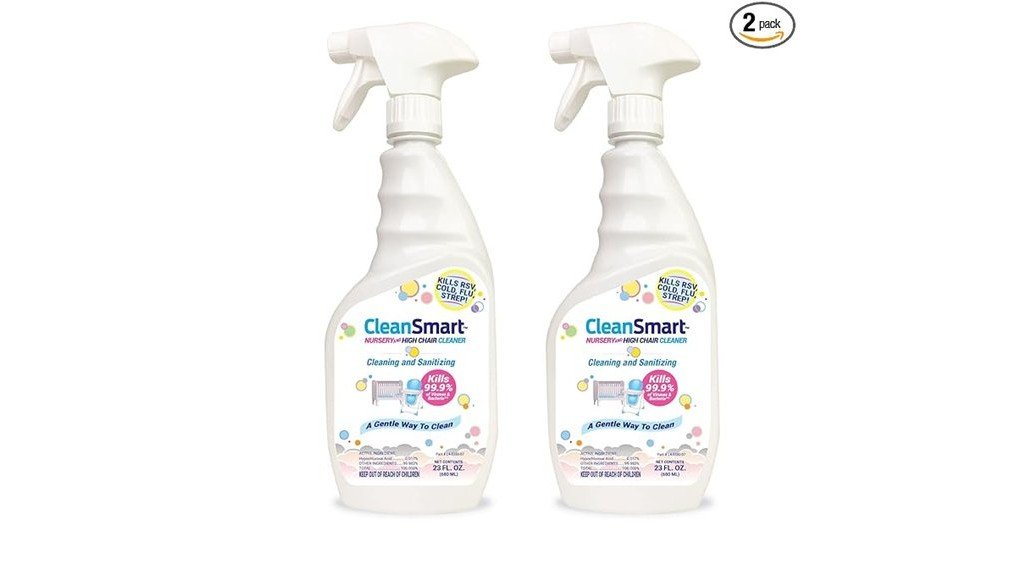
CleanSmart Nursery & High Chair Cleaner is a hypochlorous-acid spray designed to sanitize and disinfect hard surfaces around babies. Its EPA-registered formula can sanitize food-contact surfaces without rinsing when used as directed. The two-pack contains 23-ounce spray bottles intended for everyday nursery and feeding-area use.
Its biggest advantage is the combination of a simple formula and no-rinse convenience. However, sanitizing and disinfecting require different contact times, and the spray cannot replace proper washing of feeding equipment. This review explains the benefits, limitations, and safety details you should understand before buying.
Quick Verdict
CleanSmart Nursery & High Chair Cleaner: 8/10
Documentation-based editorial assessment. Not a hands-on performance rating.
EPA Reg. 89896-2
23 oz × 2
No-rinse food surfaces
Fragrance-free
Best for: Parents who want a ready-to-use sanitizer for high chairs, feeding tables, and washable nursery surfaces.
Skip if: You mainly need a heavy-duty grease cleaner, a fabric sanitizer, or a replacement for washing baby bottles.
Bottom line: A practical option for routine nursery hygiene, provided you follow the correct contact time and surface instructions.
Before You Buy
- Sanitizing is not the same as disinfecting: Food-contact sanitizing takes 60 seconds under the EPA-approved directions, while full disinfection generally requires 10 minutes.
- Preclean visible messes: Dried food, grease, and heavy debris should be removed before the germ-killing step.
- Not every material qualifies: The primary EPA directions cover hard, nonporous surfaces, not upholstery or absorbent fabric.
- No-rinse does not mean immediate use: Follow the label’s contact time and allow treated baby items to dry before returning them to a child.
On This Page: Review Sections
Key Takeaways
- CleanSmart Nursery & High Chair Cleaner uses 0.017% hypochlorous acid as its EPA-registered active ingredient.
- The EPA-approved directions allow no-rinse sanitizing of hard, nonporous food-contact surfaces.
- The formula has no added fragrance and is marketed as free from alcohol, ammonia, and gluten.
- Full disinfection against pathogens such as RSV and influenza A requires the applicable labeled contact time, generally 10 minutes.
- The two-pack is convenient for households that clean nursery and feeding surfaces frequently.
- The spray is a useful addition to normal cleaning, not a substitute for washing bottles, utensils, or heavily soiled equipment.
What Is CleanSmart Nursery & High Chair Cleaner?
CleanSmart Nursery & High Chair Cleaner is a ready-to-use surface sanitizer and disinfectant made with hypochlorous acid. The product reviewed here is sold as two 23-ounce spray bottles, providing 46 fluid ounces in total.
Its main selling point is no-rinse surface sanitizing with an EPA-registered disinfecting formula.
Hypochlorous acid is an antimicrobial substance that helps damage and inactivate microorganisms. It is also produced naturally by certain immune cells, although that fact alone does not establish the safety of every product containing it.
CleanSmart uses a prepared, stabilized solution intended for household surfaces. The manufacturer positions it for high chairs, snack tables, changing stations, washable toys, and similar nursery areas.
The important distinction is that the product has different uses and contact times. You can use it for everyday food-surface sanitizing or for longer-contact disinfection when the label permits that application.
CleanSmart Nursery & High Chair Cleaner Specifications
| Specification | Details |
|---|---|
| Brand | CleanSmart |
| Product | Nursery & High Chair Cleaner |
| Amazon ASIN | B011ANKN2A |
| Package | Two 23-fluid-ounce bottles |
| Total liquid | 46 fluid ounces |
| Active ingredient | Hypochlorous acid, 0.017% |
| EPA registration | 89896-2 |
| Form | Ready-to-use liquid spray |
| Food-contact sanitizing | 60 seconds under EPA-approved directions |
| General disinfection | 10 minutes under EPA-approved directions |
| Recommended surface type | Hard, nonporous surfaces compatible with water-based cleaners |
What’s in the Box?
The reviewed Amazon listing identifies a two-pack of 23-ounce CleanSmart Nursery & High Chair Cleaner bottles. No separate cleaning tools or additional accessories are specified.
You do not need to mix a concentrate or purchase an appliance before using the product. The bottles contain a prepared solution.
Why CleanSmart Is Suitable for Baby Items
CleanSmart is intended for household surfaces, including many surfaces that babies touch or that come into contact with food. Its EPA registration and no-rinse food-contact directions are more meaningful than a general claim that a cleaner is simply “baby-safe.”
The manufacturer also markets the formula for pacifiers, teethers, and sippy cups. However, you should use it only on compatible, cleanable surfaces, follow the bottle directions, and allow items to dry before your baby uses them.
Food-contact sanitizing approval does not mean the solution should be sprayed into a baby’s mouth, added to food, or used as a substitute for washing feeding equipment.
| Baby Item | Suitable Use | Important Precaution |
|---|---|---|
| Pacifiers | Compatible hard surfaces | Wash first and follow pacifier-maker instructions |
| Teethers | Compatible washable surfaces | Avoid materials or finishes not approved for treatment |
| Sippy cups | Approved hard surfaces | Disassemble and wash drinking components properly |
| High chairs | Food trays and washable frames | Remove visible food before sanitizing |
| Changing tables | Hard, nonporous surfaces | Use disinfection contact time when needed |
| Nursery tables | Sealed, washable surfaces | Check finish compatibility first |
What About Newborns and Premature Babies?
CleanSmart says its disinfecting technology is suitable for neonatal-care settings. That is a manufacturer claim, not proof that every use around a newborn has been independently approved by a pediatric specialist.
For premature infants, babies younger than two months, or infants with weakened immune systems, extra care with feeding equipment is particularly important.
The CDC’s infant feeding-item guidance recommends careful washing and daily sanitizing for higher-risk babies. CleanSmart should not replace those procedures unless the baby’s healthcare team and the item’s manufacturer specifically support the method.
Safety note: Never spray directly at a baby’s face or skin, and never use the surface cleaner as medicine. Keep bottles out of children’s reach and follow the actual container label.
How CleanSmart Kills Germs and Viruses
CleanSmart’s active ingredient, hypochlorous acid, is an antimicrobial oxidizing agent. It can damage structures and essential components of microorganisms, reducing their ability to survive on treated surfaces.
Its effectiveness depends on the organism, surface condition, application method, and contact time. The most important detail is that a quick spray is not automatically the same as full disinfection.
Sanitizing vs. Disinfecting: The Contact Times
The EPA-approved CleanSmart label identifies different treatment conditions:
| Application | Contact Time | Purpose |
|---|---|---|
| Food-contact surface sanitizing | 60 seconds | Reduces specified bacteria on food-contact surfaces |
| Non-food-contact surface sanitizing | 5 minutes | Sanitizes specified hard surfaces |
| General hard-surface disinfection | 10 minutes | Disinfects against listed microorganisms, including RSV and influenza A |
These times come from the EPA-accepted CleanSmart label dated October 3, 2023. Some organism-specific directions differ, so the label on your purchased bottle takes priority.
For a disinfectant to work as directed, the surface must remain wet for the required time. The EPA explains that contact time means the period the treated surface must remain visibly wet.
Does CleanSmart Kill RSV and Flu Viruses?
The EPA-approved CleanSmart label includes claims against respiratory syncytial virus (RSV) and influenza A (H1N1) on hard, nonporous surfaces under its disinfection directions.
That is a surface-disinfection claim. It does not mean spraying nursery furniture prevents all RSV or influenza infections. Hand hygiene, appropriate cleaning routines, and other infection-control steps still matter.
What’s in CleanSmart Cleaner?
The main active ingredient is hypochlorous acid at 0.017%, according to the EPA registration. The remaining ingredients form the water-based solution that carries and stabilizes it.
The manufacturer’s safety data sheet identifies water, sodium chloride (salt), hypochlorous acid, and hypochlorite ion as components of the formulation.
- Hypochlorous acid: Provides the antimicrobial action.
- Water: Forms most of the solution.
- Sodium chloride: Is part of the salt-based formulation.
- Hypochlorite ion: Is present in a small amount in the solution.
CleanSmart describes the product as free from added fragrance, alcohol, ammonia, gluten, and common allergens. Its simpler formulation may appeal to families avoiding strongly scented household cleaners.
Does It Smell Like Bleach?
Some hypochlorous-acid solutions have a faint chlorine-like smell even without added fragrance. CleanSmart acknowledges that its products may have a light scent.
That smell does not mean the product has the same formulation as ordinary household bleach. Nevertheless, “fragrance-free” does not guarantee that every person will find it completely odorless.
Does It Leave Residue?
CleanSmart states that its stabilized hypochlorous-acid solution breaks down toward a saline solution after use. The manufacturer markets the product as leaving no harmful cleaning-chemical residue.
That should not be interpreted as proof that every surface will look completely streak-free. Surface finish, application amount, and drying conditions can affect visible marks.
Storage and Formula Stability
Store the cleaner in its original, tightly closed container, away from excessive heat and direct sunlight. The manufacturer’s documentation also warns against mixing CleanSmart with other cleaning products.
Its published 2020 safety data sheet advises discarding product older than 1.5 years. Confirm the applicable shelf-life and date information on the current packaging before relying on an older bottle.
When to Use CleanSmart on Baby Gear
CleanSmart is most useful after routine cleanup, when you want to reduce germs on suitable baby-contact surfaces. It fits naturally into everyday nursery and feeding-area maintenance.
1. High Chairs and Feeding Trays
High chairs collect spilled food, milk, crumbs, and sticky handprints. Remove visible debris and wash away heavy residue before applying CleanSmart for the labeled sanitizing period.
This is one of the product’s strongest use cases because feeding trays are frequently touched and often have washable, nonporous surfaces.
2. Changing Tables and Diaper Areas
Changing areas can be exposed to urine, stool, and contaminated hands. Clean the area first, then follow the appropriate disinfection directions when disinfection is necessary.
Do not assume the short food-contact sanitizing time is adequate for every diaper-area contamination concern.
3. Pacifiers, Teethers, and Sippy Cups
The manufacturer markets CleanSmart for compatible mouth-contact accessories. This can be convenient after normal washing, but it does not remove trapped milk, food residue, or dirt from small openings.
Follow the accessory manufacturer’s cleaning and sanitation instructions, especially for items with valves, nipples, fabric sections, or internal channels.
4. Washable Toys and Play Areas
Hard plastic toys and sealed washable play surfaces may be suitable when their materials are compatible with the cleaner.
For plush toys, fabric books, untreated wood, electronics, and other delicate items, use the cleaning method recommended by the item’s manufacturer instead of assuming the disinfectant is suitable.
5. After Illness in the Household
When someone in the home has been sick, properly disinfecting frequently touched, compatible surfaces can help reduce environmental contamination.
Use the appropriate organism-specific directions, and remember that surface disinfection is only one part of household infection prevention.
CleanSmart Nursery & High Chair Cleaner Pros and Cons
Pros
- EPA-registered hypochlorous-acid formula for hard surfaces.
- No-rinse food-contact sanitizing when used as labeled.
- No added fragrance, alcohol, or ammonia.
- Two 23-ounce spray bottles suit frequent nursery cleanup.
Cons
- Full disinfection usually requires 10 minutes of wet contact.
- Heavy food residue still needs washing or precleaning.
- Not a substitute for washing and sanitizing feeding-bottle parts.
Who Should Buy CleanSmart, and Who Should Skip It?
Who Should Buy It?
- Parents who regularly sanitize hard, washable high-chair trays and feeding tables.
- Caregivers who prefer fragrance-free surface cleaners.
- Households looking for a ready-to-use spray without mixing or dilution.
- Families who want an EPA-registered product for appropriate nursery surfaces.
Who Should Skip It?
- Anyone who needs a dedicated laundry or fabric sanitizing product.
- Parents looking for a complete bottle-washing or sterilization system.
- People who mainly need to remove heavy grease, dried formula, or stubborn stains.
- Shoppers who cannot regularly wait for the required disinfection contact time.
How to Use CleanSmart Correctly
CleanSmart is simple to apply, but correct preparation and contact time are essential. Follow these steps for suitable hard surfaces:
- Check the surface. Confirm that the material is compatible and that the bottle label permits the intended use.
- Remove visible dirt. Clean food, grease, saliva buildup, or other debris before sanitizing or disinfecting.
- Spray the surface. Apply enough CleanSmart to thoroughly wet the treatment area.
- Wait the required time. Use the exact contact time specified for the relevant surface and microorganism.
- Keep the surface wet. Reapply if necessary so it remains visibly wet throughout the required treatment period.
- Allow the surface to dry. Follow the label’s wiping or air-drying instructions before returning an item to a baby.
For ordinary hard food-contact surfaces, the EPA-approved sanitizing directions specify 60 seconds and no post-treatment rinse. For general disinfection, the directions typically specify 10 minutes.
Practical tip: Clean the high-chair tray immediately after the meal, then apply the sanitizer. This separates food removal from the required germ-killing contact time.
Common Mistakes to Avoid
- Wiping immediately: Removing the liquid too soon can prevent the required contact time.
- Skipping washing: Sanitizing does not physically remove all food and debris.
- Mixing chemicals: Adding other cleaners can affect stability and safety.
- Using it on unsupported materials: Always check fabric and delicate-surface compatibility.
- Storing it incorrectly: Heat, sunlight, and unsuitable containers may affect the formulation.
What Owners Report About CleanSmart
Public product feedback discusses convenience, mild odor, and ease of using the spray around nursery surfaces. However, the available independent evidence is not strong enough to establish reliable, repeated patterns about performance or bottle durability.
For that reason, this review does not present selected testimonials as proof of real-world disinfecting effectiveness. The strongest evidence for germ-killing performance is the product’s EPA registration and its approved directions.
When evaluating buyer comments, pay particular attention to whether someone followed the correct contact time. A positive impression of cleanliness does not independently establish that a surface was disinfected.
CleanSmart vs. Alternative Nursery Cleaners
CleanSmart is not the only cleaner marketed for homes with babies. The alternatives below differ in whether they focus on cleaning, disinfecting, or producing a reusable solution.
| Product | Main Approach | Best Reason to Consider | Trade-Off |
|---|---|---|---|
| CleanSmart Nursery & High Chair Cleaner | Ready-to-use hypochlorous-acid sanitizer/disinfectant | No-rinse food-contact sanitizing | Required contact time |
| Babyganics Toy & Highchair Cleaner | Surfactant-based cleaning formula | Removing ordinary dirt and grime | Not presented as an EPA-registered disinfectant |
| Force of Nature Cleaning System | Appliance-generated cleaning and disinfecting solution | Reusable-bottle system | Requires appliance, activator capsules, and preparation |
| CleanSmart Toy Disinfectant | Hypochlorous-acid disinfectant in toy-focused packaging | A smaller, toy-oriented spray format | Different packaging rather than a fundamentally different solution |
CleanSmart vs. Babyganics Toy & Highchair Cleaner
Babyganics focuses on cleaning dirt and grime with a surfactant-based formula. Its listed ingredients include water, decyl glucoside, and other cleaning components.
Choose a regular cleaner when removing food debris is the main task. Choose CleanSmart when you specifically need its labeled sanitizing or disinfecting function on appropriate surfaces.
CleanSmart vs. Force of Nature
Force of Nature uses an appliance and activator capsules to prepare a cleaning and disinfecting solution. This may appeal to households interested in a reusable-bottle system.
CleanSmart avoids the preparation equipment. It is more straightforward for users who want to open a bottle and apply a prepared product.
CleanSmart Nursery Cleaner vs. CleanSmart Toy Disinfectant
The manufacturer says its surface spray products share the same underlying solution, with packaging adapted for different uses.
If you already own a compatible CleanSmart product, compare the exact label directions and bottle format before purchasing another version. Different product names do not necessarily mean different active formulations.
Is CleanSmart Nursery & High Chair Cleaner Worth the Price?
CleanSmart is worth considering if you use a nursery surface sanitizer frequently and value a prepared, fragrance-free formula. The two-pack provides a supply that can be kept in separate household areas.
Its value depends on the tasks you expect it to perform. The product offers more than a basic dirt-removing spray because it has EPA-registered sanitizing and disinfecting applications.
However, it does not eliminate the need for washing feeding equipment or cleaning up heavy messes. You still need an appropriate cleaning routine, and the longer disinfection contact time can be inconvenient.
Buying verdict: A sensible choice for regular sanitizing of compatible nursery surfaces, but less compelling if your primary need is removing food residue rather than reducing germs.
Compare the current CleanSmart listing and package options.
How We Evaluated CleanSmart
This is a documentation-based product review. No hands-on cleaning experiments, laboratory disinfection tests, or independently measured drying-time trials were conducted for this article.
The assessment draws on these sources:
- The current product identity and package information listed for Amazon ASIN B011ANKN2A.
- The EPA registration record and accepted product label for registration 89896-2.
- The manufacturer’s product information, ingredient disclosures, and safety data sheet.
- CDC guidance on cleaning and sanitizing infant feeding items.
- Manufacturer information for competing cleaning products.
The editorial score considers documented efficacy claims, label clarity, everyday convenience, formulation, and practical limitations. It should not be interpreted as a measured laboratory performance score.
Readers should distinguish EPA-accepted use claims from marketing language and from unverified personal experiences.
Frequently Asked Questions
How Long Does CleanSmart Take to Dry?
CleanSmart drying time depends on the amount sprayed, room ventilation, temperature, and surface material. There is no single verified drying time for every application. More importantly, the surface must remain wet for the required sanitizing or disinfecting contact time before you allow it to dry.
Does CleanSmart Leave Any Residue on Surfaces?
CleanSmart is formulated to leave no harmful cleaning-chemical residue when used as directed. Its manufacturer explains that the solution breaks down toward saline after use. That does not guarantee every surface will look perfectly streak-free. Test delicate finishes before applying the product broadly.
Can CleanSmart Be Used on Fabric Baby Items?
CleanSmart’s main EPA directions cover hard, nonporous surfaces. Do not assume those directions establish disinfecting performance on fabric, plush toys, mattresses, or untreated textiles. Use the fabric manufacturer’s recommended cleaning method and confirm that any intended antimicrobial application is specifically permitted by the product label.
How Often Should I Spray CleanSmart on High Chairs?
You can use CleanSmart as part of regular high-chair cleaning after meals or when sanitizing is appropriate. Remove food debris first, apply the spray to compatible surfaces, and follow the labeled contact time. Disinfecting after illness or contamination may require a longer treatment than ordinary sanitizing.
Is CleanSmart Safe Around Newborns and Preemies?
CleanSmart is marketed for nursery environments, but use around newborns and premature infants should follow the product label and appropriate healthcare guidance. The CDC recommends extra care with cleaning and daily sanitizing of feeding items for higher-risk infants. A nursery surface spray does not replace those procedures.
Does CleanSmart Need Rinsing After Use?
The EPA-approved CleanSmart directions allow no-rinse use on specified hard, nonporous food-contact surfaces. However, no-rinse use does not eliminate the required contact time or the need to preclean dirty items. Follow the current bottle label and allow treated baby accessories to dry before use.
Does CleanSmart Kill RSV and Flu?
Yes, the EPA-approved CleanSmart label includes disinfection claims against RSV and influenza A (H1N1) on hard, nonporous surfaces when used as directed. These claims depend on the required contact time, generally 10 minutes. They do not mean the spray treats an infection or guarantees that illness will be prevented.
Can You Mix CleanSmart With Other Cleaners?
No. CleanSmart should not be mixed with other household chemicals, soaps, essential oils, or disinfectants. The manufacturer warns that mixing can interfere with the formula and its effectiveness. Keep the product in its intended container and follow the storage instructions instead of making homemade mixtures.
Does CleanSmart Expire?
CleanSmart’s hypochlorous-acid formulation can lose effectiveness over time or with improper storage. A manufacturer safety data sheet issued in 2020 advises discarding product older than 1.5 years. Confirm the current shelf-life instructions for your bottle, and store it away from heat and direct sunlight.
Conclusion: Is CleanSmart Worth Buying?
CleanSmart Nursery & High Chair Cleaner offers a useful combination of EPA-registered germ-killing capability, no-rinse food-contact sanitizing, and a relatively simple formulation. It is particularly appealing for households that regularly clean high chairs, feeding tables, and hard nursery surfaces.
The limitations matter just as much as the benefits. Effective disinfection requires enough wet-contact time, visible debris still needs cleaning, and infant feeding equipment requires proper washing and sanitizing practices.
Final verdict: CleanSmart is a practical supplemental nursery sanitizer for families willing to use it according to the label. It earns an 8/10 documentation-based editorial assessment for its combination of convenience, clearly registered uses, and manageable limitations.
CleanSmart Nursery & High Chair Cleaner
Editorial Assessment: 8/10
Best for routine sanitizing of compatible nursery and food-contact surfaces.
Check the package version and use directions before purchasing.