Disclosure: As an Amazon Associate, we earn from qualifying purchases. If you buy through links on this page, we may earn a small commission at no extra cost to you.
By Editorial Team | Updated October 8, 2026
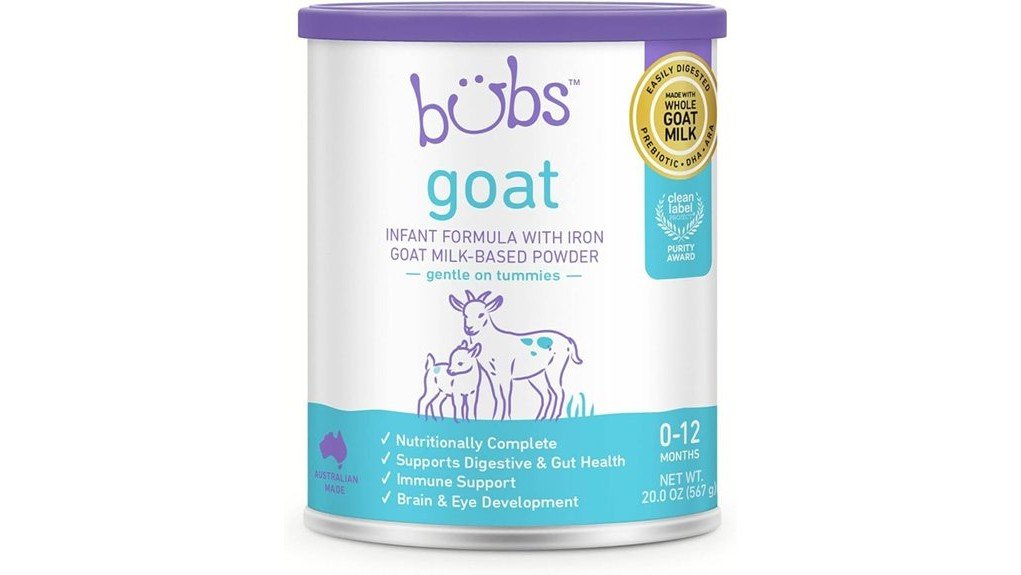
Bubs Whole Goat Milk Formula is a 20 oz powdered infant formula designed for babies from birth through 12 months. Made in Australia, it combines whole goat milk, naturally occurring A2 beta-casein, DHA, ARA, prebiotic GOS, iron, and essential vitamins and minerals.
The main appeal is its goat milk protein and fat composition, which some babies may tolerate well. However, it is not proven to prevent gas, reflux, or constipation, and it is not suitable for babies with cow’s milk protein allergy. This review explains the ingredients, verified specifications, preparation requirements, parent feedback, and buying considerations.
Quick Verdict: Bubs Whole Goat Milk Formula
Editorial assessment: 8/10 | Based on published formulation details, ingredient transparency, preparation requirements, and practical limitations. This is not a hands-on or clinical performance score.
20 oz / 567 g
A2 goat protein
DHA + ARA
Prebiotic GOS
Iron-fortified
Best for: Families seeking a nutritionally complete goat milk-based infant formula who want an alternative to standard cow milk formulas.
Skip if: Your baby has a diagnosed cow’s milk protein allergy, galactosemia, or needs a medically specialized formula.
Bottom line: Bubs offers a well-defined ingredient profile and an established Australian manufacturing background. Its main limitation is that digestive improvements cannot be guaranteed.
Before You Buy
- Not hypoallergenic: Goat and cow milk proteins can trigger similar allergic reactions.
- Contains lactose and soy lecithin: This is not a lactose-free or soy-free product.
- Contains palm olein: Buyers avoiding this ingredient should compare other formulas.
- Not sterile: Powdered formula requires careful preparation, particularly for newborns and higher-risk infants.
Review Contents
Key Takeaways
- Bubs Whole Goat Milk Formula is designed to provide complete infant nutrition from birth through 12 months.
- Its formula includes whole goat milk, goat whey protein, lactose, DHA, ARA, GOS, and added iron.
- Goat milk naturally contains A2 beta-casein, but evidence does not establish that every baby will digest goat formula better.
- The formula is non-GMO but is not certified organic. Its ingredients include palm olein and soy lecithin.
- Bubs reports third-party purity recognition and Australian manufacturing with ingredient traceability.
- Correct mixing, safe storage, and your baby’s individual nutritional needs matter more than marketing claims.
What Is Bubs Whole Goat Milk Formula?
Bubs Whole Goat Milk Formula is an iron-fortified, goat milk-based infant formula produced by Bubs Australia. It is designed for babies aged 0–12 months and comes in a 20 oz (567 g) container.
Unlike ordinary goat milk, this product is formulated with added nutrients and an adjusted balance of ingredients for infant feeding. Its formula contains goat milk solids, whey protein, lactose, added fats, prebiotics, and micronutrients.
Bubs manufactures its formula products in Australia and describes its supply chain as traceable from dairy farms through production. The company also publishes product labels, nutritional information, and preparation instructions.
The formula is intended for routine infant feeding, not as a treatment for food allergies or medical digestive conditions.
Bubs Whole Goat Milk Formula Specifications
The verified specifications below refer to the U.S. 0–12-month, 20 oz product. Labels and ingredients can change, so compare these details with the actual container before feeding.
| Specification | Details |
|---|---|
| Product | Bubs Goat Milk-Based Powder Infant Formula with Iron |
| Age range | Birth to 12 months |
| Container size | 20 oz (567 g) |
| Protein source | Whole goat milk solids and goat whey protein |
| Main carbohydrate | Lactose |
| Added nutrients | DHA, ARA, iron, vitamins, and minerals |
| Prebiotic | Galacto-oligosaccharides (GOS) |
| Mixing ratio | 1 level, unpacked 8.8 g scoop per 2 fl oz water |
| Made in | Australia |
| Declared allergens | Goat milk and soy |
What’s in the Box?
The standard product is a sealed 20 oz can of powdered infant formula with an enclosed measuring scoop. The scoop is intended for this specific formula and should not be replaced with a kitchen spoon or a scoop from another brand.
Bubs Formula Ingredients and Key Nutrients
The formula uses lactose, whole goat milk solids, goat whey protein concentrate, a vegetable oil blend, and galacto-oligosaccharides. It also contains added vitamins, minerals, and sources of DHA and ARA.
One detail worth checking is that lactose appears first on the U.S. ingredient list. This means Bubs is not a lactose-free product, despite using goat milk.
Whole Goat Milk, A2 Protein, and Fat
Goat milk naturally contains A2 beta-casein, a type of milk protein. Bubs uses this as a major feature of its formula, alongside goat whey protein.
The listed vegetable oils include palm olein, high-oleic sunflower oil, canola oil, sunflower oil, and coconut oil. These contribute to the overall fat composition alongside the whole milk ingredients.
If avoiding palm olein is a priority, this particular formula does not meet that preference.
DHA, ARA, and Prebiotic GOS
Bubs includes DHA and ARA, fatty acids that form part of infant nutrition and support normal development. Its listed sources are Schizochytrium oil for DHA and M. alpina oil for ARA.
The formula also contains GOS, a prebiotic carbohydrate used to support the growth of certain gut bacteria. Its presence does not guarantee relief from constipation or other digestive symptoms.
Verified Nutritional Information
According to the manufacturer’s U.S. nutritional information, the prepared formula provides the following amounts per 100 calories, approximately 4.9 fl oz as prepared.
| Nutrient | Per 100 calories |
|---|---|
| Protein | 2.1 g |
| Total fat | 5.3 g |
| Carbohydrates | 10.7 g |
| Iron | 1.1 mg |
| Calcium | 70 mg |
| Vitamin D | 63 IU |
These figures describe the product’s nutritional composition, not the amount an individual baby should drink. Feeding volumes depend on age, growth, hunger cues, and medical guidance.
For a complete ingredient and nutrient breakdown, see the manufacturer’s official product information.
Why Bubs Goat Milk Formula May Suit Sensitive Tummies
Bubs markets its goat milk formula as gentle on digestion because goat milk contains A2 beta-casein and has a different protein and fat composition from typical cow milk. These differences may matter for some babies, but individual tolerance varies.
Goat milk can form softer protein curds under certain digestive conditions. However, this does not prove that the finished formula consistently reduces gas, spit-up, constipation, or reflux compared with every cow milk formula.
The American Academy of Pediatrics’ infant formula guidance explains that goat milk formulas can support normal infant growth when appropriately formulated. It also notes that claims of better digestive tolerance are not certain.
Why Goat Milk Formula Is Not an Allergy Treatment
Goat and cow milk proteins share important similarities. As a result, babies allergic to cow’s milk protein can also react to goat milk formula.
Bubs is not an extensively hydrolyzed or amino acid-based hypoallergenic formula. If your baby has a suspected milk protein allergy, discuss an appropriate feeding plan with a pediatrician.
Important safety note: Do not use goat milk formula as a home treatment for suspected cow’s milk protein allergy. Blood in stools, repeated vomiting, poor growth, or other concerning symptoms need medical assessment. Trouble breathing or swelling after feeding requires immediate emergency care.
Bubs Whole Goat Milk Formula Pros and Cons
Pros
- Nutritionally complete goat milk formula for ages 0–12 months.
- Includes DHA, ARA, iron, and prebiotic GOS.
- Australian manufacturing and documented purity recognition.
Cons
- Digestive benefits are not guaranteed for every baby.
- Contains lactose, palm olein, and soy lecithin.
- Not suitable for cow’s milk protein allergy or galactosemia.
The main strength is the product’s clearly described nutritional formulation. Its limitations relate to ingredients that some families prefer to avoid and the lack of guaranteed digestive benefits.
Who Should Buy Bubs Formula, and Who Should Skip It?
Bubs may be worth considering if you want a goat milk-based formula with iron, DHA, ARA, and prebiotics. It also appeals to families who value Australian manufacturing and third-party ingredient screening.
Suitable Feeding Situations
Routine formula feeding: The 0–12-month product is formulated for infant feeding from birth when prepared according to its instructions.
Combination feeding: It may be used as a formula option alongside breastfeeding when additional formula feeds are needed and your baby’s clinician has not recommended a specialized product.
Trying a goat milk alternative: If a baby has nonspecific digestive discomfort without evidence of a milk protein allergy, a pediatrician may help you decide whether a formula change is appropriate.
When Another Formula Is Better
Choose a different product with medical guidance when your baby needs an allergy-specific formula or has a condition affecting normal formula digestion or nutrient handling.
This product is also not the right choice if you specifically require lactose-free, soy-free, palm-oil-free, or certified organic infant formula.
How to Prepare and Store Bubs Formula Safely
Bubs requires one unpacked, level scoop containing approximately 8.8 g of powder for every 2 fl oz (60 mL) of water. Always measure the water before adding the powder, and follow the exact directions on your own container.
- Wash your hands: Clean the feeding surface and use properly cleaned bottles, nipples, and equipment.
- Measure the water: Pour the required amount of safe drinking water into the bottle.
- Add the powder: Use one unpacked, level Bubs scoop for each 2 fl oz of water.
- Mix thoroughly: Close the bottle and shake until the powder dissolves.
- Check the temperature: If warm water was used, cool the prepared formula to a safe feeding temperature.
- Feed and discard safely: Follow the product’s time limits, and throw away remaining formula after a feeding.
Mixing Examples
| Water | Level Scoops |
|---|---|
| 2 fl oz | 1 |
| 4 fl oz | 2 |
| 6 fl oz | 3 |
| 8 fl oz | 4 |
These quantities describe the water added before mixing. The finished bottle volume may be slightly higher after powder is added.
How Long Can Prepared Bubs Formula Be Stored?
The manufacturer’s published U.S. directions call for prepared formula to be fed immediately or refrigerated promptly. Its product guidance also instructs caregivers to discard unrefrigerated formula after one hour.
Prepared, untouched formula may be kept refrigerated in a sealed container for up to 24 hours. Once your baby begins drinking, use the bottle within one hour and discard any leftovers.
The CDC’s general formula preparation guidance allows up to two hours after preparation before refrigeration or disposal, but Bubs publishes a stricter one-hour unrefrigerated instruction. Follow the stricter product label when it applies.
Storing Opened Formula Powder
Bubs directs caregivers to close the lid tightly, store the container in a cool, dry area below 77°F, and use the powder within four weeks of opening.
Do not refrigerate the dry powder. Discard containers with damaged seals, and never use formula past its labeled expiration date.
Extra Precautions for Young or Higher-Risk Infants
Powdered formula is not sterile. Babies younger than two months, babies born prematurely, and infants with weakened immune systems face greater risks from certain bacterial infections.
The CDC recommends additional precautions for these infants, including considering ready-to-feed formula or preparing powder with sufficiently hot water. Follow the CDC’s age-specific guidance and your baby’s healthcare professional’s advice rather than assuming ordinary room-temperature mixing is always appropriate.
Never heat formula in a microwave, which can create dangerous hot spots.
What Parents Report About Bubs Goat Milk Formula
Public customer feedback on Bubs is mixed, although many parents describe positive experiences. These reviews are useful for understanding common impressions, but they are not controlled evidence of effectiveness or safety.
Common Positive Feedback
Some parents report that their babies accepted the taste, that the powder mixed easily, or that feeding comfort and stool consistency appeared to improve after switching.
These comments appear in retailer customer reviews for the Bubs infant formula. They describe individual experiences and cannot establish that the formula caused the reported changes.
Common Watch-Outs
Other caregivers report persistent gas, changes in bowel movements, fussiness, or vomiting after starting the formula. Such symptoms can have several causes, including feeding technique, illness, or an underlying medical condition.
Customer reviews do not establish how often these problems occur. They also cannot reliably show whether a particular formula caused them.
Track feeding, wet diapers, stool changes, and growth concerns, and discuss persistent or severe symptoms with your baby’s pediatrician.
Bubs Whole Goat Milk Formula vs. Alternatives
The best alternative depends on why you are considering a change. Families comparing goat milk formulations have different needs from those seeking a standard cow milk formula or a medically specialized option.
| Formula | Milk Base | Key Difference |
|---|---|---|
| Bubs Goat Infant Formula | Whole goat milk | A2 goat protein, GOS, DHA, ARA; contains palm olein and soy lecithin |
| Kendamil Goat Infant Formula | Whole goat milk | Goat-based alternative marketed without palm oil or added soy |
| Bubs 365 Day Grass Fed Infant Formula | Cow milk | Whole cow milk with a prebiotic and probiotic blend |
| Bubs Essential Infant Formula | Cow milk | Whole cow milk formula with prebiotics and probiotics |
Kendamil Goat Infant Formula
Kendamil Goat is another whole goat milk-based infant formula for ages 0–12 months. Its U.S. product information describes a formula without palm oil or added soy, with GOS, DHA, and ARA.
It is worth comparing if those ingredient differences matter to you. However, it is also unsuitable for cow’s milk protein allergy. Check the current Kendamil Goat ingredient label, as formulations and labeling can change.
Bubs 365 Day Grass Fed Infant Formula
This option uses whole cow milk instead of goat milk. Bubs lists added DHA, ARA, prebiotics, and probiotics in its U.S. formulation.
It may suit families who prefer a standard cow milk-based option while remaining with the same manufacturer.
Bubs Essential Infant Formula
Bubs Essential is another cow milk-based formula for infants aged 0–12 months. The manufacturer’s published formulation includes whole cow milk, DHA, ARA, prebiotics, and probiotics.
For a baby who is already doing well on a standard formula, there is no clear reason to switch solely because goat milk is marketed as gentler.
Is Bubs Goat Milk Formula Worth Buying?
Bubs Whole Goat Milk Formula is worth considering if you specifically want a goat milk-based infant formula and its ingredient profile matches your needs. The 20 oz format, transparent nutritional listing, and Australian production are meaningful strengths.
Its non-GMO formulation, added DHA and ARA, and prebiotic GOS may appeal to families comparing conventional formulas. Bubs also reports Clean Label Project Purity Award recognition and First 1,000 Day Promise recognition.
However, a purity award does not establish that a formula improves digestion. A2 protein also does not make the product hypoallergenic.
Compare the cost per prepared fluid ounce rather than only the can price. Also consider availability, any unused powder after the four-week opening limit, and whether your baby comfortably accepts the formula.
For families whose babies already tolerate a suitable infant formula well, switching is not automatically necessary. If digestive problems are the main reason for considering Bubs, review the symptoms with a pediatrician first.
How We Evaluated Bubs Formula
We assessed Bubs Whole Goat Milk Formula through published product specifications, the ingredient label, manufacturer preparation guidance, public customer feedback, and authoritative infant-feeding recommendations.
We compared its formulation with other advertised infant formulas and examined the differences between marketing claims and established pediatric guidance.
This is a desk-based editorial review. We did not perform laboratory analysis, conduct clinical feeding trials, or personally test the formula with infants. The editorial rating reflects ingredient transparency, documented features, and practical limitations rather than verified health outcomes.
For regulatory context, the FDA’s infant formula transition-plan information lists Bubs Goat and records that Bubs submitted a new infant formula notification by the expected July 2025 date. This should not be interpreted as an FDA endorsement of the product’s claimed digestive benefits.
Frequently Asked Questions
Is Bubs Whole Goat Milk Formula safe for newborns?
Bubs Whole Goat Milk Formula is formulated for infants from birth to 12 months. However, powdered formula is not sterile, and newborns may need extra preparation precautions. For babies younger than two months, those born prematurely, or those with weakened immunity, consult a healthcare professional about safe feeding and preparation methods.
Is Bubs Whole Goat Milk Formula organic?
No. Bubs Whole Goat Milk Formula is marketed as non-GMO but is not certified organic. The company reports ingredient screening and Clean Label Project recognition, which are different from organic certification. If organic certification is a purchasing requirement, compare products that carry an appropriate recognized organic label.
Can babies with cow’s milk protein allergy drink Bubs goat formula?
No. Bubs goat formula is not a suitable substitute for babies with diagnosed cow’s milk protein allergy. Goat and cow milk proteins can cause cross-reactions, even though their compositions differ. A pediatrician may recommend an extensively hydrolyzed or amino acid-based formula depending on the child’s specific condition.
Is Bubs Whole Goat Milk Formula lactose-free?
No. Lactose is the first ingredient listed on the U.S. formula label. The manufacturer’s customer guidance identifies the lactose in this product as goat-derived. Babies who require a medically prescribed lactose-free formula should not assume a goat milk formula is suitable simply because it uses a different milk source.
Does Bubs goat milk formula contain palm oil or soy?
Yes. The published ingredient list includes palm olein in its vegetable oil blend and soy lecithin among the additional ingredients. The formula label declares goat milk and soy as allergens. If your family is avoiding these ingredients, compare the latest labels of alternative products before making a purchase.
How many scoops of Bubs formula do I use for 4 oz of water?
Use two unpacked, level scoops for 4 fl oz of water, following the published ratio of one 8.8 g scoop for every 2 fl oz. Measure the water first, then add the powder. Always use the scoop supplied with the container and follow its label rather than estimating measurements.
How long does prepared Bubs formula last?
The manufacturer instructs caregivers to discard unrefrigerated prepared formula after one hour. Untouched prepared formula can be stored in a sealed container in the refrigerator for up to 24 hours. Once feeding starts, use the bottle within one hour and throw away leftovers. Follow the instructions on your specific container.
Where is Bubs Whole Goat Milk Formula manufactured?
Bubs Whole Goat Milk Formula is manufactured in Australia. Bubs identifies its production location in Victoria and describes a managed dairy supply chain and in-house blending and packing operations. The brand also reports third-party purity recognition, but these statements should not be confused with proof of superior clinical results.
What is the difference between Bubs 0–12 months and its toddler formula?
The 0–12-month product is designed as infant formula for the first year of life. Bubs toddler nutritional drinks are marketed for older children, generally ages 12–36 months, as part of their diet. Toddler drinks should not replace appropriate infant formula for babies younger than 12 months.
What should I do if my baby refuses Bubs goat milk formula?
If your baby refuses the formula, check its preparation, feeding temperature, and whether the bottle and nipple are appropriate. Do not dilute formula or add sweeteners to improve acceptance. Persistent refusal, fewer wet diapers, poor weight gain, or signs of illness warrant pediatric advice before further formula changes.
Conclusion: Is Bubs Whole Goat Milk Formula a Good Choice?
Bubs Whole Goat Milk Formula is a reasonable option for families seeking a complete goat milk-based infant formula with A2 protein, DHA, ARA, GOS, and iron. Its verified nutritional profile and Australian manufacturing are strengths, while its ingredient restrictions and uncertain digestive advantages deserve equal attention.
The best formula is one that meets your baby’s nutritional and medical needs, can be prepared safely, and is consistently tolerated. If you are considering switching because of gas, constipation, reflux, or suspected allergy, discuss the symptoms with your pediatrician before deciding.
Considering Bubs Whole Goat Milk Formula?
Review the current product label, ingredients, and buying options before choosing a formula for your baby.