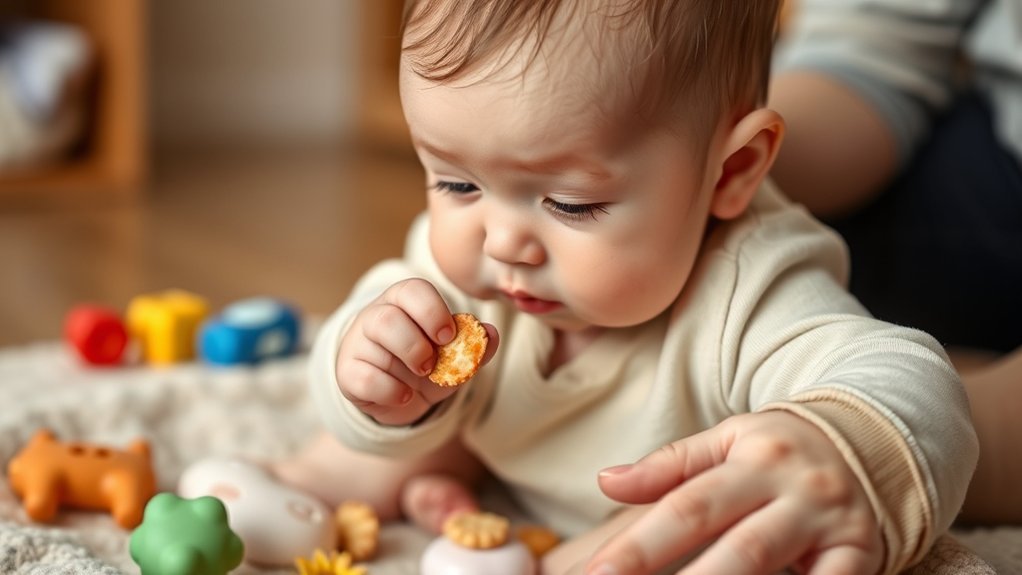
If your 9-month-old does not have a neat pincer grasp yet, that alone does not usually mean something is wrong. Nine months is often a transition point: your baby may still rake food with several fingers, start using the thumb side of the hand, or begin an early thumb-and-index-finger grasp. What matters most is steady progress across several fine-motor skills, not one perfect movement on one birthday.
Quick Answer
A missing refined pincer grasp at exactly 9 months can still fall within normal development. The CDC lists raking food with the fingers as a 9-month milestone and picking up small items between the thumb and pointer finger as a 1-year milestone. Ask your pediatrician sooner if other skills are delayed, asymmetric, or lost.
Key Takeaways
- At 9 months, raking and less-refined thumb-side grasps can still be normal.
- A mature pincer grasp uses the tips of the thumb and index finger and usually becomes clearer toward the end of the first year.
- Practice should use developmentally appropriate foods and large, safe toys rather than coins, marbles, beads, or other choking hazards.
- Loss of a skill, marked one-sided hand use, or delays across several areas deserves earlier medical attention.
What Is the Pincer Grasp at 9 Months?
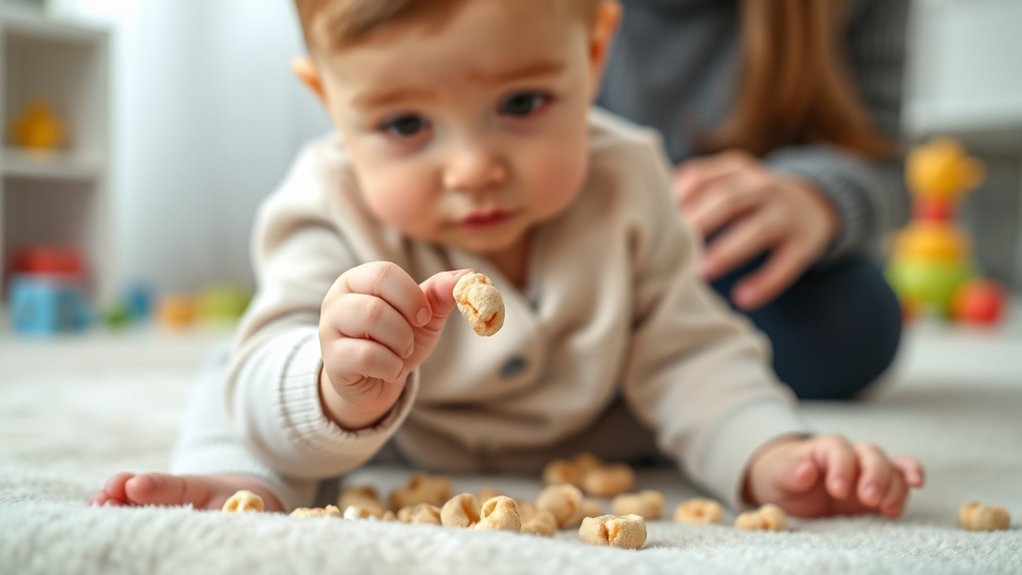
A pincer grasp is the ability to pick up a small object using the thumb and index finger. At 9 months, however, that movement may still look rough. Your baby may use the thumb with several fingers, the thumb against the side or pad of the index finger, or a raking movement instead of a precise fingertip pinch.
The CDC’s 9-month developmental milestones include moving objects from one hand to the other and using the fingers to rake food closer. The American Academy of Pediatrics also notes that the thumb-and-index-finger pincer grasp begins around 9 months, so this age is better viewed as the beginning of the skill than a strict deadline for mastering it.
As the grasp becomes more precise, it helps with self-feeding, exploring objects, turning pages, placing items into containers, and later hand skills such as using utensils, crayons, and fasteners.
If your baby is still raking food at 9 months but is reaching, transferring objects between hands, sitting, exploring toys, and making steady progress, that pattern can be reassuring. One milestone should always be considered alongside the rest of your baby’s development.
Pincer Grasp Milestones From 8 to 12 Months
Hand control usually changes gradually rather than switching suddenly from a whole-hand grasp to a perfect pincer grasp. Babies move through overlapping stages as the thumb becomes more active and the palm becomes less involved.
| Approximate stage | What you may see |
|---|---|
| Around 8 months | The thumb becomes more involved. Your baby may trap an object between the thumb and the side of the index finger or use the thumb with several fingers. |
| Around 9 months | Raking can still be present. A more finger-based grasp may emerge as your baby relies less on the palm. |
| 9 to 12 months | The pads and then the tips of the thumb and index finger increasingly handle small objects with better precision. |
| By about 1 year | Picking up small bits of food between the thumb and pointer finger is included on the CDC’s 1-year milestone checklist. |
This progression agrees with clinical descriptions of the stages leading to a refined pincer grasp. The exact timing varies, so use the age ranges as a guide rather than a pass-or-fail test.
The CDC’s 1-year milestones include picking up small items between the thumb and pointer finger. The American Academy of Pediatrics similarly describes increasingly accurate thumb-and-finger pickup during the later part of the first year in its guidance on hand and finger development.
Watching this progression can help you understand normal development and support your baby’s growing independence. Additionally, being aware of nutritional needs during pregnancy can contribute to overall developmental health.
Signs Your Baby May Be Behind
A pincer grasp is only one part of fine-motor development. At 9 months, a broader pattern matters more than whether your baby can already pick up a tiny item neatly between two fingertips.
Look at skills such as reaching for toys, moving an object from one hand to the other, raking food, banging two objects together, sitting without support, and exploring objects with both hands. These give your pediatrician more useful information than the pincer grasp alone.
Consider discussing development promptly if you notice any of the following:
- Your baby rarely reaches for or tries to grasp objects.
- Your baby is not transferring objects between the hands.
- Several 9-month milestones are not emerging.
- Your baby consistently reaches with only one hand while keeping the other tightly fisted.
- Your baby loses a skill they previously had.
One-sided reaching or an unusually persistent fisted hand does not prove a neurological condition, but it is worth mentioning rather than waiting for a later milestone. Loss of previously acquired skills also deserves prompt medical review.
Note: Developmental milestone lists are screening and surveillance tools, not diagnostic tests. If something about the way your baby moves, plays, feeds, or uses the hands worries you, bring that concern to your pediatrician even if your baby technically meets other milestones.
Common Reasons for a Late Pincer Grasp
A late-looking pincer grasp can reflect ordinary developmental variation, limited practice with appropriate objects, or a broader motor delay. You cannot identify the cause from one hand skill alone.
Watch how your baby uses both hands during meals and play. Steady movement from raking toward more precise thumb-and-finger use is more informative than comparing your baby with another child of the same age.
Normal Development Variation
Babies do not all acquire fine-motor skills on the same day or in exactly the same order. At 9 months, one baby may already pinch a small soft food neatly while another still uses several fingers and the palm.
The most useful question is whether your baby is gaining control over time. Signs of progress can include:
- Reaching accurately toward toys or food.
- Using the thumb more often during grasping.
- Moving objects between the hands.
- Picking up progressively smaller safe items.
- Releasing or dropping objects deliberately.
Temperament can also affect what you see. A baby who enjoys self-feeding may get more natural grasping practice than a baby who prefers being fed, even when both have normal motor ability.
Motor Skill Delays
A pincer-grasp delay deserves more attention when it appears with delays in other hand, posture, or movement skills. Stable sitting and coordinated reaching give the hands a better base from which to work.
| What you notice | Why it matters |
|---|---|
| Difficulty sitting steadily | Postural control supports reaching and hand use |
| Little interest in reaching or grasping | May reduce opportunities to practice fine-motor skills |
| Poor coordination across several hand tasks | May suggest a broader fine-motor concern |
| Strong, persistent difference between the two hands | Should be discussed with a healthcare professional |
A single late milestone cannot diagnose developmental coordination disorder, cerebral palsy, or another neurological condition. Your healthcare provider looks at the full developmental pattern, medical history, muscle tone, symmetry, feeding, vision, hearing, and other skills before deciding whether further assessment is needed.
Easy Activities to Build Pincer Grasp
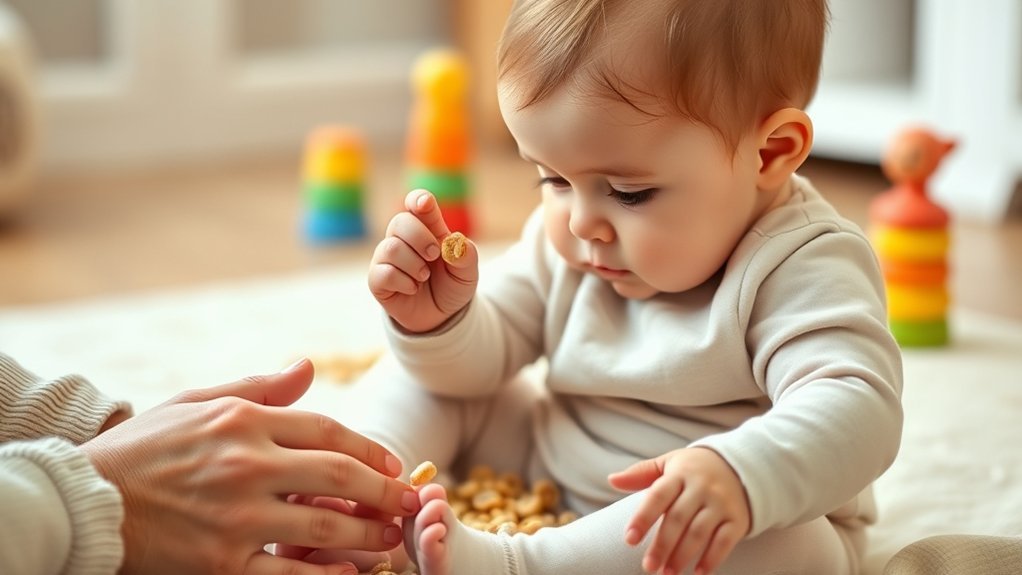
The best pincer-grasp practice is usually ordinary supervised play and self-feeding. You do not need to force the thumb and index finger into position or repeatedly drill the movement.
Try these age-appropriate activities:
- Offer one piece of soft food at a time. Placing a manageable piece on the high-chair tray gives your baby a reason to reach, grasp, and bring it to the mouth.
- Let your baby explore large blocks. Picking up, banging, placing, and releasing blocks builds hand control without relying on tiny loose objects.
- Use stacking rings or nesting cups. These encourage reaching, finger opening, controlled grasping, and deliberate release.
- Point at pictures together. Touching pictures in a board book encourages isolated index-finger use and hand-eye coordination.
- Offer safe activity toys. Buttons, flaps, dials, and attached parts can encourage more precise finger movement when the toy is designed for your baby’s age.
Keep practice short and enjoyable. If your baby turns away, becomes frustrated, or starts throwing everything, switch activities and try again later.
Safe Foods and Toys for Pincer Grasp Practice
Choose foods your baby can manage safely and toys that cannot fit into the mouth. Small objects may make the pincer grasp easier to see, but that does not make them appropriate practice tools for an infant.
| Practice option | How to use it |
|---|---|
| Ripe banana or avocado | Prepare it in a soft, developmentally appropriate shape and texture for supervised self-feeding. |
| Soft-cooked vegetables | Cook until soft and prepare the size and shape for your baby’s current eating ability. |
| Large blocks and stacking toys | Use age-rated pieces that are too large to become a choking hazard. |
| Board books and activity toys | Encourage pointing, page touching, pushing, pulling, and grasp-and-release movements. |
The CDC’s choking-prevention guidance recommends preparing food for a child’s developmental level, keeping children seated while eating, and supervising them closely. It identifies hazards that include hard raw fruit or vegetables, uncut grapes, whole nuts, popcorn, whole beans, and uncooked dried fruit such as raisins.
Warning: Do not use coins, marbles, loose beads, buttons, or other small nonfood objects for pincer-grasp practice with a baby. These items can be choking hazards. Supervision does not make an unsafe object safe to put within an infant’s reach.
During meals, keep your baby upright and attentive. Food texture, shape, and size should match your baby’s feeding skills rather than being chosen only because a piece is easy to pinch.
When to Call Your Pediatrician
You do not have to wait until a specific deadline if you are worried about your baby’s development. Nine months is already an important time to discuss fine-motor skills because routine developmental screening is recommended at this age.
The American Academy of Pediatrics recommends standardized developmental screening at the 9-, 18-, and 30-month well-child visits, as well as screening whenever a parent or clinician has a concern.
Bring the issue up sooner if you notice:
- Little or no interest in reaching for and picking up objects.
- No progress from whole-hand raking toward more precise finger use as the first birthday approaches.
- A strong and persistent difference in how the two hands are used.
- Difficulty with several other movement or developmental milestones.
- Loss of a skill your baby previously used.
The CDC advises parents who have developmental concerns to talk with their child’s doctor and ask about developmental screening. If concern remains after screening, your clinician may recommend a more detailed evaluation or early-intervention services.
Your pediatrician can review milestones, muscle tone, symmetry, vision, hearing, feeding, and your baby’s general development. Additionally, they can assess proper healing to ensure there are no underlying issues affecting your child’s development.
How Occupational Therapy Can Help
Occupational therapy may help when a healthcare professional identifies a meaningful fine-motor, self-feeding, sensory, or functional concern. It is not automatically necessary simply because a 9-month-old has not mastered a refined pincer grasp.
A pediatric occupational therapist can observe how your baby reaches, grasps, releases, uses both hands together, handles food, and interacts with toys. The therapist can then choose play-based activities appropriate for your baby’s current abilities.
Parents may also receive ideas for building practice into normal routines instead of turning development into repeated exercises. Examples can include positioning toys within reach, encouraging two-handed play, supporting safe self-feeding, and choosing toys that invite grasp-and-release movements.
Therapy is most useful when it targets a baby’s actual functional needs rather than one isolated milestone on a checklist.
If screening suggests a broader delay, early support can help your family understand what your baby can already do, what skills are emerging next, and whether additional assessment is needed.
Frequently Asked Questions
Should I Worry About a Late Pincer Grasp?
Not usually if your baby is only 9 months old and other hand skills are progressing. Nine months is often when the pincer grasp begins to emerge, while the CDC lists thumb-and-pointer pickup as a 1-year milestone. Discuss it sooner if several milestones are delayed, hand use is markedly asymmetric, or your baby loses a skill.
What Are Signs of Developmental Delay at 9 Months?
A single imperfect pincer grasp is not enough to identify developmental delay. More useful signs include difficulty with several expected skills, such as sitting without support, transferring objects between hands, raking food, banging objects together, or interacting and communicating as expected. Loss of previously acquired skills should always be discussed promptly.
What Are the Early Signs of Giftedness in Babies?
An early pincer grasp does not establish that a baby is gifted. Babies develop individual skills at different rates, and reaching one motor milestone early does not reliably predict later intellectual ability. Focus on supporting curiosity, communication, play, and development across many areas rather than trying to label an infant from one early skill.
What Are the First Signs of Cerebral Palsy in Babies?
A late pincer grasp by itself is not a sign that a baby has cerebral palsy. Cerebral palsy can involve broader delays or unusual movement patterns, including abnormal muscle tone, difficulty bringing the hands together, persistent one-sided reaching, or other delayed motor milestones. A clinician should evaluate these signs rather than trying to diagnose them from a milestone checklist.
Conclusion
If your baby does not have a refined pincer grasp at 9 months, look at the direction of development rather than one exact deadline. Raking, transferring objects, reaching, and increasing thumb use are all useful signs of progress. Offer safe chances to practice, avoid small choking hazards, and bring any concerns to the 9-month visit or sooner if your baby loses skills or shows a broader movement problem.
Sources
- CDC: Milestones by 9 Months: Supports the 9-month fine-motor milestones, including transferring objects and raking food.
- CDC: Milestones by 1 Year: Supports thumb-and-pointer pickup as a 1-year milestone.
- American Academy of Pediatrics: Movement Milestones: Supports the general timing of pincer-grasp development around 9 months.
- American Academy of Pediatrics: Hand and Finger Skills: Supports progression from raking toward accurate thumb-and-finger grasping.
- Cleveland Clinic: Pincer Grasp: Supports the sequence from raking and thumb-side grasps to inferior and refined pincer grasp.
- CDC: Choking Hazards: Supports safe food preparation, supervision, and avoidance of common choking hazards.
- American Academy of Pediatrics: Milestones Matter: Supports routine developmental screening at 9, 18, and 30 months.
- CDC: Concerned About Your Child’s Development?: Supports talking with a healthcare provider, requesting screening, and seeking further evaluation when concerns remain.